



“What protection teaches us, is to do to ourselves in time of peace what enemies seek to do to us in time of war.”
—Henry George, Protection or Free Trade, 1886
“Trade wars are good, and easy to win.”
—Trump, Twitter, 2018
We’re Back to the Future this week.
Or is it Ferris Bueller’s Day Off?
Since the Supreme Court ruling, Trump has dug up dusty laws, including the Smoot-Hawley Tariff Act of 1930, to rebuild his tariff wall.
For those of us not brushing 100, that arcane bit of law was first introduced to us in the 1986 classic, Ferris Bueller’s Day Off in this mind-numbing scene.

Source: Paramount Pictures
It’s mad to think that movie is now forty years old!
It seems that over those four decades, many in the White House forgot the lessons handed down from prior generations.
So we’re back to the tariff game.
Thankfully, this time around Australia has been spared. Countries like China, Canada, Japan and the EU haven’t been as lucky.
China is facing the highest rate of ‘up to 40%’, while others like Vietnam are also facing up to 35%.
These newly proposed tariffs arrive just as economists, including those at the Dallas Federal Reserve, note that previous tariff-led cost pressures were waning.
It seems like governments everywhere are intent on making dumb decisions to ensure our cost crisis continues.
This brings us to the central challenge for those of us hoping for a Christmas rally.
You see, central banks are in a bind.
Stagflation Haunts
You’re excused if you missed the bad macro news this week; all eyes have been on the Jensen saga.
This week, we saw both the Australian Consumer Price Index (CPI) and the US Personal Consumption Expenditures (core PCE) index hit unexpected highs.
Inflation remains sticky.
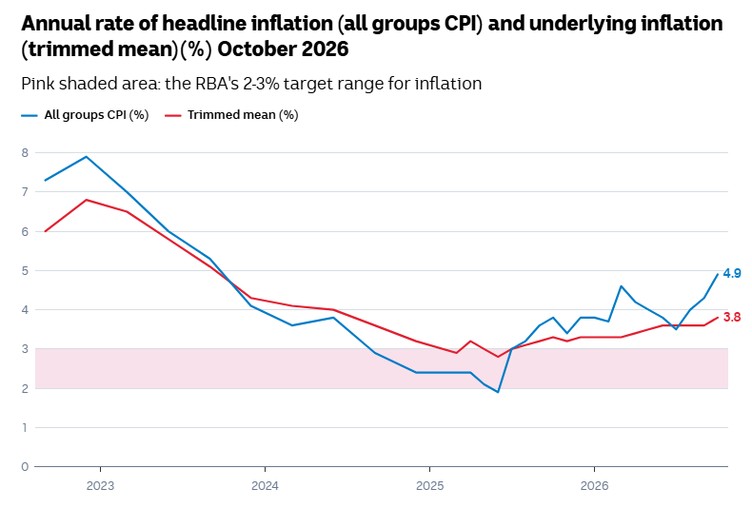
And while monthly numbers can be bumpy, the October numbers for Australia were hard to ignore. Headline inflation hit an annual rate of 4.9%, up from 4.3% in September.
Source: ABC
[Click to open in a new window]
That’s the highest number in three years and leaves our central bank between a rock and a hard place. Lofty RBA and Treasury forecasts have just had a reality check.
As humans, we love magical thinking. ‘This time it’s different’, we tell ourselves.
This cycle’s dream was the newly coined ‘Immaculate Disinflation’ — a hope that we’d be able to bring inflation back down to target without sending folks to the Centrelink line.
Those hopes are now dashed as the RBA now stares down stubborn inflation and unemployment climbing to a five-year high.
Morgan Stanley now estimates that our unemployment will rise from 4.9% to 5.4% in 2027.
That’s roughly 80,000–95,000 more Australians out of work. Sacrificed at the altar of curbing inflation.
It’s no surprise the bugbear of recession is creeping back into the discourse.
Since Australia introduced inflation targets in 1993, there have been only two other periods resembling our current challenge.
Times when both inflation was this high while unemployment was spiking this fast.

Source: Ray White
[Click to open in a new window]
With weak economic growth, high inflation and elevated unemployment coming down the pike, I’m more concerned about the spectre of stagflation returning.
Let’s hope AI can solve our productivity woes, because governments aren’t throwing us a line.
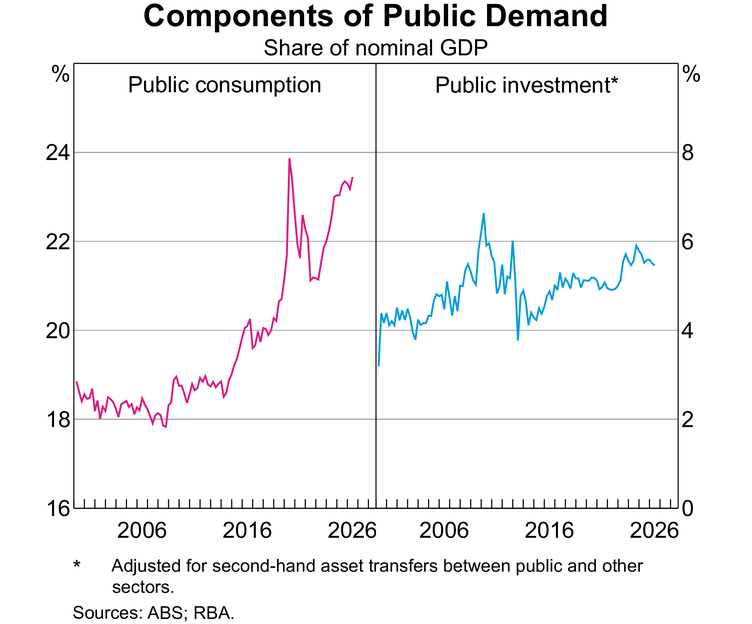
As Lachy laid out earlier this week, while plenty of blame can be placed on Trump’s foray into Iran, a great deal of our inflation challenges have also stemmed from unrestrained Government spending.
Source: RBA
[Click to open in a new window]
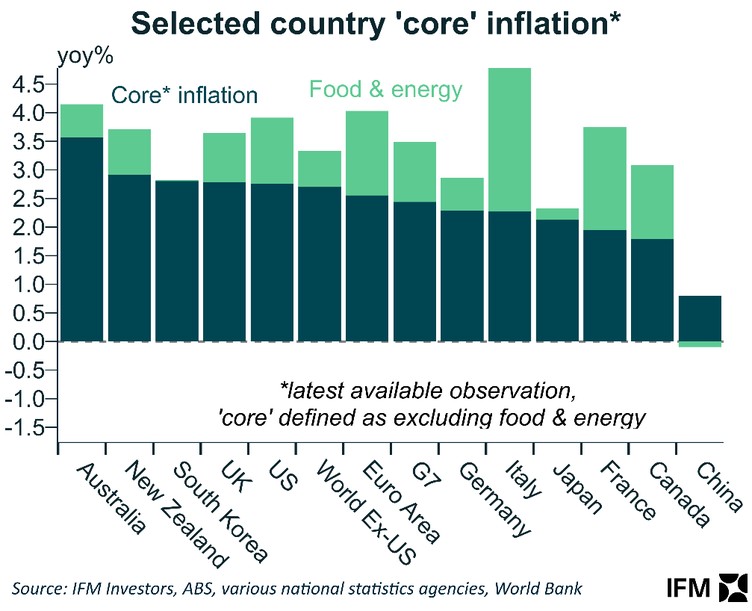
Using a US definition of Core inflation (ex-food and energy), which strips out the more volatile elements, casts Australia in an extremely unflattering light relative to some of our peers.
Source: Alex Joiner
[Click to open in a new window]
So let’s look at some options for where you can bolthole your hard-earned capital amidst the challenges.
Where to Look When Prices Rise and Jobs Fall
History offers a rough guide here, though the sample is small.
Schroders studied ten years of stagflation between 1974 and 2025. Energy and materials stocks typically did well (because high commodity prices were often what caused the inflation in the first place).
Consumer staples and utilities also held up. People still buy groceries and pay the power bill when times get tough, though those companies’ values appear stretched right now.
The laggards were sectors that rely on confident consumers and cheap money. Tech and consumer discretionary stocks generally struggled.
Industrials are a harder call. As a broad group, they tend to suffer when growth stalls, because their order books follow the business cycle.
One corner of the sector looks better placed, though: businesses that sell to government.
Defence contractors and energy infrastructure builders have order books funded by budgets rather than by stretched households.
Aussie investors also have a structural edge. The ASX, heavy with miners and energy producers, has historically proven more resilient during stagflationary periods than energy-importing nations.
But every cycle is different, and AI is the great curveball for us all.
The number one rule to follow when growth is weak: picking the right companies matters more than picking the right sector.
Commodities sit at the centre of this story, and they are notoriously hard to time.
My colleague James Cooper has spent over two decades as a geologist across Australia, the US and Africa. He has combined that experience with his reading of market cycles to build a system that flags entry and exit points in resource stocks.
That system powers his new service, Time & Price Trader. Earlier this month, James told his paid readers to sell some copper stocks while copper traded at US$13,900 a tonne. It now sits at US$11,825, roughly 15% lower.
If you want to see how James separates the signals from the noise, click here and watch his presentation.
Regards,
Charlie Ormond,
ATLAS and Altucher’s Investment Network Australia




Comments