



This month, the world saw how one man could change a business’s value by US$1 trillion and move markets by multiples of that in a matter of days.
Jensen Huang, the CEO of the world’s most valuable listed company, NVIDIA Corporation [NVDA], was embroiled in several scandals. It started with a shocking revelation in a New York Times article on 29th October claiming he had an affair with Alice Huang, an alleged Chinese spy.
This wasn’t the only scandal. A subsequent article published on 11th November claimed that five employees came forward to accuse Jensen of having another affair, this time with someone employed at NVIDIA.
Along with other stories on how the company sold some chips to China, his position looked increasingly untenable. He announced his resignation on 12th November.
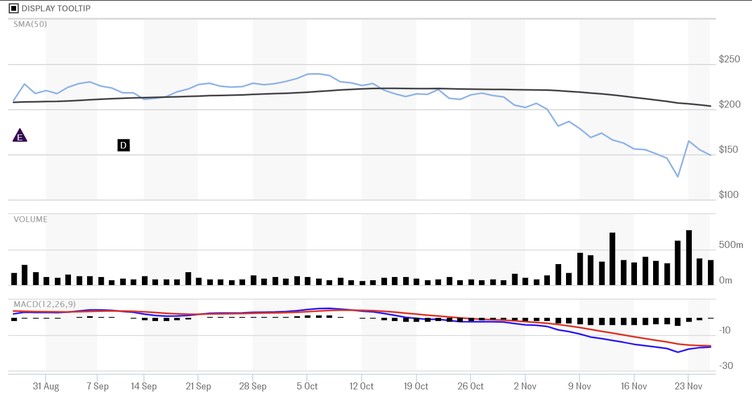
NVIDIA stock was worth around US$214 at the time of the New York Times article, valuing the company at around US$5.2 trillion. It had been declining since the start of October and dipped over 9% on 5th November. The scandal, Jensen’s resignation and reports that the Securities and Exchange Commission was probing into the company’s accounts pushed it to its low of US$124.50 last Friday, a 42% slump.
Source: Market Watch
[Click to open in a new window]
One man with several scandals threatened not only the company’s value, but potentially the capabilities of the US in the Global Artificial/Superintelligence Race.
However, there was a significant twist.
On Monday, Jensen Huang was reinstated as the CEO. The board was unanimous in the decision. However, the board didn’t change its mind on its own. The Trump administration reassured it that Jensen’s return didn’t pose a national security risk.
The markets had previously been on a downward trend. Not just the NASDAQ [COMP], but across the board – stocks, bonds, commodities, Bitcoin. Of course, other factors played into this. Jensen’s reinstatement helped boost the markets on the day too! US$1 trillion, adding 32% of NVIDIA’s value at the time, and multiples of that for the global markets.
Don’t think that this closes the chapter on Jensen, NVIDIA, or the broader markets. News outlets will likely flog this story to death… until they decide that there is another newsworthy story to plaster over the front page.
Given how news cycles work, this could change within weeks, or even days. They may move on to another juicy story.
To an astute investor, these stories are worth a glance. Some may be consequential for the market, but fewer than expected. In fact, the difference between what rewards or costs a portfolio is one’s ability to discern what’s worth following for the payoff.
Let’s investigate this today.
A wild November
The past month has been quite tumultuous in the markets. It started with gold and silver, which were already in a bear market. Gradually, we saw major market indices, oil, copper, zinc, Bitcoin, and more, join them.
If you looked at your portfolio during this time, you may have seen a sea of red. That is, unless you shorted the market and managed to take profits before they ripped higher and those profits vanished. You may even have stopped monitoring your portfolio during this time as losses mounted and markets whipsawed from one day to another.
As for me, I’d been in bear market mode for several months already, given my exposure to gold and silver assets – bullion, ETFs, and mining stocks. I was beginning to feel a little lonely watching many sectors and commodities in a bull market. However, as last weekend rolled in, it seemed like the rest of the market had just basically crashed. The flurry of events came together, bringing almost everything down.
What happened during this time?
There is more than one event driving the market’s decline. They didn’t all move together in one go.
During September and October, oil climbed back to its highs, driven by the increased strikes by the Iranian regime against vessels crossing the Strait of Hormuz and Ukrainian drones bombing Russian oil refineries. This led to the narrative that the Trump administration conducting its military and naval campaign against Iran had led to an affordability crisis. It carried through to the midterm election on 3rd November. For that reason, the Republicans endured a decisive defeat in the midterm election, as reflected in the current voting results now being checked and certified.
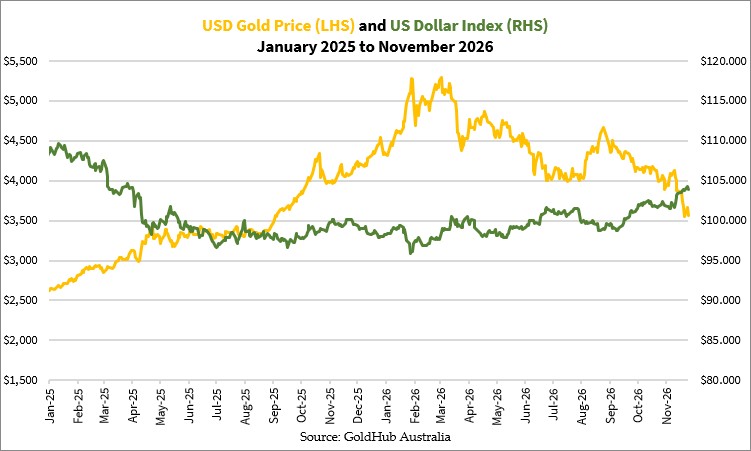
Gold and precious metals assets had been in a bear market for at least half a year, having dropped as spectacularly as they rallied in the last 12 months:
[Click to open in a new window]
Inflation began to gain momentum amid rising oil prices and living costs. This prompted the US Federal Reserve to adopt a more aggressive stance on raising interest rates. Rising interest rates led to the US dollar paying a higher yield, prompting investors to prefer it over gold, which pays no yield, as a safe-haven asset.
Incidentally, gold is trading at its lowest level in over a year, while global ETF holdings were reported by XTB to reach a record 4,275 tonnes last month. Along with that, central banks continued to buy more gold as prices are falling.
When the Democratic Party looked set to win both chambers of Congress and the governorship in a few previously Republican-run states, oil retreated and is now more than 20% lower than at the start of the month:

[Click to open in a new window]
The price started falling as Vice President JD Vance attributed the Republicans’ defeat at the midterm to the prolonged conflict with Iran. The market began to position itself on the US and Iran moving towards a resolution of sorts ahead of the change in Congress. However, conditions in the Middle East haven’t changed, and Ukraine continued to attack Russian refineries.
But more striking was the narrative regarding Artificial/Superintelligence and data centres. The Democratic Party aimed to scrutinise technology companies and those seeking to build data centres, potentially blocking the construction of new ones.
At this point, the markets accelerated their descent. Joining the NASDAQ were copper, zinc, and aluminium.
Particularly for copper and zinc, they were in a strong bullish trend until now. Under a Democratic Congress, proposed tariffs on refined copper may be less likely, placing further downward pressure on the metal. Copper fell by 13% in a fortnight, while zinc around 12%:

[Click to open in a new window]
Both are trading nearly 20% below their highs from less than three months ago.
Add to these the IPO of Anthropic [ANT]. That may have drawn significant capital in the market as investors sold some of their shares to buy the stock ahead of and when it debuted on the NASDAQ last Thursday.
All these would have led you to believe last weekend that the market had crashed.
Trading headlines or identifying value?
There’s a famous saying that the trend is your friend. But in a volatile market without clear trends, investors quickly find themselves in trouble. They are lulled into the false belief that doing something is better than nothing. They begin to try to read every daily, or even hourly, signal as a trend.
Traders who have been doing this for years are trained to recognise the signals and patterns. Even then, they have found the past month to be particularly challenging.
Those who had taken a short position on the market as the midterm results emerged were served a rude shock when it suddenly bounced. The headlines shifted from claiming that a Democratic sweep could be bad for the US economy to suggesting that gridlock could be good for markets, as the rate-rise cycle could end earlier. Same scenario, different outcomes!
Then Jensen’s resignation shook the entire technology sector, sending the NASDAQ down and the broader markets with it. Short sellers began to pile into their positions once again.
They did so, and were handed a hearty smacking this Monday as the markets bounced after Jensen’s reinstatement to NVIDIA. Short-sellers were down by an estimated US$12 billion, or around AU$17 billion, in a day, a substantial amount equal to a large-cap Australian company.
Markets like these tempt investors to throw away their plans and instead chase volatility in the hope of pocketing quick-turnaround profits. However, many learn the hard way as they realise that headlines can swing markets, but usually don’t build a trend.
That’s why successful investors seek to understand what really drives value in particular sectors or industries, rather than letting prices take them for a spin. Prices are indicators. Their patterns could yield some useful insights about fund flows and who is behind them.
Trade the right signals with James Cooper…
Recently, my colleague, James Cooper, has been building a system to detect and interpret market signals to help him determine entry and exit points. He incorporated his background as a geologist with over two decades of experience in Australia, the US, and Africa, along with his understanding of market cycles, into the commodities market.
He is now launching his new service, Time & Price Trader, which complements his existing services, Diggers and Drillers and Mining: Phase One. This trading service is well-suited to what we’ve seen in the markets where headlines drive emotional decisions and create more noise than signals.
James will use his system and experience to guide you in filtering out the noise to identify the signals.
Just a fortnight ago, James instructed his paid readers to sell some copper stocks while they were in a position of strength. This was while copper traded at US$13,900 a tonne. Today, it is trading at US$12,050, or just over 13% lower. That drop wiped out US$141 billion in eleven of the world’s largest copper producers.
This is what successful trading should be – reading the correct signals, not reacting to headlines and blindly guessing where investors will go.
If you want to understand more about James and his time-tested approach, I invite you to click here and watch his presentation:

The volatility is going to be with us for quite a while yet. How you choose to respond could determine whether you generate profits or rack up losses. Have the best tools with you during such times!
Enjoy the weekend ahead!
God Bless,
Brian Chu,
Gold Stock Pro and The Australian Gold Report




Comments