



“RAILROAD, n. The chief of many mechanical devices enabling us to get away from where we are to where we are no better off. For this purpose the railroad is held in highest favor by the optimist, for it permits him to make the transit with great expedition.”
— Ambrose Bierce, The Devil’s Dictionary, 1906
We got a one day reprieve from Nvidia and Jensen this week, and markets are back to wobbling.
The US markets slipped again overnight, their ninth loss in ten sessions.
Chip stocks now sit roughly 40% below their June peak.
Even a freshly listed Anthropic fell below its IPO price as pessimism looms.
It’s feeling very gloomy. But zooming out, this could be a normal correction on the road higher.
Nobody can call the top of a bubble. My hunch is we’re closer to the end of this one than the start, but we’re not there yet.
So today, let’s leave the screens and ride back to another time investors fell head over heels for network technology.
It holds some very big clues for us about where the AI boom is going, and how investors can play it.
The Railroad of the 21st Century
|

Historian Richard White, author of Railroaded, is one of many to draw the comparison with AI.
Today’s AI boosters (and doomers) claim that AI will change the way we work and think.
The railroad did just that.
According to James Gleick, trains transformed our sense of time and space so dramatically that they arguably invented the very idea of time travel.
According to Alfred Chandler, trains transformed business so dramatically that they gave rise to managerial capitalism.
And according to White himself, the transcontinentals invented modern political lobbying, modern finance, and the first theories of climate change.
AI’s impact could well be far larger.
Railroads were in many ways a physical network technology. Bringing news, commerce and people closer in ways that defined a century.
As the judge put it in Bloodgood v. Mohawk & Hudson Railroad Co. case in 1837:
‘[Railroads] …tend to annihilate distance, bringing in effect places that are distant near to each other: tending in their magic influence to the extension of personal acquaintance, the enlargement of business relations, and cementing more firmly the bond of fellowship and union between inhabitants of the States.’
It’s no accident that Iowa, where the first transcontinental railroad began, is now home to a massive data centre industry.
Where the rail lines went, the telegraph followed. Later that same path defined the telecoms and fibres that dominate our digital networks.
But not everyone swooned at the changes. Ambrose Bierce, writing as the railway age wound down had plenty to say about the struggles of his time.
‘The chief of many mechanical devices enabling us to get away from where we are to where we are no better off.’
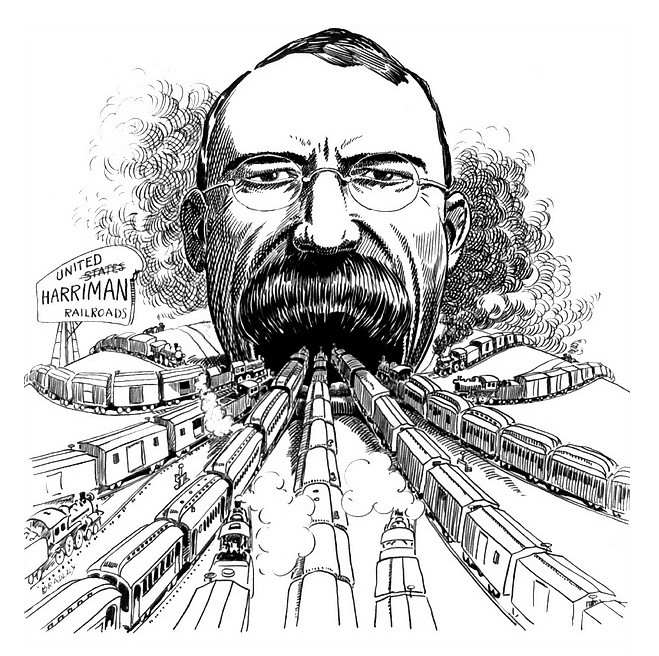
Plenty shared his criticism. The resentment of the Robber Barons mirrors much of today’s mood toward the tech titans.
Source: HistoryExtra
Beyond the inequities is also the story of risk and return. Plenty of the people who paid for tracks never saw a return.
And here lies the risk for investors in the AI age.
Track Before Traffic & Bonds for All
The first lesson is that the railroads were built well ahead of demand.
As White outlined, experienced railroad men warned early that the transcontinental lines would never carry enough traffic to pay for themselves.
They built them anyway. Largely on borrowed money.
As with the current AI buildout, rail builders turned to bonds to raise funds.
But the railwaymen took it to another level. They’d issue bonds for everything that wasn’t nailed down, and plenty that was.
Bonds on the track. Bonds on the locomotives. Bonds for bridges. Bonds for land Washington gave them for free. Bonds for equipment (the literal picks and shovels).
Bonds for profits that didn’t exist — on it went.
When the Panic of 1873 hit, most lines went bust.
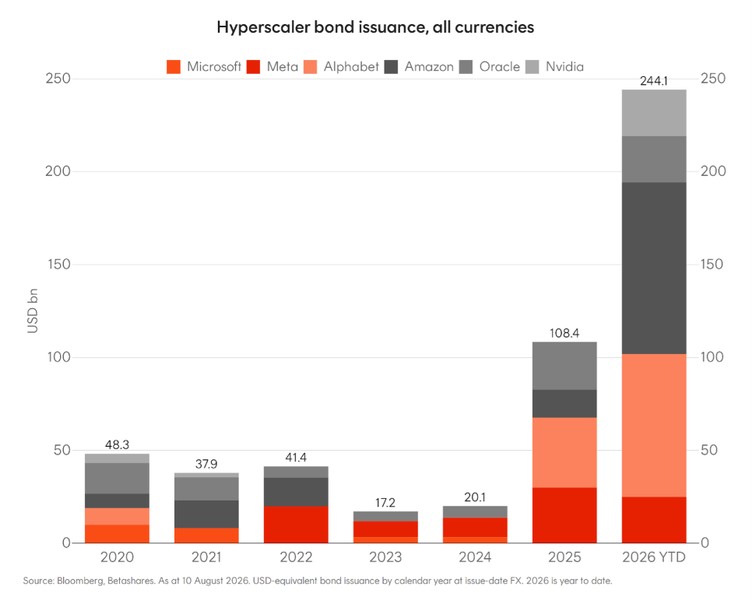
AI is following a similar script. Microsoft, Alphabet, Amazon and Meta have guided to more than US$760 billion in capex this year, and analysts expect it to cross the trillion-dollar mark in 2027.
That cash comes from a deluge of bonds:
Source: Betashares
[Click to open in a new window]
And this mountain of debt needs to be repaid from profits.
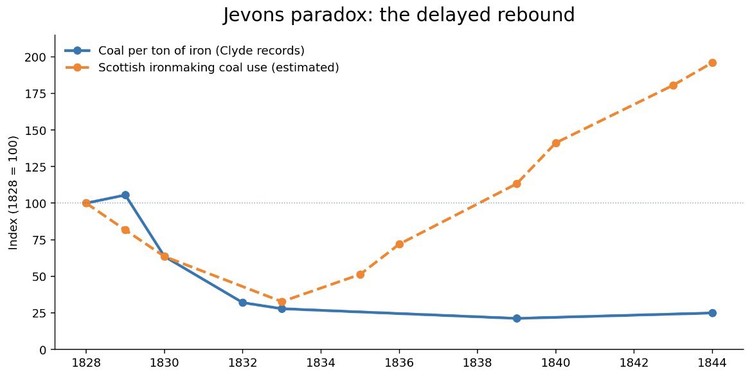
AI bulls argue demand will catch up as capex continues to drive AI costs down. They often cite Jevons paradox, the 19th-century observation that as coal became cheaper to use, Britain ended up burning more of it.
Cheaper AI should mean greater demand for AI and, eventually, profit.
I think there’s a decent chance that happens. But Jevons says nothing about timing, or about who pays while demand catches up.
In Jevons’s own coal example, demand took years to pick up.
Source: Michael Mayer
[Click to open in a new window]
That kind of gap is exactly where railroads came unstuck.
So that is the BIG risk here.
A Dollar a Carload
The second lesson is about rivals fighting over too little traffic.
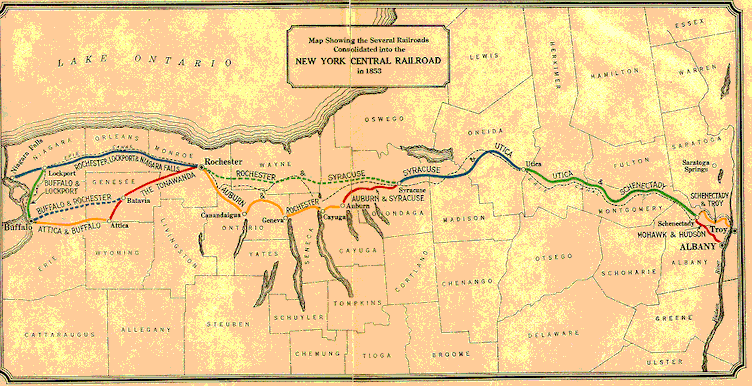
One story from the rail buildout was Cornelius Vanderbilt’s New York Central’s fight against Jay Gould and Jim Fisk for control of the cattle trade between Buffalo and New York.
Source: University of Georgia
Just like today’s AI boosters, Fisk is quoted saying, ‘Let em rip!’ as the buildout peaked.

Source: Library of Congress
The usual rate in the cattle trade was ~$125 a carload, but competition was fierce.
After a price war, cattle travelled for $1 a car. Vanderbilt’s trains filled up while the Erie’s ran almost empty.
The music stopped when he found out why. Gould and Fisk had bought up thousands of cattle and were shipping them on Vanderbilt’s line, at his loss-making price.
AI is in a similar price war today.
In July, OpenAI cut the price of its cheapest model by 80%, bringing it into line with Chinese rivals like DeepSeek. AI prices have more than halved since May.
That’s great news for anyone using AI.
But it’s a threatening iceberg for the companies spending hundreds of billions to supply it at a loss.
The Track Stays
Skipping some nuance, you can guess how the railroad bust played out.
The builders took the losses, the track stayed, and the trains kept running — often under new owners.
The real winners were eventually the farmers and merchants who enjoyed cheap transport for decades.
If the AI bubble pops, something similar could happen.
Data centres won’t vanish. Spare capacity would be sold off cheaply, pushing AI prices lower and spreading the technology faster and beyond the few monolithic owners.
The investors who funded it with debt would bear the cost.
The risk to that view is consolidation. The railroads eventually formed pools to fix rates.
This then ushered in the next generation of antitrust laws, something we could see in the incoming Congress, but we’ll leave that for another day.
For investors, the railroad lesson is to be wary of owning the track. The true gains will go to those with cattle to ship.
And for me, in practical terms for investors, that means staying clear of the big hyperscalers for the foreseeable.
At least until the bond issue subsides.
Regards,

Charlie Ormond,
ATLAS and Altucher’s Investment Network Australia




Comments