




It’s often said that price leads narrative.
In other words, the price moves first. And then everyone and their dog tells you their pet theory about why.
Interesting analysis usually… but not much use to you as an investor after the fact.
To make money, you need to be ahead of the narrative.
And practically speaking, that means reading price action: looking at charts to see which trends are developing, and which are breaking down.
The best opportunities tend to sit where price action and the prevailing narrative disagree.
Which brings me to copper…
How I got here
I first got interested in copper back in late 2022 when prices were falling sharply. Nobody else was. Finding value was relatively easy then…much easier than it is today.
So I recommended a bunch of copper stocks to my paid readership, and most have done very well since.
The narrative has since been propelled forward by the AI data-centre build-out, the electrification of transport, and heavy spending on power grids.
All three are copper-intensive. Meanwhile, mine supply growth has been sluggish for years, and ore grades at established mines keep falling.
Even today, the narrative is all about tightening copper supply.
Take the news out of China this week…
A genuine squeeze in Shanghai
Buyers there are scrambling for metal.
The Yangshan premium (the fee paid to import copper into China’s key port) hit a record $230 a tonne on Monday.
Spot premiums in Shanghai tripled in two weeks to a record 2,615 yuan ($392) a tonne.
And copper held in Shanghai Futures Exchange warehouses plunged more than 24% last week to 33,848 tonnes, the lowest in almost three years.
That pile would cover less than one day of China’s copper use.
China still consumes almost 60% of the world’s refined copper. So, when metal gets scarce there, the whole market feels it.
What’s causing the tightness?
Chinese smelters can’t get enough feedstock, and both concentrates and scrap remain hard to find.
Treatment charges for copper concentrates are actually negative!
Spot charges run near –$150 a tonne, meaning smelters are effectively paying miners to process their ore.
So smelters have cut or delayed output even as demand stayed steady rather than strong.
One analyst put it plainly: the squeeze comes from supply, not booming orders.
It’s more fodder for the copper bulls, even as markets digest the effect of last week’s US midterms on the AI data-centre build-out.
But I’d caution against getting carried away.
Here’s why…
The chart is telling a different story
As I said at the start: price leads narrative.
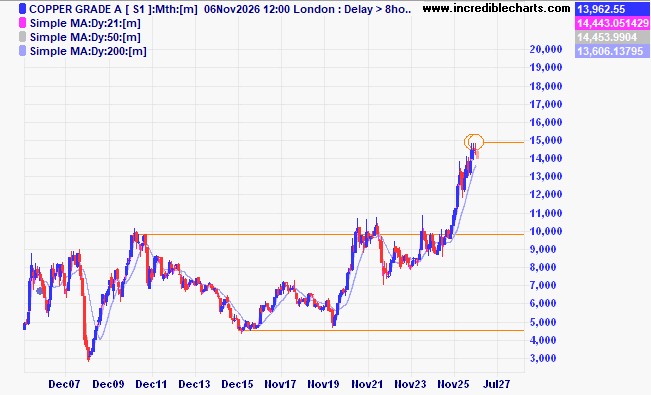
With that in mind, look at the long-term chart of copper prices.
Source: Incredible Charts
This is a monthly chart covering 20 years, so I’m looking at long-term trends here.
As you can see, copper staged a decisive breakout in late 2025, when it cleared its previous 2022 record. And it hasn’t closed below that old high since.
That’s also when a lot of my 2022 picks began to rocket, in some cases delivering triple-digit returns.
It took patience, but that’s often the price of getting in ahead of the narrative.
What I want to show you now is that red bar at the end – and it’s why I’ve closed most of my copper positions (Editor’s note: Quick distinction. I’m talking producers not explorers).
Copper has made three runs at the $15,000/t mark this year: in late January, in August and again in September. Each time it ran out of steam just short of it. September’s record close was $14,999/t.
That’s a signal worth paying attention to
This month the price has slipped back to around $14,000/t – roughly 7% off its high, after its worst week since March – and that’s despite the tightness we’ve just seen in China.
Add it all up and, to my mind, it argues for caution right now.
That $15,000 ceiling held strong and now the price is going to test the market to see what level the buyers come out at.
There’s a good reason the physical squeeze hasn’t lifted the price, too.
You see, much of the “shortage” in China is an artefact of American stockpiling.
Comex warehouses in the US are sitting on 732,943 tonnes, more than double a year ago, after two years of metal being shipped to the US ahead of threatened tariffs.
That stockpile could theoretically come back to Asia but only if the tariffs are definitively ruled out.
President’s Xi and Trump are due to meet in China soon, and we’ll see if there is any deal.
But if that supply does come back into the market, the tight supply story evaporates…in the short term at least.
That could see copper price falls with it.
Long term, copper is still a good story. The demand drivers and the supply constraints are real.
But the price action right now suggests other factors are at play.
Whatever happens, the real reasons
will become apparent later
So my suggestion: keep an eye on the copper price, put together a watchlist of copper names, and wait to see how the narrative shifts.
If we suddenly get people abandoning copper on stories of data-centre slowdowns, new supply coming online, or global growth concerns, that is the time to get interested.
Speak soon.
Regards,

James Cooper,
Mining: Phase One and Diggers and Drillers




Comments