



Tut, tut…Jensen Huang.
Now I’m no moralising puritan, so let’s talk markets and price implications.
On Sunday, the Nvidia boss admitted to an affair with Alice Huang (no relation).
She’s a former executive at Megaspeed, a Singapore-based Nvidia customer.
A series of reports has identified her as a suspected Chinese spy.
Bloomberg also reports Huang had previously lied about the nature of their relationship.
Nvidia’s board has launched an independent investigation.
It says it has no reason to believe national security or company secrets were compromised.
Nvidia shareholders took a dimmer view.
The stock fell 4.27% overnight to US$178.67, which leaves it below where it started the year.

Source: TradingView
[Click to open in a new window]
Governance has a price
Here’s what interests me about this little imbroglio.
A large slice of any individual stock’s performance can be tied back to the ethereal concept of “governance”.
Governance lives in board minutes and character judgements, well away from the income statement.
Yet the market prices it every single day, and you can put hard numbers on the result.
The same thing plays out in ASX small cap land, usually with far less fanfare.
The biggest domestic case of recent years is WiseTech Global and its founder Richard White.
When four WiseTech directors resigned over White’s role in February 2025, the shares fell more than 20% in a single session.
When the powers that be searched the company’s Sydney office over alleged share trading in October 2025, the stock dropped around 16%.
That’s the governance discount, applied and measured by the market in real time.
Each of those falls was a judgement about people, made on headlines alone.
Usually these storms blow over.
ASIC closed its share trading probe into White last month with no enforcement action.
The damage can linger, though.
WiseTech shares were still around 75% below their November 2024 record last month, although the sell-off across software stocks has done plenty of harm as well.
Then there’s the question of who owns the shares.
White still holds roughly a third of WiseTech, while Huang owns around 3.5% of Nvidia, a stake worth about US$150 billion at last night’s close.
Imagine if that 3.5% stake was punted out quickly or worse, was forced out into the market by regulators in one fell swoop?
That’s a double-edged sword.
A founder with that much skin in the game is heavily incentivised to see the company succeed.
BUT…
A founder who feels wronged by the board can also spite sell and crater the share price.
The market knows this, and it prices the possibility in.
Nearly 7% of the S&P 500
Nvidia’s problem quickly becomes America’s problem.
The chipmaker makes up nearly 7% of the S&P 500 on its own.
Wall Street met the news with a firm shrug (for now) overnight, and the S&P 500 rose 2.35% on a broader chip rally and cheaper oil.
That resilience would be tested if the board’s investigation drags on.
Some quick arithmetic shows the stakes.
A further 20% fall in Nvidia would shave around 1.4 percentage points off the index before any other stock moves.
This could weigh on US indices for a while yet.
It also lands in a market still digesting the midterms, where Democrats now control both chambers of Congress and two years of spending fights look likely.
Meanwhile, back home…
Australia is wrestling with a very different set of problems.
The RBA lifted the cash rate to 4.85% on Melbourne Cup Day, its fifth hike this year and the highest level since 2008.
Add the capital gains tax changes due from July 2027, and the domestic backdrop for small caps is about as hostile as I’ve seen it.
Is this a big rotation moment away from the debt-ridden hyperscalers and the rocks beneath our feet?
Well, that could be a massive opportunity if you’ve got time in a Salvador Dali sense:
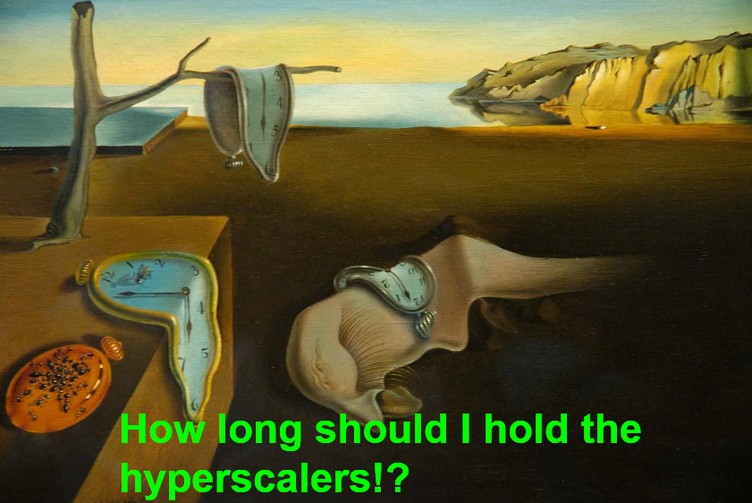
Source: Lachlann Tierney
That’s the discrepancy Australian small cap investors have to manage right now.
Wall Street can rally on chip stocks and cheaper oil while the local economy grinds through rate hikes.
Here’s the strange upside.
The ASX has very little riding on Nvidia’s short-term success or failure, at least in direct and obvious links.
Our index leans heavily on banks and miners, and local tech is a small slice of the whole.
If Nvidia’s board shemozzle is painful and ugly, the ASX could outperform the US market for a decent stretch.
My small cap watchlist surged on Monday.
Today it’s a more cautious shade of green, which feels about right to me.
I’m playing this environment conservatively.
If a position runs 70% or 80%, I’m inclined to bank a decent chunk of that gain, because the tax settings make chasing ten-baggers a much harder game.
(If you’re exclusively in large-caps, I know 70% winners sound bizarre and unlikely, but that’s the size of metric that the volatility in this side of the market brings)
I also currently favour profitable companies that make physical things.
They can fund themselves when conditions turn, which spares shareholders a dilutive capital raise at the worst possible moment.
So consider how great the ASX now looks that a single person’s affair can’t destroy the returns of an index for months…
Oh, the benefits of an ossified, decaying economy and a punitive tax system!
Cold solace indeed.
But we may yet get our revenge as the world realises the physical inputs to life are increasingly found in ASX resource companies.
Speaking of which, read what our in-house resource stock guru James Cooper has to say about the next leg of the commodity trade here.
Warm regards,
Dr. Lachlann Tierney,
Australian Small-Cap Investigator and Fat Tail Microcaps





Comments