



Markets spent last week trying to sort the winners from the losers in Washington.
Democrats took both houses of Congress, and the ASX swung hard.
Overnight, the Nasdaq dropped more than 5% as investors priced in a crackdown on AI data centres.
Beneath the noise, I see a massive contradiction.
It will shape commodity markets for years.
Give us the stuff, but don’t make us dig
Democrats want renewables.
US solar and wind stocks jumped as much as 7% the morning after the vote.
Every solar farm and wind turbine runs on copper and a long list of critical minerals.
The trouble starts when someone wants to dig a hole in America.
Democrats would argue they support domestic mining in the right locations.
In practice, every proposed mine seems to end up in the wrong spot.
I call it “magic wand economics.”
Wave it, and the minerals appear from somewhere else.
Usually, somewhere else means China, which refines around 90% of the world’s rare earths.
It’s an endless war between supposed carbon footprint warriors and Birkenstock clad tree enthusiasts that want to protect local species.
Wind turbines need rare earths, and don’t even get me started on where cobalt in batteries comes from Greta Thunberg.
Problem is you need Chinese produced critical minerals for clean energy.
So the battle of the climate-environmental purity tests see China win by default.
In so many words, magic wand economics = let China do it.
Gosh it feels good to be virtuous, doesn’t it?
And at least Australia still digs things up.
Before we get too smug, take a look in the mirror.
Australia holds the world’s largest known uranium resources and ships yellowcake to reactors across the globe, yet nuclear power generation has been banned here at the federal level since the late 1990s.
Same wand, different hemisphere.
Deadlock is gold’s friend
The other big takeaway is gridlock.
Trump keeps his veto, and Democrats now control the purse strings.
Expect two years of spending fights, with little appetite on either side to rein in deficits.
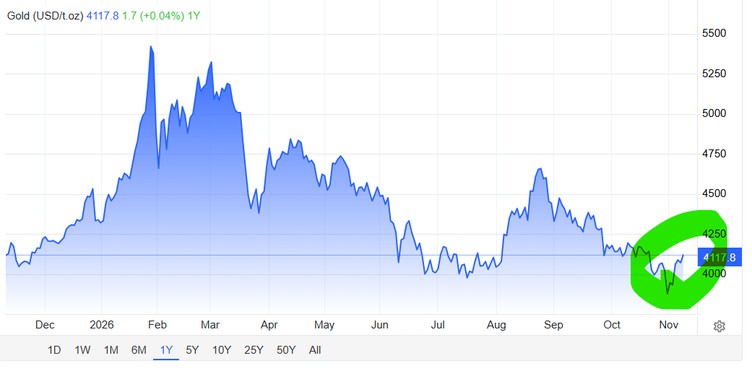
That’s bullish for gold. The US dollar index fell to a one-month low on the result, and gold bounced hard off its lows.
Source: Trading Economics
[Click to open in a new window]
Gold slid from above US$5,400 in late January to below US$4,000 just before the vote.
It’s now back around US$4,118, and I expect a deadlocked Washington to keep the move alive.
The data centres will move
Data centres were the other casualty.
Voters pushed back on their water use and power demands.
That capital will find a new home with countries happy to take the money.
Wherever those halls get built, they still need copper wiring and grid connections.
Janus Henderson’s Darko Kuzmanovic put it well in the AFR recently: “Right now we’re all fixated on AI and computing, but just to get to the point at which that technology changes things for us, you need all this material.”
And another powerful set of quotes from Darko:
“Industrialisation. Full stop…Forget data centres for a minute…There is a short supply of materials just to build anything industrial.”
So I read this as the ultimate aftermath of the AI data centre trade – the commodity trade remains intact.
No matter what, we need more stuff out of the ground.
Canberra’s own headwind
There’s a local catch.
From 1 July 2027, the 50% capital gains tax discount gets replaced with indexation, plus a 30% minimum tax on capital gains.
That hurts small-cap developers most.
They live on retail money, and a capital gain is usually the only reward for backing a company with no revenue.
Producers are in a stronger position.
Cashflow lets them fund growth internally and lean less on dilutive capital raisings.
When cashflow closes the gap
That brings me to uranium.
Kuzmanovic points out the uranium price is up more than 10% this year while many related stocks are down 20% to 40%.
Gaps like that tend to close once cash starts landing in the bank.
Two ASX companies are right at that point.
Lotus Resources [ASX:LOT] restarted the Kayelekera mine in Malawi and doubled output to 155,900 pounds in the June quarter.
It secured export permits in late October, and its first uranium shipment left the mine at the start of November.
Peninsula Energy [ASX:PEN] is ramping up its Lance project in Wyoming and has reaffirmed guidance of 500,000 to 600,000 pounds for 2027.
Lance already holds its permits, which matters more now that new US mines face a tougher road through Washington.
***Note: Not financial advice. Always do your own research and never risk more than you can afford to lose.***
Neither has had a smooth ride.
Peninsula withdrew its 2026 guidance after slow wellfield flow rates, and Lotus paused processing in June when acid supply ran short.
Still, both are crossing from developer to producer.
Under Canberra’s new tax rules, that’s the right side of the line to be on.
The world wants the minerals without the mines, and the power without the reactors.
Someone has to fill the gap, and a pair of small ASX uranium producers are stepping up.
An unlikely renaissance indeed.
Warm regards,
Dr. Lachlann Tierney,
Australian Small-Cap Investigator and Fat Tail Microcaps





Comments