



Wall Street just had its worst day in 19 months, and the AI trade was at the centre of it.
Over US$2.3 trillion evaporated on Thursday’s US session as the Nasdaq Composite fell ~5.5%, its steepest drop since the tariff shock of April 2025.
That puts the tech-heavy index in correction territory, more than 10% below its October high.
Nvidia sank 9.3%, erasing its gains for the year. The Philadelphia Semiconductor Index lost more than 12%. Meanwhile, cloud operator CoreWeave fell around 12% for a second heavy loss in two days.

Source: Reuters
[Click to open in a new window]
This quarter has already been shaky. What started as debt concerns amid earnings season turned into panic as expectations of data centre growth had its wings clipped.
The central blame for last night’s sell-off is political. Democrats took both chambers of Congress and a string of governorships in a blue wave this week.
In the immediate aftermath, markets rose with their best day in three months.
In hindsight, that now looks like a volatility-crush starter pistol that many took as a signal that the uncertainty was over.
But then investors looked at what the new governors had promised to do about data centres.
Democracy Manifest
All we can say is that voters have spoken.
The backlash started in town halls rather than Washington, with data centres directly on the ballot in 41 local elections.
By my count, the vote to limit them won at least 36 times.
What started as frustration with big tech forcing NDA’s on local officials turned into full opposition as energy costs compounded by the Iran conflict drove up the cost of everyday life in America.
In Piqua, Ohio, for example, about two-thirds of voters backed a block of Meta’s 1.4GW campus and removed the mayor for good measure.
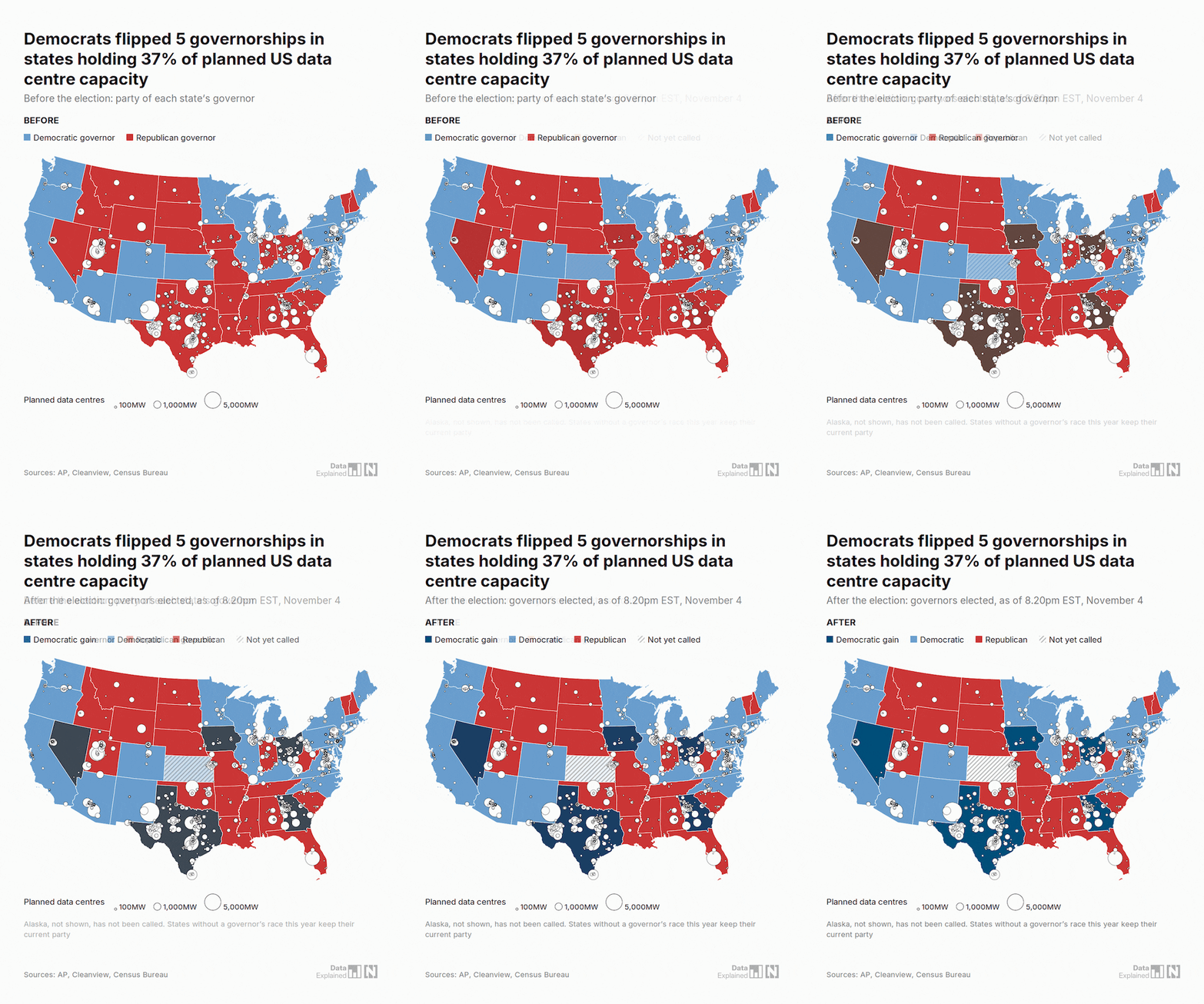
That’s a dramatic example but the governors’ races matter more. There are nine states where the governor or governor-elect has promised or imposed a pause on new data centres.
Those states hold 158 GW of America’s planned capacity, or around 40%.
Source: NationalNews
Texas and the gas turbine problem
Texas is the big one. It holds roughly a quarter of all planned US data centre capacity.
Democrat Gina Hinojosa beat Greg Abbott after campaigning for a moratorium on new data centres ‘until we can pass laws to protect Texans’.
Abbott had already paused new grid approvals as a stopgap to ease pressure before the election, but now he’s on his way out.
That matters because of how Texas data centres get their power.
With the grid queue stretching for years, developers have been building their own gas turbines on-site thanks to Texas’ looser regulations. Now that’s all up in the air.

Source: Cleanview
[Click to open in a new window]
Wired found that at least 38 Texas data centres had secured ‘minor’ air permits for on-site power since 2024, avoiding public notice.
Oracle’s Stargate campus alone was cleared to run 10 gas turbines.
Now those air permits will run through agencies Governor Hinojosa controls.
She can’t write permanent rules on her own, since Republicans still hold the state Senate.
But she can keep the pause in place while the legislature negotiates next year.
UBS estimates 18GW of Texas capacity planned for 2028 is now at risk.
Debt was always the weak point
I’ve been warning about leverage in this build-out for some time. This week shows why it matters.
The cash-rich giants can likely wait out a permit freeze. The neoclouds and debt-funded developers can’t.
CoreWeave carries roughly US$50 billion of debt, according to Reuters. Last month the yield on its unsecured bonds pushed towards 15%.
Now, after the most recent selloff, shares are down 45% for the year.
When debt costs that much, time is the enemy. Every month a site waits on a permit is another month of interest without revenue.
Still, the sell-down may offer some great buying opportunities in the coming weeks.
Not the time to be a hero
However, now is not the time to be a hero. I’m not calling for a great reversal or a larger crash; who knows where we go from here.
This could fall further, especially with Nvidia due to report on 17 November.
But I also don’t think this is the unwind moment of this cycle.
It is a time to take stock and adjust your strategy to the political reality. I expect the US build-out to slow, and I expect AI regulation to come through.
Neither will be existential.
The 57GW already under construction nationwide is less exposed, and the new governors campaigned on pauses and new rules rather than bans.
History suggests that’s how these fights tend to end.
Here’s one example of these regulatory waves from the history of tech buildouts.
The Grangers
In the 1870s, the fight was over railroads.
After the Civil War, Midwestern farmers in states like Illinois and Iowa relied on a single line to get their grain to market.
Early railroad barons abused their monopoly position to raise transport rates for these farmers.
As those rates climbed, so did their anger.
Farmers organised through the Grange and elected friendly legislators, who passed laws capping freight and storage rates.
‘Farmer Attempts to Wake the Nation’ 1873

Source: Historical Picture Archive
In some states, regulation went too far, and the railroads halted; in others, too light.
Eventually, the patchwork of regulations from the ‘laboratories of democracy’ worked its way up the system to higher courts and federal-level regulation.
And in 1887, Congress created the first federal regulator, the Interstate Commerce Commission. The railroads found they could live with it.
And the building carried on.
America laid around 70,000 miles of track in the 1880s, a record decade despite fears of overregulation.
In fact, the year the regulator was born, 1887, was the biggest year of construction yet. Of course, this historical analogy cuts both ways, and this time was also notable for its overcapacity buildout.
But the Ganger moment is just one tiny part of a much larger trend.
Ultimately, the public stood up to concentrated power and what felt like exploitation and won rules the industry had to accept.
The trend marched on regardless.
I expect the AI version to rhyme, with a slower and more expensive American build-out and fewer easy approvals.
For investors, the useful question now is who can afford to wait.
Regards,
Charlie Ormond,
ATLAS and Altucher’s Investment Network Australia




Comments