



I’m listening to a classic early 2000s album by Modest Mouse “Good News For People Who Love Bad News” as I write this.
That album title kind of captures the market zeitgeist right now.
So call me a contrarian, but things just might work out for a bit longer.
Global markets could be setting up for a strong rally into the new year.
But watch it happen, I’m calling a US market rally for the next two months.
I know that’s a lonely view on the ASX right now.
(Remember, the ASX is another story)
Surely I know the world is about to end?
The ASX 200 has gone nowhere this year.
Over the same stretch, the S&P 500 is up 13.4% and South Korea’s KOSPI has surged 60%.
Madness.
The world is falling apart.
Well, that just might be a purely Australian phenomenon.
Smaller companies in the domestic market have copped it even worse.
Bell Potter found only 23 of the 200 stocks in the Small Ordinaries index were higher for the year as of 1 October.
With the cash rate at 4.6% and inflation running at 4%, big fund managers are heading for the exits.
Many are piling into companies that make their money in the US instead.
The AFR recently laid out how “anything domestic” has a stench about it for small-cap fund managers:

Source: Australian Financial Review
So why am I feeling upbeat?
It starts in the Strait of Hormuz.
Iran is losing its grip
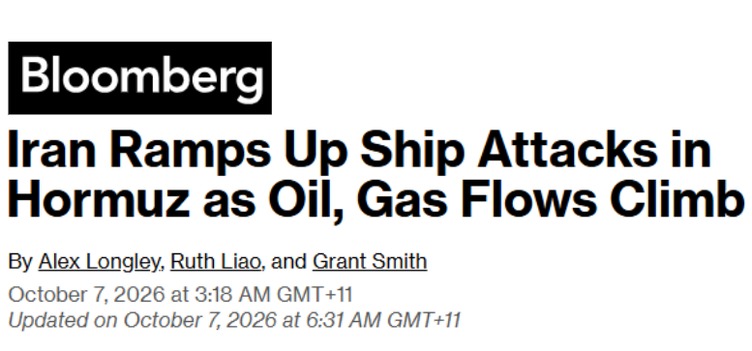
Bloomberg reported this week that Iran has stepped up its attacks on tankers in the strait.
Call me an absolute loon — but that’s a good thing.
I can smell a distinct waft of desperation…
Iran can see its main bargaining chip slipping away.
UK maritime authorities have logged nine attacks in the waterway so far this month, half of September’s total across the strait and the Persian Gulf combined.
Source: Bloomberg
On Tuesday, Oman’s defence ministry rescued 10 crew from a burning tanker that had been attacked.
Here’s why I think Iran is stepping things up.
(Shhh…Oil is flowing again)
Top commodity traders said this week that Middle East flows are back to around 80% of prewar levels.
That’s helped drag Brent crude, the global oil benchmark, back below US$100 a barrel.
One risk management boss quoted by Bloomberg said Iran “does not need to stop every vessel”.
It only needs shipowners to believe any ship could be next.
It’s a bit like a shark sighting at Bondi.
One fin is enough to clear the whole beach.
The fear is showing up in shipping costs.
Carrying oil from the Gulf to China cost a record US$1.3 million a day on Monday, more than 20 times last year’s average.
But the big oil consumers are pushing back.
Several countries announced plans last week to release millions of barrels from emergency stockpiles, and Donald Trump wants cheaper fuel before next month’s US midterm elections.
Cheaper oil takes pressure off inflation, which weakens the case for more interest rate hikes.
That’s the kind of backdrop that could fuel a rally into the new year.
Gold looks set to benefit as well.
Where I’m hunting
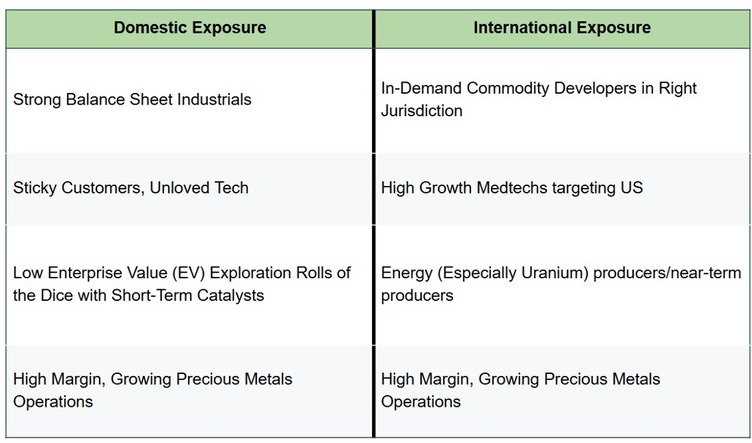
Across my paid advisory services, here’s a summary of what I’ve recommended to subscribers, or intend to recommend:
Source: Lachlann Tierney
The glue holding all of these together is straightforward.
They’re out of the limelight, but each is designed to capture upside from a major shift in how the world works.
When the market’s attention shifts to these types of companies, that’s when I’ll hopefully be able to recommend we take profits.
If a layman-level investing chap at the Saturday barbecue starts asking me about uranium, I’ll know it’s time to bank the win.
It’s always better to be early and “wrong” than late, when everyone agrees that you’re “right”.
Speaking of getting things right…
You remember my relentless notes on humanoid robots and rare earths from the last few weeks?
The recent call to sell Meteoric Resources [ASX:MEI] worked out pretty well for members of Australian Small-Cap Investigator.
We banked a 39% win in three weeks on the dot.
(In this dire government-enforced market malaise…I’ll take it!)
The trigger was a takeover offer from Lynas Rare Earths last week, at a 68% premium to Meteoric’s last close.
Lynas wants the Caldeira project in Brazil, which it describes as the largest known clay-hosted rare earths deposit outside China.
That’s an Australian company with a Brazilian asset, in case you needed another reminder of where I think the value is.
Rare earths go into the powerful magnets inside electric motors.
A humanoid robot needs a motor at almost every joint.
Not a bad indicator that I might be onto something with this whole humanoid robot and rare earth magnet thesis?
Anyway, I’ll keep digging for the best ideas regardless.
(Pssst….There’s still time to hear about the other four companies I recommended as part of that report which included Meteoric Resources…)
Click here to learn more…
Warm regards,

Dr. Lachlann Tierney,
Australian Small-Cap Investigator and Fat Tail Microcaps





Comments