



Ouch, what a ruthlessly red September that was.
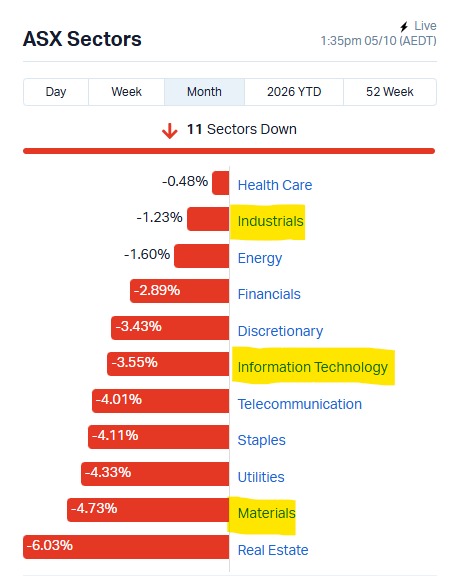
Every single sector finished the past month in the red. Take a look at this chart from Market Index:
Source: Market Index
[Click to open in a new window]
The ASX 200 fell a little over ~3% across September.
Real estate took the biggest hit, down 6.03%. Even health care, the best of a bad bunch, slipped 0.48%.
I’d flagged September as a likely rough patch ahead of time in an August note to you.
And so it came to pass.
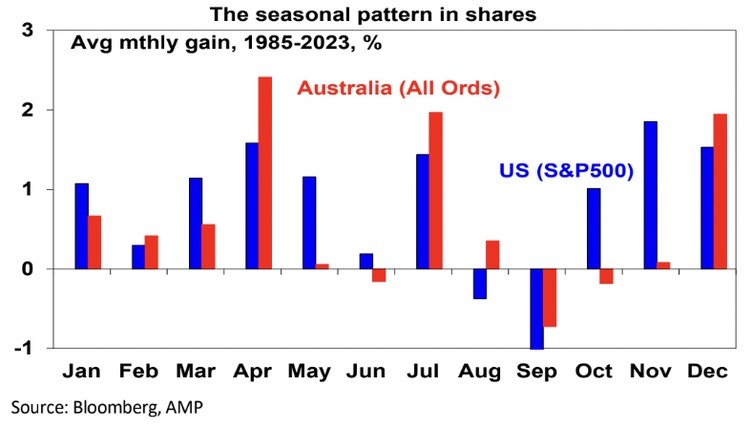
History says it’s the weakest month on the calendar:
Source: Livewire
[Click to open in a new window]
The RBA added to the pain on 29 September, lifting the cash rate to 4.6% in its fourth rate rise of the year.
The RBA’s board also noted the economy appeared to be slowing.
So where do you look when everything is falling?
You’ll notice I highlighted three sectors on that chart.
Industrials, IT and Materials.
That’s where I’m hunting for small-cap opportunities right now, particularly industrials.
Industrials took a lighter hit
Industrials held up better than most, down just ~1.2% over the month.
Companies doing essential work with healthy balance sheets can help shield investors from the worst effects of a slowdown.
With the RBA itself pointing to slowing growth, that protection could be very handy.
Tech looks oversold
Information technology fell ~3.6% over the month, although the real damage started much earlier.
Between October 2025 and March 2026, the ASX tech sector lost around half its value.
The market dubbed it the “SaaSpocalypse”.
SaaS stands for software-as-a-service, the subscription model the industry relies on, and investors feared AI would make a lot of it redundant.
I think the selling went too far in certain places.
When a whole sector gets dumped at once, quality businesses land can often go missing with the bathwater.
For patient investors, I think there could be significant value in tech companies with loyal customers and strong cashflows and growth ahead.
Developer costs (overheads on labour) are coming down quickly.
If the customers keep signing up for long-term contracts – you’ll likely see some great margins emerge at certain tech companies.
Many investors are still terrified of tech.
And that has me thinking of Warren Buffett’s old advice about being greedy when others are fearful.
Materials and the China signal
Materials had a tough month, down ~4.7%.
I still believe commodities are the only way the world digs itself out of this high inflation mess.
Prices rise when the world runs short of stuff.
The long-term fix is more supply, and that starts with raw materials pulled out of the ground.
There’s also an encouraging signal coming out of China.
China’s official manufacturing purchasing managers’ index, or PMI, rose to 50.1 in September from 49.8 in August.
The PMI surveys around 3,200 Chinese manufacturers each month, and any reading above 50 means activity is growing.
September marked the first expansion since June, with factory output hitting a nine-month high.
China is the world’s largest buyer of most industrial metals.
Busier factories there could mean stronger demand for Australian resources in the coming quarters.
The rate that stops a nation
The RBA meets again on Melbourne Cup Day, and another rate rise is likely.
It’ll probably rain on the actual day too!
In the meantime, I’ll be narrowing my shortlist of potential ASX small-cap winners from companies across these three sectors.
Warm regards,

Dr. Lachlann Tierney,
Australian Small-Cap Investigator and Fat Tail Microcaps





Comments