




Today, I want to start with a key stat I flagged last Monday as ‘more important than the RBA’s interest rate call.’
Then we’ll discuss why it doesn’t really matter!
Because beneath it all, there’s something more fundamental driving commodities along.
Bear with me here, as it’ll all make sense by the end.
First up…
The big (but not so big) data point
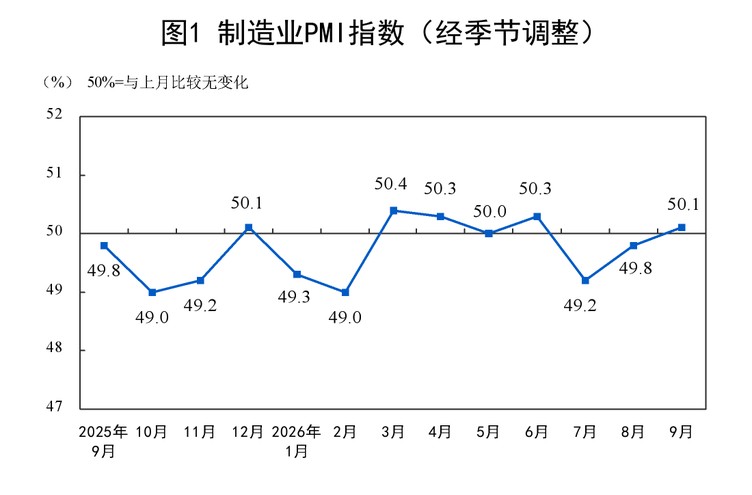
September’s China Purchasing Managers’ Index (PMI) came out on Wednesday. This is a key gauge of manufacturing activity in China.
The headline figure landed at 50.1, up from August’s 49.8 and right on consensus.
That puts China’s factory sector — our most important commodity customer — back in expansion territory.
Here are the readings over the past 12 months:
Source: CN Wire
[Click to open in a new window]
Good news for Aussie miners. It suggests overall demand should remain solid…for now.
But I don’t want to get you too excited — it’s only one month’s data point after all.
The truth is no ‘one figure’ ever matters that much.
And at the end of the day, you’ll tie yourself up in knots trying to trade every morsel of data that comes along.
Be it oil prices, bond yields, economic data, interest rate calls, or anything else.
So how do you make sense of it all?
In a world of constant noise, the relative predictability of the commodity cycle is
our North Star
Understanding the commodity cycle allows you to step away from whatever the ‘current thing’ is and instead get back to basics.
After all, your goal isn’t to guess what every new headline means.
It’s simply to identify well-run miners, sitting on good prospects at attractive valuations, with strong trends supporting them.
If you do that consistently, you’ll make money.
Easier said than done, I know!
But it’s a solid framework to start from.
With that in mind, today I’ll show you how a normal commodity cycle works — and what it tells you about where to put your money.
I’ll then show you why the advent of AI has perhaps changed the cycle we’re in…with important implications for how long this commodity bull can run.
Let’s start with the basics…
The four-part cycle
The last big commodity bull market was simple to understand. It was all about one thing — China.
Today’s cycle is different. Several mega trends are pushing it along, not just China. That’s the crux of why this time may be different.
But let’s hold that thought.
The underlying principle of how any cycle works remains the same.
Here’s the quick guide.
Every commodity cycle has four parts.
Part one: prices fall, and miners stop spending. Exploration budgets shrink. New projects stall. Supply quietly dries up.
Part two: a demand shock hits the system. A nation builds, or a new tech arrives. Prices surge, and supply can’t keep up.
Part three: high prices pull in money. Miners raise capex and green-light new mines. Investors pile in.
Part four: the new supply finally arrives, years late. Prices fall, and the cycle starts again.
History backs this up.
The rapid urbanisation of the US, along with the beginning of the Texas oil boom in 1901 (an energy shift like today), drove a Supercycle from 1899 to 1932.
War and the European rebuild drove the next; from 1939 to 1961.
China’s rise drove the last one, in the 2000s.
Each wave lasted a decade or more. And each one needed the same two things: a long stretch of underinvestment, and a generational demand shock.
So where are we now?
Right in the sweet spot.
Capex (capital expenditure) in mining and oil and gas peaked in 2012–2014 and never came back.
Meanwhile, energy transition investment has more than doubled since 2020, from $1 trillion to $2.3 trillion. Wind, solar, and EVs all need copper, lithium, nickel, and rare earths.
Trade wars have pushed nations to lock up critical minerals.
And India now has the fastest-growing middle class on Earth. Its government has tripled capex since 2019.
Furthermore, mines now take 10 to 15 years to build, up from around seven. That stretches the timeline, too.
Tight supply PLUS many new sources of demand.
That’s the recipe for a Supercycle.
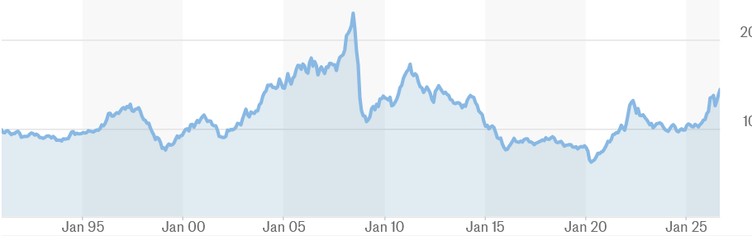
And here’s the kicker: commodity benchmarks haven’t even made new highs yet. The BCOM index (Bloomberg Commodity Index) still sits below its 2008 peak:
Source: Bloomberg
[Click to open in a new window]
In other words, this cycle has more juice left in it.
But this is where it gets interesting…
Commodity fund Auspice Capital argued recently that the cycle reset in 2025.
Why?
Because that’s when “the AI and electrification trade changed the landscape.”
They contend that ‘part two’ of the cycle – the demand shock phase caused by a new technology (AI) – restarted from the original 2020 start date (the covid response).
Auspice now sees the cycle running ten years from 2025 — or 15-plus from 2020. Longer than many expect.
I’d agree with this to a certain extent.
Though if there’s any weakness in the AI build-out — high rates are the big risk here — we may reach a ‘phase four’ oversupply period bang on time for some related commodities.
That’ll hurt anyone who buys into the final mania too late.
Still, there’s little doubt in my mind that this commodity cycle has longer to run.
In fact, I’ve got a bit of a left-field idea on why this bull run is all but assured for the foreseeable future.
More about this on Wednesday.
Regards,

James Cooper,
Mining: Phase One and Diggers and Drillers




Comments