



A quick word about the upcoming Firmus IPO.
Firmus started taking orders from big investors this week.
It’s set to be the second-largest float in Australian history, after Telstra in 1997.
Firmus builds “AI factories”, renting out specialised Nvidia chips to tech giants that need computing power for AI.
The float values it at around $44 billion, despite a reported forecast loss of US$77 million for the first half of this financial year.
Here’s the bit that caught my eye.
In April, Firmus raised money at a US$5.5 billion valuation, and by August it was US$10.5 billion. At roughly US$30 billion, the float is close to triple August’s price.
Everyone wants to go public at once
Firmus is part of a much bigger rush to market.
In June, SpaceX priced the largest IPO in history at US$135 a share.
Four days later, it hit US$225, then slumped below US$110 by late July ahead of insiders being allowed to sell.
It’s since recovered to around US$170:
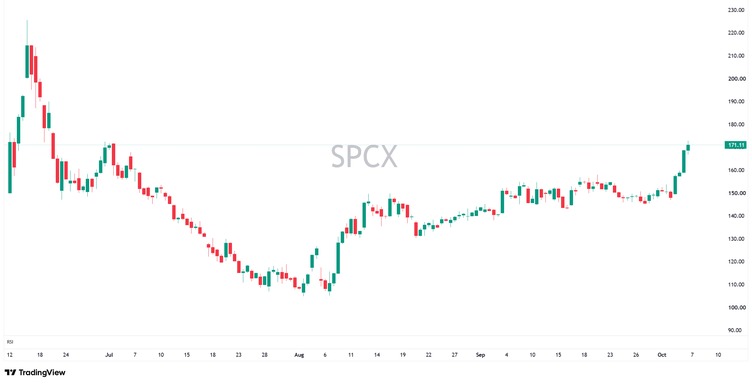
Source: TradingView
[Click to open in a new window]
Anthropic is reportedly eyeing a November listing at up to US$2 trillion.
OpenAI is reportedly leaning towards 2027, after advisers warned SpaceX’s slide could cool retail enthusiasm.
History shows that a flurry of big floats often appears near a market top.
In 1999, the average US float jumped about ~71% on its first day.
The Nasdaq peaked the following March, then lost close to 80%.
In 2021, more than ~1,000 US companies were listed, once you count SPACs, the blank-cheque shells built to buy private businesses.
The Nasdaq peaked that November.
Closer to home, the 1999 Telstra T2 sale priced shares at $7.40 for retail investors.
By 2006, they were trading at around $3.59.
People working on IPOs are paid to read the mood of capital markets.
When they sense a window closing, they hustle to get the biggest chunk of change in the door.
That window is getting tighter, with smart ring maker Oura postponing its US float last week.
Who’s on the other side of your trade?
Exit liquidity is a blunt term for a simple idea. When an early investor wants to cash out, they need a buyer, and that buyer is the exit liquidity.
In the good fun poker film Rounders, Matt Damon’s character reckons if you can’t spot the sucker in your first half hour, you’re the sucker.
Floats work the same way.
I’ve seen this play out many times in micro-cap land.
Without escrow, which locks up shares for a set period, a float often becomes a liquidity event for seed round and pre-IPO investors.
Wouldn’t you want the best possible price if your capital had spent years stuck in an illiquid company?
Broadly speaking, the same rules apply to Firmus, which does have some escrow in place.
According to the Australian Financial Review, about 42.4% of the company will be locked up on day one.
That leaves around 57.6% of the register free to sell straight away, including big backers like Blackstone, Nvidia and Coatue.
Firmus may well operate in the hottest corner of the market during a once-in-a-generation technology shift.
In my view, exit liquidity is still exit liquidity.
Unless you know why the major shareholders are on the register, assume they’d love to see retail whipped into a frenzy.
A frenzy gets them a better price on the way out.
Let someone else go first
I remain sceptical about how Firmus performs in the short term once it lists.
That comes purely from years of digging through ASX micro-cap share registers.
Big hedge fund, Plato Investment Management, says it will try to bet against the stock once it trades, a strategy known as short selling.
If you’re tempted, read the prospectus when it lands on 12 October.
Go straight to the fine print on escrow and debt, then check how reliant Firmus is on a handful of big customers.
In cricket, good Test batting openers spend the first few overs mostly leaving balls outside off stump.
They get their eye in before playing shots.
It makes sense.
So sometimes the best way to avoid becoming exit liquidity is to wait a few months for price discovery.
That’s the market working out what a stock is worth once it trades.
Anyone who waited six weeks on SpaceX could have bought in around 20% below the float price.
So maybe consider making your own call once the dust settles.
Warm regards,

Dr. Lachlann Tierney,
Australian Small-Cap Investigator and Fat Tail Microcaps





Comments