




Three letters kept the Cold War cold.
M.A.D. — Mutually Assured Destruction.
The logic was brutal but elegant: if either superpower fired its missiles, both nations would be annihilated. No winner. So nobody fired.
It was the most stabilising idea of the 20th century.
Now a different M.A.D. is deciding who rules the 21st.
Not mutually assured destruction…
Mutually assured demand.
Here’s the uncomfortable truth about the US–China conflict: both superpowers need the same things to win. Energy. Copper. Lithium. Rare earths. Antimony. Graphite. Tungsten. The raw ingredients of power itself.
Neither can stop buying them without destroying its own ambitions and ceding control to its rival.
Which means — no matter how ugly it gets or how high prices go — demand for those resources is assured. From both sides. At the same time.
I call it the M.A.D. Scramble.
If you own Australian resource stocks, this is why they’ll buy our commodities NO MATTER WHAT.
And it’s creating compelling trading opportunities in key niche areas for those who are positioned for it.
Don’t take my word for it. It’s already playing out. Three examples…
Proof #1: Antimony
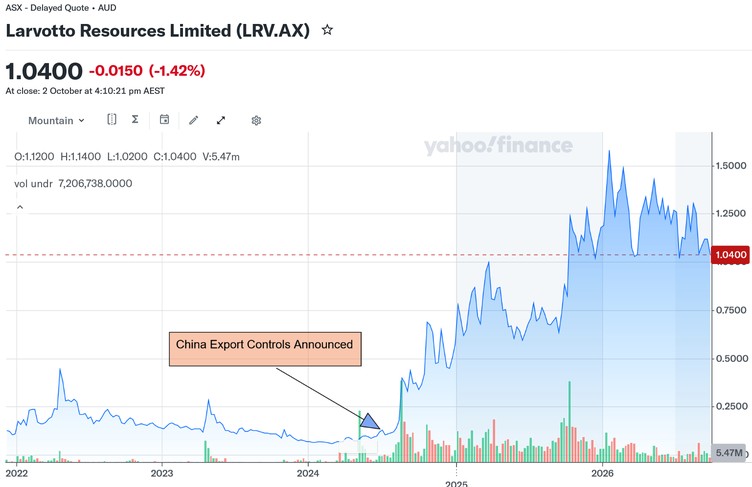
On 15 August 2024, China announced export controls on a little-known munitions metal: antimony. A metal the US barely produces — it imports the bulk of what it uses, with China the single biggest source.
Then, on 3 December 2024, Beijing went further — banning antimony exports to the US outright.
On the ASX, a tiny junior called Larvotto Resources [ASX: LRV] had been sitting on one of the biggest antimony resources outside China — Hillgrove, NSW — for years. They’d done the drilling. Completed the studies. Defined the resource. Nobody cared.
Then, BANG!
Larvotto doubled within days — and didn’t stop. It finished 2024 up a staggering 829%. A $10M duster became a $200M+ prospect in mere months.
Source: Yahoo Finance
[Click to open in a new window]
And today?
It’s in production — first gold-antimony concentrate out of Hillgrove just weeks ago.
Proof #2: Rare earths
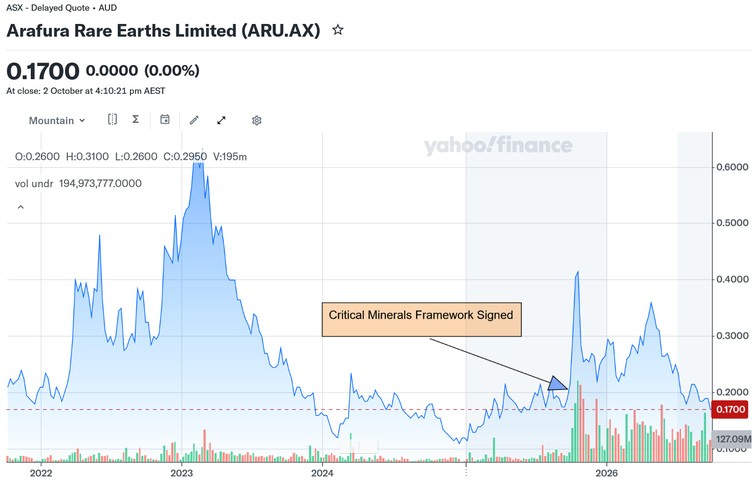
Fast forward to 20 October 2025. Trump and Albanese signed a critical minerals framework at the White House.
Arafura Rare Earths [ASX: ARU] — whose long-stalled Nolans project was going nowhere fast — was suddenly centre stage.
The stock jumped almost 30% in a day. Then Gina Rinehart’s Hancock Prospecting nearly doubled its stake, to 15.7%. The US Export-Import Bank is weighing $300 million of financing support.
A forgotten stock suddenly re-rated by geopolitics.
Source: Yahoo Finance
[Click to open in a new window]
You can see it has since given back those gains and is almost back to where it started.
There’s a reason for this, and in next week’s update, I’ll explain why it’s setting up for a stage two trading opportunity very soon. (In fact, a ‘one-two punch’ is the best way to play most junior mining stocks.)
But the point for today is that the China v US battle is very much alive in the rare earths space.
We’ve seen multiple deals over the past 12 months, as each side tries to lock up supply, including:
- USA Rare Earths $2.8 billion takeover of Brazil’s Serra Verde Group. The transaction locked in the only scaled producer of all four magnetic rare earths (Nd, Pr, Dy, Tb) outside Asia, significantly strengthening USAR’s integrated mine-to-magnet platform.
- China’s Shenghe completed its acquisition of Australian-listed Peak Rare Earths on 30 September 2025 via a scheme of arrangement. The deal secured full control of the high-grade Ngualla project in Tanzania, giving Shenghe long-term feedstock for its Chinese processing operations and further consolidating Beijing’s grip on emerging African supply.
- Energy Fuels (US) entered a binding agreement on 21 January 2026 to acquire Australian Strategic Materials and closed the transaction on 28 August 2026. The move added commercial-scale rare earth metal and alloy production (via ASM’s Korean Metals Plant) to Energy Fuels’ existing capabilities
It’s clear both sides are trying to one-up each other in rare earths.
But buying in blindly into any old rare earth stock isn’t the answer. You need a method to get in (and out) at the right time. More on that next week.
Proof #3: Tungsten
In February 2025, China imposed new export controls on tungsten and related rare metals (a “one-item, one-certificate” licensing regime). This came against a backdrop of earlier US tariffs – the tit for tat battle continues.
At the same time, China also increased imports of Western tungsten concentrates, interpreted by most as stockpiling while limiting outbound supply.
By mid-2025, the price of tungsten reacted HARD!
It rose from US$330 per tonne in July to $650 in November, to over US$900 by January.
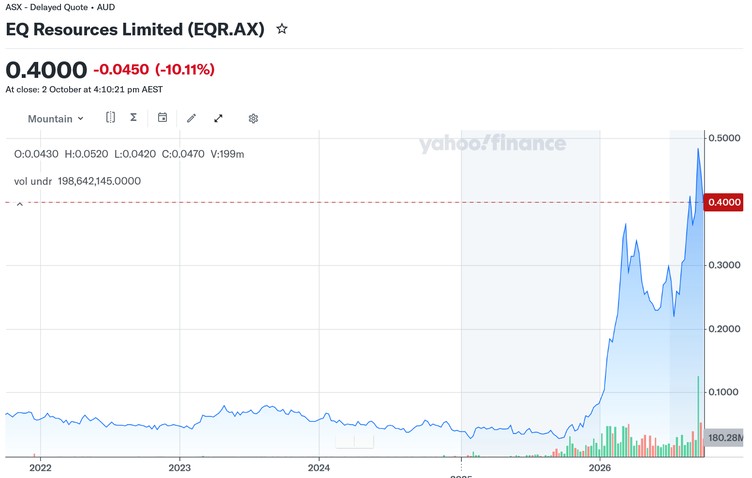
Little-known tungsten miner, EQ Resources [ASX:EQR] went ballistic.
Source: Yahoo Finance
[Click to open in a new window]
In early 2025, EQR was worth $125 million.
Today, it’s valued at over $2 billion, and Andrew ‘Twiggy’ Forrest is an investor (he holds a 16% stake).
The conclusion — and
two dates for your diary
Now, you might mistake these moves for news-driven pump-and-dumps (and we all know Trump doesn’t mind a bit of market manipulation every now and again!)
But those with keener eyes see something beneath the bluster: the M.A.D. Scramble in action. An incumbent superpower and a rising challenger, both bidding for the same finite ingredients of power.
Demand isn’t in question in this fight. It’s mutually assured.
And the next moves already have dates on them. Both in January 2027.
On 1 January, a 15% American tariff on refined copper is scheduled to kick in. As of a few weeks ago, the White House still hadn’t decided whether to pull the trigger. It’s sitting on Trump’s desk right now.
And on 10 January, the US–China truce — extended after Trump and Xi met in Washington just last week — runs out. If it lapses, China’s sweeping rare earth export controls snap straight back into force.
[Editor’s Note: That could be very interesting for Arafura]
Two deadlines. Two very different sets of winners. And two different ways to play them.
I’ll explore which is which next week — including a 160-year-old insight from a dead economist who predicted the fall of the last superpower that sat where America sits now.
But first, I want to hear from you.
What do you think will be the big winners in this environment? Copper? Rare earths? Antimony? Something else entirely? And are you already positioned or watching from the sidelines?
Tell me what you think at letters@fattail.com.au. I read every email and your answers will help shape where I take this next week.
Regards,

James Cooper,
Mining: Phase One and Diggers and Drillers



Comments