



You’d probably agree that the market doesn’t care about crypto right now.
But that’s exactly why you should.
Today, I’m going to show you why.
Starting with what Bitcoin did while bond yields climbed this year.
The older financial textbooks are pretty clear on this one.
When safe government bonds start paying more, investors are supposed to dump speculative assets and run for the comfort of that juicy yield.
And for most of its short life, Bitcoin has played along…
The casino chip
Over weeks and months, Bitcoin tends to trade like a tech stock on steroids.
When money is cheap and plentiful, it flies.
When money gets tight, it falls hard.
That’s the standard narrative, and June was a textbook case.
Investors pulled about US$4 billion out of US Bitcoin funds that month, the worst month since those funds launched in 2024.
By the end of June, Bitcoin had slumped below US$60,000, less than half its October 2025 peak.
That’s the casino chip side of Bitcoin. Volatility is part of the furniture.
So far, very predictable.
Then the textbook went out the window
Between early July and early October, Bitcoin climbed by almost half, from around US$58,000 to around US$86,000.
And it did that while US bond yields were marching towards their highest level since 2002.
According to the textbook, that’s completely back to front.
The real fireworks came in late August.
US government debt passed US$40 trillion, and the US Treasury said it would double the size of its bond buybacks to help steady the bond market.
Bitcoin jumped 22% in a single week.
CNBC called it the return of the “debasement trade”.
I covered this here as well.
Debasement is a fancy word for your money losing its buying power over time, usually because governments keep borrowing and creating more of it.
Turns out, some very serious money was paying attention too.
That same week, Bloomberg ran this headline:
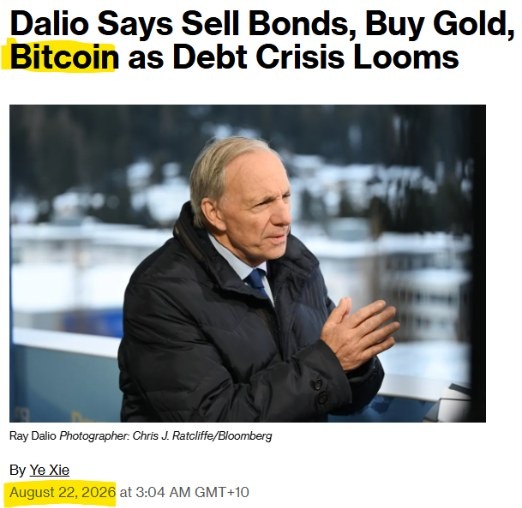
Source: Bloomberg
Ray Dalio founded the world’s biggest hedge fund and has been a gold man for most of his career.
He’s about as far from a crypto cowboy as you can get.
Oh lord, do I despise his cynical approach to markets.
A strategy where he positions months ahead of announcing a certain asset or sector of the market is a “good idea”.
He’s a cunning, serpentine operator alright.
He probably only speaks parseltongue.
But putting aside my personal disdain, two months ago he told investors to hold roughly 10% to 15% in gold, plus “a bit of Bitcoin”.
You bet he’s always positioning well ahead of any public pronouncements.
But gosh darn it! He’s powerful, he’s got a lot of money, and just like the rest of the Wall Street gang (Jamie Dimon too)…he’s damn good at making money.
So here’s why Dalio’s moving lips in August were so intriguing to me…
Bitcoin’s fling with gold
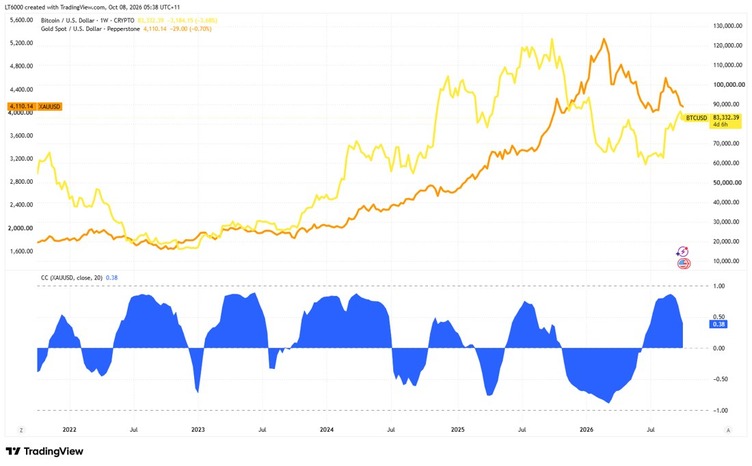
Here’s a key chart.
It tracks Bitcoin against gold, the oldest hedge against money printing there is.
Below, in orange, is gold’s spot price, while in yellow you’ve got Bitcoin.
In blue, you can see their correlation coefficient — a fancy way to say how much they move together.
Source: TradingView
[Click to open in a new window]
At +1 at the top of the blue wave, the two move in lockstep, and at -1, they move opposite ways.
In early 2026, Bitcoin and gold were moving almost perfectly opposite ways. By August, they were moving almost in lockstep.
Bitwise, a crypto fund manager, reckons the link between the two hit its strongest level in almost six years.
The score has eased back to about 0.4 since.
So for now, I’d call it a fling.
Whether it gets serious is one of the big questions for 2027.
Two clocks
So which is it? Casino chip or digital gold?
Risk asset or hedge or…both, that’s the riddle.
It’s certainly not neither. Bitcoin is worth upwards of US$1.5TN so fake and scam just don’t hit right anymore.
I think it’s both. Bitcoin is a little Janus-faced.
Janus was the Roman god of doorways, with one face looking forward and one looking back.
Which face you see in Bitcoin depends on how long you’re holding it.
Here’s the simplest way I know to picture it for readers of my crypto advisory service:

Source: Lachlann Tierney
On the short clock, Bitcoin trades as a risk asset.
It tends to do well when interest rates fall, and money is easy.
On the long clock, I think it works as a hedge against debasement.
That clock ticks to a slower, more inexorable rhythm: governments creating money to keep up with their debts.
Think of it like Melbourne’s weather versus its climate.
Day to day, you can get four seasons, but it’s the climate that tells you what to plan for.
And two weeks ago, I told you a crash WILL happen, and that the bailout that follows tends to send commodities flying.
That bailout logic runs straight through Bitcoin too.
In a crash, I’d expect the short clock to strike first and Bitcoin to fall with everything else.
Then, if the bailout comes and the money printers fire up again, the long clock could take over.
Tick, tock…the time to invest
is finite much like BTC
The hedge-against-debasement aspect of BTC comes down to one simple feature.
There will only ever be 21 million Bitcoin.
That’s fewer than one for every person in Australia. And more than 95% of them have already been created.
Every four years or so, the flow of new coins to reach that 21 million gets cut in half. No central bank or government can vote to change that.
Australians already get this in their bones.
It’s the same logic behind that old property line about land: they’re not making any more of it.
Of course, Bitcoin is still a highly speculative asset.
It more than halved between October 2025 and June, and it’s slipped back to around US$83,000 this week, a reminder of how quickly the short clock can take over.
It will test your stomach again.
And as always, only ever put in money you can afford to lose.
But my gosh, if there’s ever a time to consider what crypto means, it’s now.
Right as the global money printing machine threatens to go into overdrive.
Right when stress is building in the plumbing of our debt-based financial order.
Something special this weekend
With this in mind, I want to tell you about a very special, very quirky, wickedly smart person I work with.
In April 2013, a former hedge fund manager told one of his readers a bitcoin was worth $0.
Within weeks, he’d changed his mind so completely that he was offering his new book for Bitcoin before it even hit Amazon.
On Friday, my publisher James Woodburn will tell you who that man is, and why he believes the same forces are lining up again.
It all comes down to four letters.
There’ll also be a special offer for Fat Tail Daily readers this weekend, so keep an eye on your inbox.
In the meantime, watch both clocks.
The textbooks, it seems, are overdue for a rewrite.
Warm regards,
Dr. Lachlann Tierney,
Australian Small-Cap Investigator and Fat Tail Microcaps





Comments