



The ASX 200 is clawing back ground on Wall Street.
Take a look at this one-year chart:

Source: TradingView
[Click to open in a new window]
The S&P 500 is up ~10% over the year, while the ASX 200 is up ~3.32%.
That gap was much wider a month ago, and the highlighted patch shows how fast it has narrowed in November.
The US has plenty to digest right now.
As I wrote earlier this week, Nvidia’s board is investigating its own CEO over his relationship with a suspected Chinese intelligence asset.
Nvidia makes up nearly 7% of the S&P 500, and it reports quarterly earnings next week.
Then there are the political ructions.
Democrats won both chambers of Congress in last week’s midterms, setting up two years of divided government with Donald Trump from January.
The ASX has very little direct exposure to Nvidia.
For now, our dull mix of banks and miners is working in its favour.
A quiet win for ASX miners in America
On Monday US time, the Senate voted 73 to 25 to open debate on the Bipartisan American Affordability and Jobs Act of 2026.
It’s a 494-page overhaul of how the US approves new projects, and it was only introduced on 30 September.
For miners, one key part is highly relevant.
Anyone challenging a project’s environmental approval in court would have 150 days to file, down from a default of six years under current law.
In the US, the lawsuit often arrives after the permit.
A shorter window would shrink one of the biggest risks facing ASX companies funding mines in states like Nevada, Arizona and Wyoming.
There are hurdles left.
The bill needs a final Senate vote and a House vote before the new Congress arrives in January.
If it gets through, I think ASX miners with American projects could find raising money a lot easier.
Remarkable! The two parties can actually work together (for now).
Back home, the numbers are grim
Here in Australia, I doubt the broader index (including a swathe of small-caps) can keep this catch-up going for long.
The Australian Financial Review ran some sobering numbers this week.
Real wages, which means your pay after inflation, have fallen back to where they were in 2011:
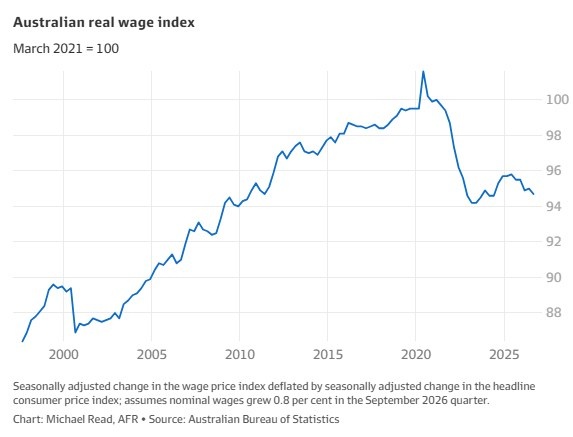
Source: Australian Financial Review
[Click to open in a new window]
Real wages are down almost 5.5% since March 2021.
Deloitte Access Economics expects them to stay below pre-pandemic levels until 2034.
Really, only 8 years to wait?
We’ll likely, and quite literally, have robots walking around on Mars by then.
Add five rate hikes this year, taking the cash rate to 4.85%.
Then add bracket creep from taxes, which research from the e61 Institute and UNSW says will eat at least 28% of real income gains by 2035.
That’s a problem for small caps.
Many small and micro-caps run on retail money.
When households have spare cash after the mortgage and the grocery bill, some of it finds its way into riskier companies.
When that spare cash dries up, so does the buying.
I expect the squeeze to weigh on the smaller end of the market until we get closer to the next federal election, which must be held by September 2028.
It’s not all bad news, and the market never moves in a straight line, but I’m feeling a bit dour.
Which means a change of approach is necessary.
Why I’m hunting for “defensive” small caps
So I’m looking for defensive small caps.
Yes, I know that sounds like a paradox.
What I mean is smaller companies that carry themselves like large caps.
Here’s what I want to see:
- Cash in the bank and little or no debt
- Cash flow that covers the bills without constant capital raisings
- Disciplined management teams who own a meaningful stake in the business
- A habit of returning capital to shareholders through divvies or buy backs
These companies also carry far less bureaucracy than many in the ASX 200.
That matters, because plenty of ASX 200 companies deliver returns largely through passive and mandated buying.
Index ETFs and super funds have to own them, and employers pay 12% on top of most Australians’ wages straight into super.
Australians held AU$4.77 trillion in super at 30 June, according to APRA.
A big chunk of that money ends up in our largest companies whether they’ve earned it or not.
That’s how a sclerotic company with a big market cap can coast for years.
I’d rather back smaller outfits that have to earn their share price the hard way.
The ASX’s catch-up run could have a bit further to go while the US works through its Nvidia problem.
I’ll be using the strength to take some profits more quickly and tighten up on quality.
More on what that looks like next time.
Hint: it hinges on a strategy defined by one of Wall St most powerful quant fund operators.
Warm regards,
Dr. Lachlann Tierney,
Australian Small-Cap Investigator and Fat Tail Microcaps





Comments