



“But lo! men have become the tools of their tools.”
— Henry David Thoreau, Walden (1854)
In automation theory, there’s something called a centaur.
Picture the Greek mythical creature: half-man, half-horse. Though here, the horse part is the strong, tireless body of a machine.
Think of a software engineer writing code with AI help, or a writer using autocomplete.
Throughout history, we’ve built tools that move us in this direction — technology that augments our labour, lifting output or freeing us for loftier pursuits.
But our latest wave of AI tools may be flipping that relationship. The machine sets the pace. The human does the running.
That’s the critique by author and renowned tech critic Cory Doctorow in ‘The Reverse Centaur’s Guide to Life After AI’.
|
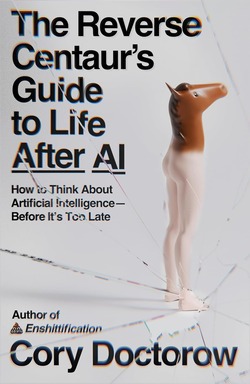
In it, he asks not just what the technology does, but who it serves — and who ends up serving it.
And he thinks we’ve got it all backwards.
Cory sees reverse centaurs forming from AI — people pushed by technology to work at an inhuman pace.
Think of an Amazon warehouse worker struggling for a bathroom break while systems push them to scan faster.
Or a radiologist facing steadily rising caseloads as automation makes it possible to process more scans.
Calling a highly trained radiologist the ‘legs’ of a machine may sound absurd.
But the metaphor extends to what economist Dan Davies calls ‘accountability sinks’ for AI.
A description that’s analogous to how a heat sink takes up unwanted heat from a system. As one medical study warned, ‘human clinicians risk being used as a tool to absorb liability while also being disenfranchised from the decision-making process.’
A Melbourne study found that between 2009 and 2022, the number of image slices radiologists ‘scanned’ per month increased by 399%. Almost all of that is due to automation.
Now there are clear benefits to this. If AI helps diagnose more patients, or spots a solid-mass tumour that might otherwise have been missed, that’s plainly valuable.
The risk is that skilled professionals gradually become little more than the green tick beside an AI decision. Formally responsible, but increasingly removed from the reasoning behind it.
This problem becomes acute when we think about the generation of radiologists that comes next.
You might reasonably say, ‘Well then, we just have fewer radiologists; the point is to find cancer, not pay workers’.
The Achilles’ heel of this ‘humans in the loop’ way of working is a phenomenon called automation blindness.
That is, the way our brains work makes it incredibly difficult to remain vigilant for things that rarely occur.
So a future of work where we become AI’s rubber-stamp is one where services get worse long before they get better.
This goes back to the challenges I highlighted in the article Mind the Gap.
Namely, where AI fits into society and our concept of work.
Douglas Adams from The Hitchhiker’s Guide to the Galaxy fame had a great way to describe our relationship to technology. He called it the three rules:
- Anything here when you’re born: Feels ordinary — simply how the world works
- Invented when you’re 15–35: Feels thrilling and full of possibilities — career worthy
- Invented after you’re 35: Is against the natural order — violates how we work
Perhaps for us sitting in that third group, our discomfort is simply generational. But that doesn’t make every concern imaginary.
What’s Next
This month, AI anxiety has arrived alongside a fresh wave of AI product launches.
The biggest of which has been AI agents or ‘Agentic AI’ tools marketed as your personal assistant.
This week, OpenAI unveiled ‘Dots’, its fuzzy new AI agent. Dots joins the ranks of Meta’s Muse in ensuring that you associate help with a cute teddy bear rather than a cold machine.
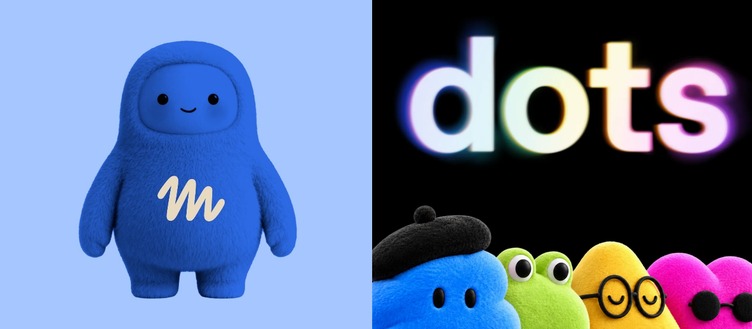
Source: Meta Muse and OpenAI Dots
‘What can I take off your plate?’ is the first question Meta’s Muse asked in its tech demo earlier this month.
A demo that saw Meta’s share price jump by ~11.5% on the day. A jump that’s the equivalent of adding the value of McDonald’s or Commonwealth Bank to its market cap.
Within that mammoth jump is the shared vision of investors imagining a different kind of digital commerce. One where your powers of delegation will be put to the test.
‘Give Muse a goal — like running your business or finding new customers — and it gets it done’, promised Meta in a post earlier this week.
Yet it’s not the first time we’ve seen these agents in action, or promised to a wider audience. In tech industries, folks have been running agents for years.
In this February snapshot, it’s probably no surprise that around half of all agent use was by software engineers.
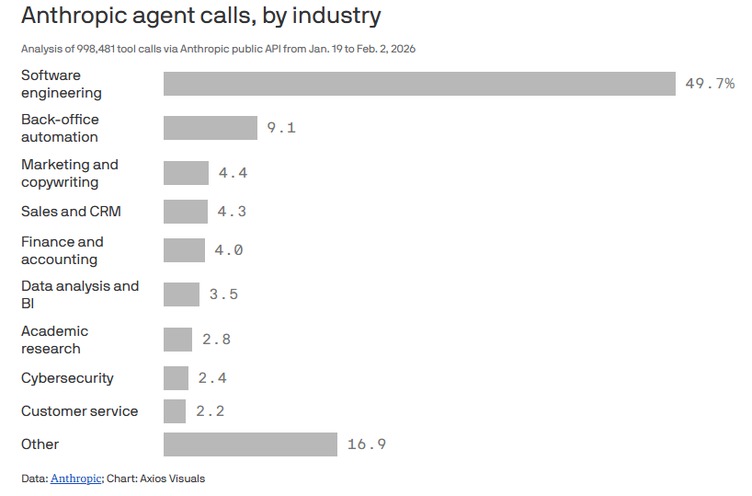
Source: Axios
[Click to open in a new window]
All I can say is watch this space. In a few months’ time, I’ll revisit to see how far these agents have spread beyond software engineering.
But I’ll also be looking to see who gets the time they save.
Who gets to be the head and who becomes the legs?
A centaur and a reverse centaur can run on the same technology. The difference may be down to who’s giving the orders.
Regards,

Charlie Ormond,
ATLAS and Altucher’s Investment Network Australia




Comments