




It’s only been a few weeks since the US national debt surpassed US$40 trillion. It broke past US$30 trillion in January 2022, helped by the massive stimulus provided by the government during the Wuhan virus outbreak.
Those keeping track of this will note that in the last twenty years, the US national debt grew 3.7 times the amount accumulated in the first 230 years of the republic. Other countries follow a similar trend, at different paces.
What’s more concerning is that the prices of nearly everything have risen sharply in recent years. Since the subprime crisis, the cost of living has become less affordable for ordinary individuals as governments racked up massive amounts of debt to bail out financial institutions, make welfare payments, and stimulate their economies.
This has strengthened the case for supporters of gold, Bitcoin, and other monetary alternatives, who claim that the petrodollar system will collapse soon under the weight of debt. The rising prices of these alternatives against the US dollar and other global currencies is proof that fiat currencies are dying a slow death.
In addition to the rise of alternative currencies, many countries have been diversifying their reserves away from the US dollar into other currencies, gold, and other instruments. De-dollarisation is happening.
With both developments becoming more evident over the last five years, a global financial reset and monetary alternatives are no longer a fringe theory supported by outsiders. Central banks and financial institutions have increasingly bought gold and other foreign currencies to manage their risks and exposures.
Everything seems to be falling into place for the global reset that was once a fascinating case study or simulation. So why is the monetary system not collapsing?
The road to de-dollarisation –
How far have we gone?
Since 1971, currencies worldwide have decoupled from gold. Their purchasing power gradually eroded away, in an accelerating pace in the last fifteen years.
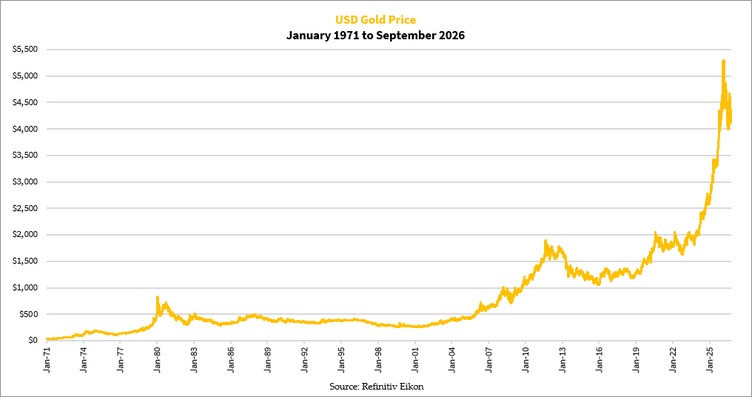
The easiest way to see this is in the price of gold. Here’s gold in US dollar terms since 1971:
[Click to open in a new window]
You can see how the price of gold increased at an accelerating pace since 2019, even going parabolic from March 2024. It’s worth noting that gold can be overvalued relative to the dollar, as we saw in 1980, 2011, and possibly earlier this year. Until the flash crash in gold and silver in late January, it seemed like there was no end to gold’s ascent.
The rise in the price of gold usually stems from excess currency supply, which may result from low interest rates, excessive government borrowing and spending, or a currency collapse. Central banks and financial institutions may respond by buying gold, other foreign currency reserves, and real assets to protect their balance sheets. Indeed, central bank gold buying has been substantial with over 1,000 tonnes of gold purchased every year from 2022-24 and 850 tonnes last year. This has fuelled gold’s rise as there is increasing public awareness about gold, causing others to do the same.
In recent years, some countries have reduced their US dollar reserves and replaced them with gold, euros, and other national currencies. The European Central Bank reported last year that its official reserves held more gold (at 27%) than US Treasury securities (22%) for the first time.
De-dollarisation is an increasing trend in some places.
Extrapolating de-dollarisation to dollar collapse – Exploring the fallacies
At this point, it’s tempting to infer that the trends in gold and countries selling their US dollar reserves equate to its imminent collapse. The rising US national debt and unfunded liabilities help fuel this inference because one may imply that the US government is unable to pay back its debt.
However, let’s unpack the fallacies with this conjecture. But before I do, I must admit that I once rode this train and publicly advocated for the dollar collapsing and gold surging to stratospheric levels. Therefore, I’m not writing this from a high horse, but a reformed observer.
Let’s start with the national debt rising above US$40 trillion. This figure is indeed astronomical and difficult for us to fathom. Some people use this figure as the sole basis for why the US government must collapse, and the dollar with it.
This is an oversimplified argument. And it is still oversimplified even if one lays out the categories for which government debt is ballooning.
Keep in mind that the US has a population of over 340 million, making it the third most populous country on Earth. It’s also one of the wealthiest and most productive, meaning it has the capacity to support such a large national debt.
Given this, a more suitable approach for studying its financial position is to consider the other side of the equation: national income. We can use the Gross Domestic Product (GDP) to represent this.
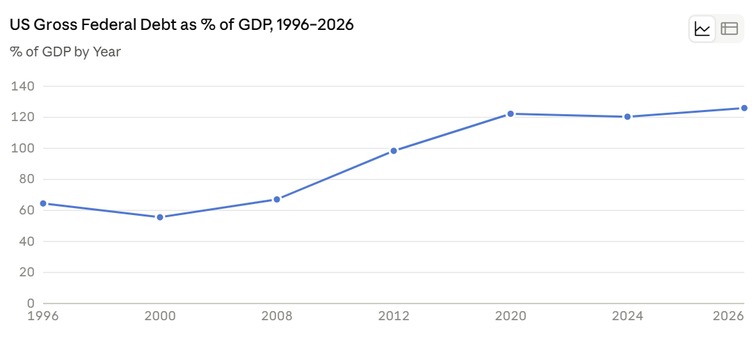
Let’s compare the country’s debt and income using the Debt to GDP ratio and track it over time. The figure below shows this ratio over the last 30 years:
Source: FRED
[Click to open in a new window]
Note that the ratio has nearly doubled over the last thirty years from 64.5% in 1996 to 126% now. The US government is indeed in a weaker position than it had been historically. However, over the last six years, this ratio has remained steady, despite massive stimulus from the Wuhan virus outbreak, funding for Ukraine in the Russia-Ukraine conflict, and the latest conflict with Iran.
The trend we saw in the last thirty years isn’t the first time for the US. During World War 2, the Debt to GDP ratio jumped from 32% to 106%. Rather than collapsing, the US dollar strengthened after the Bretton Woods Agreement in 1944 put it on equal footing with gold.
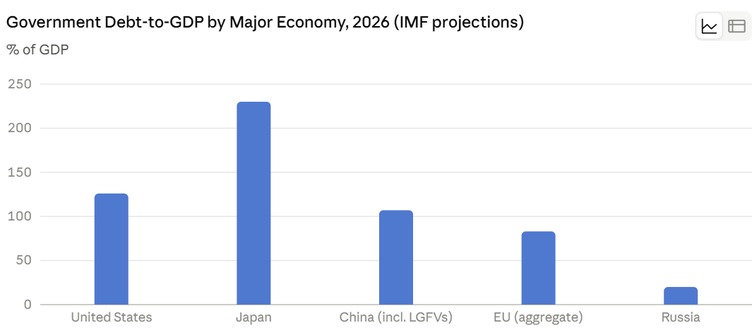
Besides the trend, the current level of the Debt to GDP ratio may be concerning, but not disastrous. Let’s compare the US against the European Union, China, Japan, and Russia:
Source: IMF
[Click to open in a new window]
You may notice that Japan’s Debt to GDP ratio is well above that of the other countries at 230%. This has been the case for the country for over three decades since the Lost Decade in the 1990s. The economy has faced much pressure from deflation, but not implode. Part of this is driven by a high proportion of domestic ownership of the national debt, the country’s trade position, financial institution and investor behaviour, etc. Yet no one has called for the collapse of the Japanese yen, even though Japan has modest gold reserves and chooses not to buy more.
Russia, on the other hand, has a much lower ratio at around 20%. However, the notion that the ruble should replace the US dollar is inconceivable because the Russian economy is much smaller and the ruble is used rarely as a global currency.
Some may use the Debt to GDP ratio argument to suggest that the US economy could collapse if it continues to rise relative other major economies. In this case, they may consider the euro and the Chinese yuan as suitable alternatives. These don’t seem too far-fetched especially when one brings into the equation their gold holdings (China’s hidden gold reserves).
But this is not what decides a reserve currency.
A reserve currency requires widespread acceptance by other nations as a means of exchange. The issuer must have the trust, or through compulsion of force, of other participants. It would also require the nation to have a large economy capable of absorbing the currency supply. The European Union has become increasingly unstable since the subprime crisis, and has been weakened further by the energy crisis after the outbreak of the Russia-Ukraine conflict. Meanwhile, the Chinese regime has increasingly imposed capital controls while its property bust is fuelling a deep recession in its domestic economy. For these reasons, neither is a plausible candidate to replace the US dollar. They may both de-dollarise to reduce their exposure, but do not present themselves as an alternative.
The Iranian conflict plot twist
Until recently, there was a belief that the US campaign against Iran would result in it drawing into a quagmire from which it cannot escape. This provided more fuel to suggest that the US national debt would spiral, trust in the US would collapse and therefore the dollar would follow.
However, since the start of the week, there have been reports suggesting that Iran’s leverage on the Strait of Hormuz has sharply decreased. Traffic through the Strait has partly recovered, along with oil flows. This is despite the Iranian regime stepping up its attacks against vessels sailing through.
At this stage, the Middle East oil production has recovered to around two-thirds of pre-war levels, even as the Saudi East-West pipeline suffered damage a fortnight ago and the Houthis increased their control at the Bab el-Mandeb. The troubles on the global oil supply aren’t over yet but the endgame is beginning to become clearer.
The US is now the world’s largest oil producer, a position further bolstered by bringing Venezuela under its influence earlier this year. It currently produces 13.9 million barrels per day, or one-sixth of the world’s production. It is 50% more than Saudi Arabia and Russia, respectively at 9 million barrels each.
The dynamics of the petrodollar system are also changing. In the past, OPEC (and OPEC Plus) drove supply and the price of oil. However, their influence is waning as the US increased oil production and the United Arab Emirates withdrew from OPEC on 1st May.
What we’re seeing is that the petrodollar is receiving a time extension, rather than a decline. This is because the oil supply falling under the petrodollar system is increasing. Demand for the US dollar to trade in oil and other goods and services should prevail.
Gold is the long game strategy,
not a one-shot wonder
The current developments suggest that while the US national debt continues to rise, its economy isn’t weakening. Moreover, the petrodollar may undergo a temporary revival, once resolution of some form is made between the US and Iran.
I don’t believe this means the petrodollar system has stopped crumbling. Human nature will inevitably unravel a debt-based system. However, those who are waiting for the dollar to collapse may not see it play out at this stage.
As for gold, when will it soar above US$10,000 an ounce?
This is something I can’t answer. However, I can provide an opinion on what would cause it to head higher.
Consider the last 30 months when gold started rallying. What sparked this was the US Federal Reserve’s commitment to cutting interest rates. The vast amount of US dollars poured into risk assets, driving inflation and sending gold and other assets higher.
We may not be far from that happening again. The causes may be different to before but the mechanism is similar. The Federal Reserve raised interest rates two weeks ago. But some members of the Federal Open Market Committee see rate cuts next year, despite the committee’s unanimous agreement to raise rates now.
That’s because some perceived the current oil price spike as a temporary shock that will subside next year, allowing for more accommodative monetary conditions to facilitate economic growth.
Just because the national debt continues to rise, this doesn’t mean an imminent economic collapse. The economy can sustain itself if it supports higher production, with business activity focused on that rather than financial speculation.
Gold may or may not set a new record by the end of 2026, or even in 2027. However, its case hasn’t diminished even if the US dollar doesn’t crash. It’s worth playing the long game, as a monetary system driven by debt and wishful thinking eventually succumbs to human nature.
If you want to learn more about building a precious metals portfolio to navigate the gold price cycle, I have a presentation to guide you. Besides buying bullion, you’ll learn about how to use ETFs and different types of gold and silver stocks to protect your purchasing power and build wealth over the long term. You’ll also become more familiar with the gold price cycle and discern between the hype and reality in financial news reports.
Please click here to find out more.
That’s it from me for this week. I hope you enjoy the weekend ahead!
God Bless,

Brian Chu,
Gold Stock Pro and The Australian Gold Report




Comments