



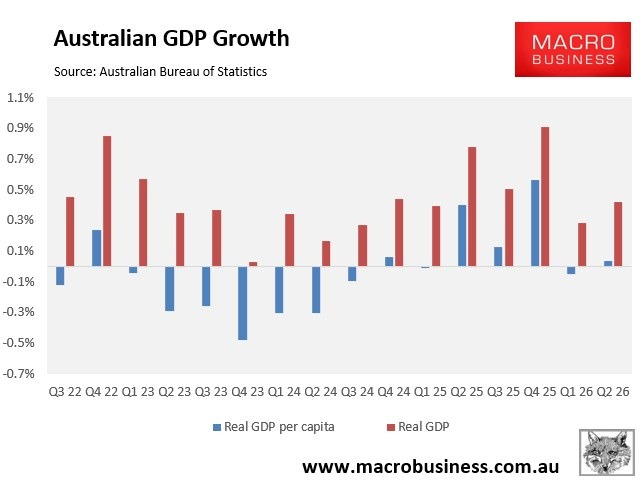
Australia’s economy grew 0.4% in the June quarter.
That sounds sort of fine until you divide it by the number of people sharing it.
Real GDP per capita measures economic output per person, after stripping out inflation. It shrank 0.1% in the March quarter and flatlined in June.
Source: MacroBusiness
[Click to open in a new window]
Two quarterly falls in a row add up to a per capita recession.
By my count, output per person has gone backwards in ten of the past 16 quarters.
In the age of AI, that is a truly staggering level of economic stagnation.
Picture a backyard barbecue where the host keeps adding snags, but the guest list grows faster.
Everyone walks away with a smaller plate.
Another per capita recession now looks one bad quarter away.
A warning light flickers in the US
Over in America, the picture looks very different.
The Atlanta Fed’s GDPNow tracker tips US growth at an annualised 5.0% for the September quarter.
Annualised means the pace the economy would hit if that quarter’s growth rate carried on for a full year.
For a big, developed economy like the US, 5% is a bona fide sprint.
Yet the US bond market has started to whisper the word recession as well.
Here’s how it works…
Lock your savings in a term deposit, and the bank usually pays a higher rate for five years than for six months.
Government bonds work the same way, so longer bonds normally pay more.
Plot those rates on a chart, from shortest to longest, and you get what economists call the yield curve.
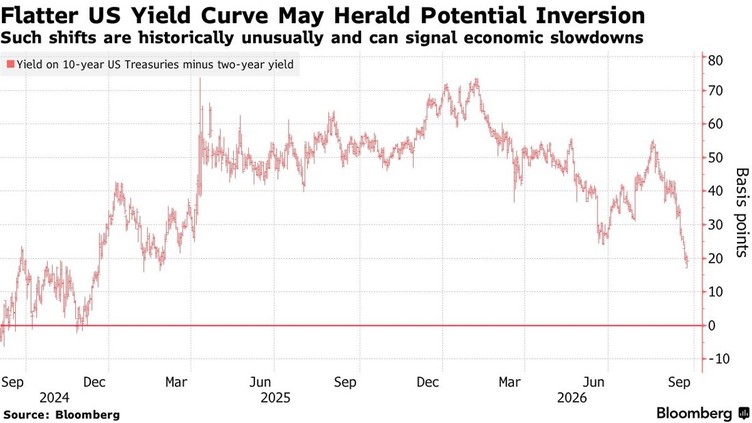
The gap between the US 10-year and two-year government bond yields shrank to just 0.17 percentage points last week.
That’s the slimmest gap since early 2025.
Source: Bloomberg
[Click to open in a new window]
When short bonds start paying more than long bonds, the curve inverts.
A dark omen on the horizon…
That inversion has happened before each of the last eight US recessions, going back to the 1960s.
Under new Chair Kevin Warsh, the Fed lifted rates this month for the first time in three years.
Bond investors worry it could keep going until the economy stalls.
The curve gave a false alarm earlier this decade, however.
But at least the Americans got the stock market party before the hangover.
Iceland rates, Puerto Rico inflation
Australia skipped the party and went straight to the headache.
By the time you are reading this, the RBA has likely lifted the cash rate to 4.6% this week, a 15-year high.
Recent data from the International Monetary Fund shows that only Iceland has a higher central bank rate among advanced economies.
Our inflation looks just as exotic/toxic.
Underlying inflation, which strips out the wildest price swings each quarter, is running at 3.6%.
Only three of the IMF’s 41 advanced economies record higher underlying inflation.
One of them is Puerto Rico.
So we now have interest rates like Iceland and inflation like Puerto Rico.
Canberra’s spending habit
Treasurer Jim Chalmers blames conflict in the Middle East for much of our inflation problem.
The budget papers tell a different story.
Federal spending hit 26.9% of GDP last financial year, according to the final budget outcome.
Outside the pandemic, that’s the highest level in almost four decades.
The states, like Victoria in particular, have also got a heap of money snags on the cash barbeque.
No wonder prices keep rising.
So the RBA then has to lean harder on everyone with a mortgage or a business loan.
RBA Governor Michele Bullock has already flagged that unemployment may need to rise from 4.6% to as high as 5%.
In plain English, the RBA looks ready to accept a slowdown to fix a problem Canberra helped create.
Paul Keating once called the early 1990s slump “the recession we had to have“.
This one looks more like the recession Canberra chose for us.
Preparing for rough weather
I reckon we’re about to face an economic storm entirely of our own making.
Years of profligate government spending have kept inflation stubborn and rates high, while output per person has gone nowhere.
So I’m now thinking hard about how to position readers of my paid advisory service, Australian Small-Cap Investigator, to weather it.
Some corners of the market could hold up far better than others if conditions turn rough.
I’ll have more on where I’m looking soon.
Warm regards,

Dr. Lachlann Tierney,
Australian Small-Cap Investigator and Fat Tail Microcaps





Comments