



“The tendency of mechanical progress is to make your environment safe and soft; and yet you are striving to keep yourself brave and hard…So in the last analysis the champion of progress is also the champion of anachronisms.”
― George Orwell, The Road to Wigan Pier
I want to look at AI in the workforce from a historical perspective.
As someone far wiser once said, ‘to look forward, sometimes we must look back’.
And so, I want to start with George Orwell.
When people reach for George Orwell, it’s often to draw on his novel 1984 to rail against some authoritarian condition.
But the origins of those thoughts came from a lesser-known book of his that recently caught my attention. The Road to Wigan Pier is a first-hand account of England’s industrial North, based on his travels there in 1936.
A ‘Pier’ makes us think of a sunny seaside town and breezy conditions.
Instead, we’re met with Orwell’s dreary depiction of ‘slag-heap infested hills and belching chimneys’.
Oldham, Manchester 1936

Source: BritanfromAbove.org
Amidst these polluted lands, Wigan’s Pier is a coal-loading jetty. Just another industrial tool.
The book’s main meditation is on the impoverished conditions of workers and their relationship to class and machine.

Source: Blackstone Publishing
It’s a reflection that leaves even Orwell dismayed. If the machine’s purpose is to eliminate work — he worries — then pursued to its conclusion, might it eliminate the good that work develops in us?
Skill, courage, endurance. Effort and striving are central to Orwell’s idea of humanity.
He muses that the logical endpoint of mechanical progress is to reduce a person to ‘something resembling a brain in a bottle’.
Oh, how he’d spin in his grave today.
Yet he accepted that machines were here to stay. One should accept the machine, he argued, ‘like one accepts a drug: warily, suspiciously, and knowing it carries cost’.
Ninety years after that journey, our questions are again about humanity, work, and machine.
The North’s ‘dark satanic mills’ are now long atrophied. The struggles are now borne by the towns left behind in this new economy. And that brain in a bottle, AI, now dominates headlines.
There’s plenty to debate about where this ends. But before we get there, we need to pass through a period that complicates every technological revolution.
The lag.
The space between inventing a technology and its effects flowing through to our lives and economy.
A time of tumult. A time of change that, today for me, feels as sharp as almost anything since 9/11.
For investors, these periods often carry a cost. The Canal bubble. The Railway Bubble. The Dotcom.
We can imagine what AI might eventually do for us. The harder question is how much we should pay for profits that depend on businesses changing how they work.
Because the bills for this revolution are arriving.
The Spending Clock
In July, Alphabet (Google’s parent company) raised its planned capital expenditure for 2026 to US$195–205 billion. The vast majority of that is dedicated to expanding its AI power.
The scale is extraordinary. Below is the infrastructure buildout compared to prior cycles.
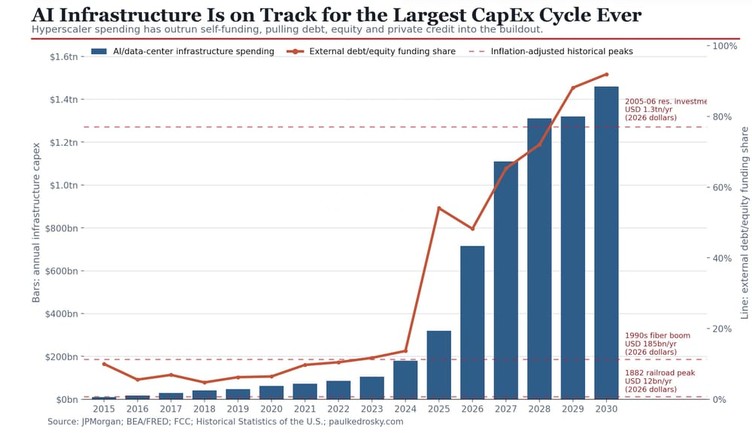
Source: Edward Conard
[Click to open in a new window]
The hyperscalers would argue that demand is already there to warrant this spending. However, I’m not the first to highlight just how circular this AI economy has become.
For example, roughly 70% of Microsoft’s contracted backlog comes directly from OpenAI.
Even the companies writing the cheques acknowledge a gap between paying for capacity and earning revenue from it.
Then comes another gap: whether customers buying that computing power can earn enough from their own customers to justify it. This has been a big part of recent concerns, though I don’t want to sound like it’s all one direction.
On Monday, Meta added US$194 billion to its market cap after launching Meta Muse — its latest personal AI assistant. That’s more than Disney or McDonald’s added to its value in a single day.
We’ll see if it stands as a real game-changer. As Wired’s senior reporter put it, ‘Meta Muse is better at surveilling than helping me’.
So, with the AI payback question hanging over the market, it’s been ‘pick and shovel’ plays that have held investors’ attention.
Chipmakers like Nvidia that can book a sale long before an office using that chip has figured out how to work differently or gain value.
But follow the money far enough, and someone eventually needs a useful result worth paying for.
A Good Invention at the Wrong Price
This is where I think the AI debate risks becoming too binary.
One side sees a technology capable of changing almost everything. The other sees enormous spending and wonders where the returns are.
Both concerns can be reasonable.
A company can sell something useful and still disappoint shareholders if its price assumes profits will arrive faster than they actually do.
Meanwhile, the bills keep accumulating. On paper, these hyperscalers are as profitable as ever. But capex doesn’t hit the income statement upfront — it hits cash.
And free cash flow (FCF) is where the strain is showing. Now moving into negatives for the hyperscalers as billions pour into chips, data centres, and power.

Source: BofA Global Research
[Click to open in a new window]
The scale of spending has now seen the AI buildout reach for the bond market, with corporate borrowing at levels that distort government bonds.
All of this puts them on a timer to find returns.
Mind the Gap
So what actually closes the gap between all this spending and the promised return?
A better AI model helps. Cheaper computing helps. But neither tells us how quickly a business can change around them.
That question troubled economists during the computer revolution too.
As Robert Solow famously observed in 1987:
‘You can see the computer age everywhere but in the productivity statistics.’
Businesses had spent billions on computers. But the expected returns and productivity surge remained elusive until the mid-90s.
That was over twenty years after the first computer that fit on a desk.

Source: Zotac.me
So a Stanford economist went looking for an explanation for this paradox. And his watershed paper in the 90s gave a better description of the problem than anything I’ve read.
His answer took him back to electricity.
And it brings us back to Orwell’s workers. Their skills, habits and working lives that sit inside those arrangements.
Next time, we’ll follow that economist’s journey into those old factories and look at what finally unlocked electricity’s gains. There’s a good chance you’ll recognise your own office.
And the lessons here could very well relate to our coming revolution.
That comes Saturday.
Regards,

Charlie Ormond,
ATLAS and Altucher’s Investment Network Australia




Comments