




Last Wednesday, I introduced the idea of the M.A.D. Scramble.
M.A.D. stands for Mutually Assured Demand.
My conjecture: the US (the incumbent) is in an ongoing battle with China (the challenger) for global supremacy. And while that battle spans many sectors, commodities is the one area neither can afford to lose.
Which means demand for our commodities is likely to remain steady, no matter any global ructions that may come.
More accurately, the key commodity is energy.
I didn’t come up with this concept.
It was a British economist, William Stanley Jevons, who first identified it in 1865, at the height of the British Empire.
His book, ‘The Coal Question’, caused a national sensation by arguing the empire wouldn’t live and die by its strength of arms or industrial acumen.
In his view, only one thing mattered — coal (energy).
He noted:
“Coal in truth stands not beside but entirely above all other commodities. It is the material energy of the country — the universal aid — the factor in everything we do. With coal almost any feat is possible or easy; without it we are thrown back into the laborious poverty of early times.”
Today, I’ll show you why — by Jevons’ scoreboard — China is a lot closer to taking the US’s crown than most think.
The US has belatedly realised the advantage China now holds, and is scrambling to catch up.
That’s the M.A.D. Scramble in one line: the US and China HAVE to keep buying key commodities, because if they don’t, they cede control to their rival.
And energy today isn’t just coal.
Energy today is a whole range of battery metals: manganese, graphite, lithium, and nickel. It’s uranium, copper and aluminium. Gas, hydrogen and, yes, coal and oil all play their part too.
If you want to be a superpower in today’s world, you need a constant, reliable supply of ALL of them.
Who ultimately wins?
I don’t know.
Maybe, like the original M.A.D. of the Cold War, peace is maintained by the delicate balance between two superpowers matching each other.
The point is, understanding this silent ‘war’ helps you make sense of our turbulent world.
And, as I’ll show you today, where to put your money.
With that in mind, let’s start with a key chart…
The Crowning of the Last Superpower
Jevons’ insight has already been confirmed.
In 1870, Britain mined roughly 112 million tonnes of coal. The US managed about 35 million.
But a seismic shift had begun: the rapid urbanisation of America, and the Texas oil boom in tandem, drove US energy consumption.
By 1913, the US produced over 500 million tonnes of coal, nearly double Britain’s 292 million.
The baton had been passed.
Within a generation, the financial capital of the world had moved from London to New York. The British Empire had reached its twilight.
And energy production was the key metric underpinning this power shift.
So, with that historical context in mind, let’s run that same analysis on today’s ‘energy production’ scorecard:
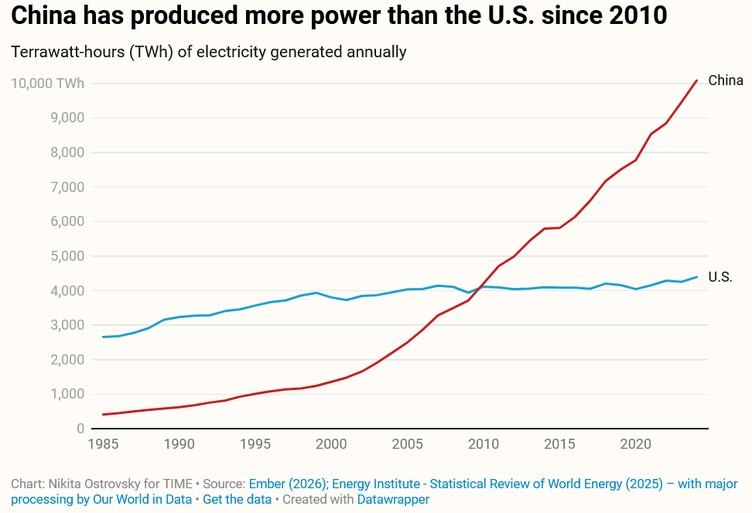
Source: TIME
[Click to open in a new window]
Take note: These lines haven’t just crossed, one is rising exponentially; the other is flatlining.
Jevons would say that China has already won and that time will do the rest.
I’m not so sure…
The US is a formidable empire with global reach, a massive defence budget, and control over the world’s financial system.
But picking an actual winner isn’t the point of what we’re trying to unpack today… The fact is, this fight is existential for both superpowers.
And the age of AI has turbo-charged this core idea.
Consider this news from last week…
Google goes nuclear
Last Tuesday, Google signed a 20-year deal with Constellation Energy to power its AI build-out.
890 megawatts of new nuclear capacity, unlocked by upgrading 11 reactors across six plants, backed by US$4.3 billion of investment.
That’s an entire new nuclear reactor’s worth of power…bought by a search engine!
And Google’s not alone.
Amazon has signed a 20-year nuclear deal with the same company. Microsoft is paying to bring Three Mile Island back from the dead.
Big Tech has quietly become Big Power.
Jevons would recognise this instantly.
He’s also the man behind the ‘Jevons Paradox’ — the idea that the more efficient technology becomes, the MORE energy we consume.
AI is that paradox at an industrial scale.
In Jevons’ day, empires ran on coal. Today they run on electrons and on the uranium, copper and grid metals that create them.
The US just spent US$2.7 billion to rebuild its own nuclear fuel industry because America still imports 20–25% of its enriched uranium from Russia.
The signs of a M.A.D. scramble for uranium are starting to light up.
According to the latest published data from Sprott, the uranium spot price sits around $89.50/lb, while the long-term (term) contract price trades at a multi-year high of approximately $96.00/lb.
The combination of speculation flooding OUT of the uranium market AND utility buyers competing more aggressively to secure long-term contracts has changed the dynamic of uranium pricing.
Basically, sophisticated long-term buyers see a stronger case for higher prices versus speculators, who, by this stage, are just trying to bail out of the market.
Watch this space…
M.A.D. Deadlines to Watch
Copper and rare earths are part of the M.A.D scramble, too.
Two important cutoff dates to mark on your calendar:
1 January 2027 — the refined copper tariff. As of last month, Trump still hadn’t decided whether to pull the trigger on 15% (rising to 30% in 2028).
The market isn’t waiting: copper hit record highs this year as buyers stockpile ahead of the decision.
If this one fires, copper producers will continue to rise towards the next deadline scheduled for 2028.
10 January 2027 — the US–China truce. If it lapses, China’s sweeping rare earth controls snap straight back into force.
(That suspension was actually due to expire on 10 November — the Trump–Xi meeting in Washington rolled it into January. And the Pentagon has its own January deadline to purge Chinese magnets from defence procurement.)
If it fires, the winners will be non-Chinese rare-earth producers and near-production developers.
More soon…
Regards,

James Cooper,
Mining: Phase One and Diggers and Drillers




Comments