



Markets are at a critical decision point.
How much risk is already in the price?
My view: not enough… yet.
And buried under all the headlines, could be a set up for a generational buying opportunity.
Let’s examine the context.
Last week, one of the big unknowns finally became known.
Anthropic, the company behind the Claude AI model, listed on the Nasdaq in the largest IPO on record.
It raised about US$81 billion, and the shares opened 34% above their US$83 offer price.
On the same day, the S&P 500 fell 2%, extending its longest losing streak since April 2024.
That tells you plenty about where sentiment is right now.
A market full of known knowns
The big risks are all hiding in plain sight.
Private credit funds, which lend to companies outside the banking system, have been wobbling all year.
Some of the biggest, including ones run by Blue Owl and Apollo, have capped withdrawals.
The AI build-out is increasingly running on borrowed money.
Top-rated US corporate bond sales hit a record US$1.88 trillion by early November, with the AI tech giants raising more than US$370 billion of it.
SpaceX and now Anthropic have set back-to-back IPO records.
Mega listings have a habit of turning up late in a bull run.
Then there’s cyber.
This month, France blamed an Iran-linked unit for sabotaging refrigeration systems at around 700 shops.
For months I’ve been following these tiny headlines of Western fighter planes dropping out of the sky, along with all the other hacks I covered last week in this piece.
My view? On cyber, we ain’t seen nothing yet.
More on that tomorrow.
But herein lies the opportunity for investors that can keep their heads…
That stomach churning sell-off event should come before the usual rescue job that sends markets back towards the stratosphere over the next year to two years.
Whatever you do, don’t panic sell the bottom and walk away from markets.
When everyone has finished doing that, that will be your cue.
Just as it always has, this time, everything hinges on the US Federal Reserve.
The Fed is warming up its vocal cords
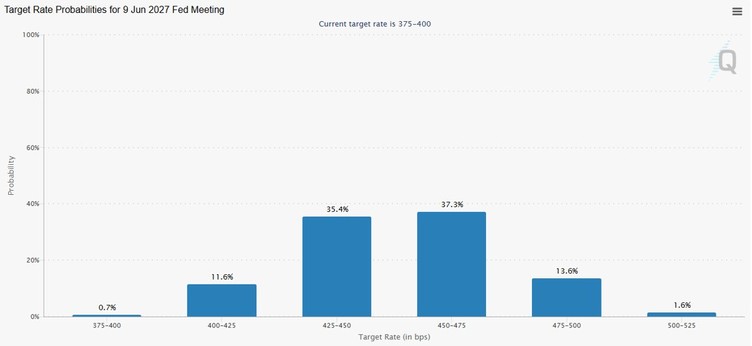
Here’s what traders expect from the US Federal Reserve by June 2027:
Source: CME FedWatch
[Click to open in a new window]
The Fed’s target rate is 3.75% to 4.00%, after one hike since the Iran war began.
A December hike looks all but locked in, with odds above 90%.
By June, the market is betting on two or three hikes in total from here.
At a stretch, it puts a 14% chance on four.
Oil is already doing the Fed’s job
Now look at oil:

Source: Trading Economics
[Click to open in a new window]
US crude went from below US$60 a barrel late last year to above US$110 in early April, after the war with Iran choked the Strait of Hormuz.
It’s now back in the low US$80s as traders bet on a peace deal.
US Treasury Secretary Scott Bessent has noticed.
Earlier this month he called the oil spike an energy supply shock and warned the Fed against hiking too hard as prices fall.
“The Fed’s supposed to look into the future, not look in the rearview mirror,” he told CNBC.
He also pointed to the European Central Bank, which raised rates in mid-2008 with oil near US$147 a barrel.
Within months, the global financial crisis was in full swing.
It ain’t over til the Fed sings
The Fed looks set to hike into an oil price that’s already falling.
That raises the risk of over-tightening, and markets could feel more pain before this is done.
But remember, politicians have retirement funds too.
When markets hurt, the pressure on central bankers to back off builds fast.
When the Fed finally sings its last note and the hiking stops, that’s when the real rally could start.
Why the small end could hold up better
Here’s what gets lost in the gloom.
The small end of the Aussie market has already taken a beating.
The RBA has hiked five times this year, taking the cash rate to 4.85%, its highest level since 2008. Smaller companies have copped the brunt of it.
In October alone, the Small Ordinaries index fell 6.4%, trailing the big end by nearly eight percentage points.
That was the widest one-month gap since April 2013.
Small caps have lagged large caps by 19% over the past year.
A gap that wide has shown up only three times since 2002, including the GFC.
Then last week’s mining rout knocked the Small Ords down more than 5% in four sessions.
That looks a lot like capitulation, the point where worn-out investors sell at almost any price.
When most of the sellers have already sold, it takes less buying to move prices.
It’s a bit like the Boxing Day sales late in the afternoon, when the crowds have thinned and what’s left on the racks is marked down hard.
Hold your nerve
I expect more volatility before the Fed is done, and the ASX will feel it too.
But for patient investors, the setup gets more interesting by the week.
One of the biggest mistakes investors make in markets like this is selling at the bottom.
If you can keep your head, the buying opportunity of the decade could well appear in the coming months.
It ain’t over til the Fed sings.
And then the rally starts.
Perhaps the most monolithic rally we’ve seen in our lifetimes.
See? It’s not all bad!
Tomorrow, I lay out what I think the trigger for a plunge could be.
Warm regards,
Dr. Lachlann Tierney,
Australian Small-Cap Investigator and Fat Tail Microcaps




Comments