



This Wednesday, US public debt passed US$40 trillion for the first time.
That afternoon, two arms of the US government moved in opposite directions.
The Federal Reserve released minutes showing that many officials believe rates will need to rise if inflation persists.
New chair Kevin Warsh held his view that the bond market can take the lead in tightening conditions.
Right on cue, 30-year Treasury yields hit 5.33%, their highest level since 2007.
For some, that was a bridge too far. Treasury Secretary Scott Bessent announced interventions designed to drive long-term yields back down.
One institution was signalling tighter policy, the other looser.
Long yields dropped sharply on the news. The dollar hit a three-month low, and gold jumped above US$4,500 an ounce.
Less than 24 hours later, the move in bonds had reversed.
Something is happening here, and it’s worth unpacking what it means for your investments.
A Paper From 2024
A dusty document explains this move better than anything published this week.
In July 2024, Stephen Miran co-wrote a paper titled ‘Activist Treasury Issuance and the Tug-of-War Over Monetary Policy’.
I’ve cited Miran in the past when talking about this admin’s economic policy. In many cases, such as tariffs and the dollar, his policy papers have been the ideological vanguard of this flavour of economic nationalism.
But that isn’t what this paper is about. In this one, he’s dressing down then-Treasury Secretary Janet Yellen for her ‘creative’ use of stimulus in the run up to an election.
In these dry, boffin papers, a word like ‘activist’ is lobbed like a slur from a librarian.
His argument goes like this: Persistent inflation risks are rising because the keys to the sugar cupboard are being handed to political insiders.
In this case, the highly political Treasury was doing the Fed’s job for it — and doing it in an election year.
The method was insidious. Treasury cannot control how much the government borrows, but it fully controls whether it borrows short or long.
So what if it buys long bonds in the market and issues short bonds (T-bills) to pay for them.
Tilt issuance toward short-term bills and you starve the market of long bonds. Less interest rate risk for investors to absorb means lower long yields.
Technocrats know this as ‘Operation Twist’. Though usually it’s a program run by the Fed, not the Treasury.
And it’s the same channel the Fed uses when it runs quantitative easing (QE).
In 2024, Stephen Miran called it ‘stealth QE’ by the Treasury. And now we’re seeing it again.
For us, everyday folks, there is a far simpler way to describe QE.
Money printing.
Give the economy a liquidity boost to keep the good times rolling.
Not directly — but in a round-a-bout kind of way.
Near the back of the paper sits a short section on buybacks that now reads like a forecast. The paper’s warning was that once such a tool exists, it likely gets used again. And again.
Keeping the Trade Alive
So what comes next? The Treasury’s calendar is the tell.
The buyback window closes on 4 November. The midterms are held on 3 November. Expect the gravy train to run into these elections.
Any macro concerns will be drowned out by the Treasury’s chequebook. A currency intervention in Japan here, another buyback there.
Stimulus now, inflation later.
Of course, these folks know this. This isn’t pedal to the metal. They’ll just keep topping things up while markets move into a seasonally slow period.
Adding liquidity to a quiet market is a cheap way to move prices. The better question is what it protects.
That answer runs through AI.
The AI buildout is the main engine of US growth, and the front line in Washington’s race against China.
As I’ve explained before, that buildout has also burned through the cash flow of the companies running it.
Alphabet reported its first negative free cash flow last quarter. Each new dollar of the buildout now comes from debt.
So the hyperscalers have gone to the bond market. Alphabet raised US$25 billion in the US this month, and on Wednesday raised another A$5.5 billion in kangaroo bonds here.
That’s the biggest corporate raising in Australian history. Amazon is expected to follow. Those corporate borrowing costs are priced off long-dated government bonds.
If the long end runs away, so does the cost of the buildout.
The buildout then slows, growth follows, and the market rolls over before the vote.
A Hail Mary on Productivity
There is a defence for all this. Bessent and Warsh have both argued that AI will become the next great disinflationary force.
The idea is that productivity gains grow so large that production costs collapse. Elon Musk sits at the far end of that spectrum, suggesting money will become irrelevant by 2036.
That needs a dose of reality. Land, real estate, raw materials and human attention cannot be replicated infinitely.
For those of us sceptical that AI gains flow in a straight line to productivity, this is a Hail Mary pass. Thrown against numbers that have yet to appear.
Meanwhile, pushing liquidity into a market already struggling to manage costs is inflationary.
To my eye, this is the debasement trade wearing new socks.
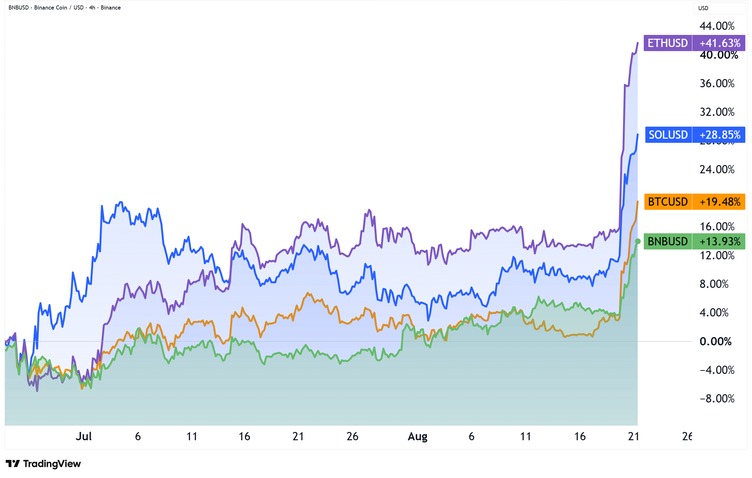
And I’m not alone in that assumption. Gold rose more than 4% on the announcement. Bitcoin jumped 8%.
A market hunting for alternatives to the US dollar may have just kick-started another crypto run. Here’s crypto’s reaction:
Source: TradingView
[Click to open in a new window]
When the Buyers Stop Showing Up
For investors, the implication is short-term gain and long-term concern.
Juice now, and a sugar high that leaves you with a headache once the debt catches up.
Clearly, a government intervening in its own bond market is telling you the buyers are not there at the price it wants.
Historically, moves like this were made by global powers in far more dire circumstances.
For 80 years, the world recycled its savings into US government debt. That flow held rates down and lifted everything Australians own, from super balances to house prices.
That trend has been slowing for over a decade now, but questions about US solvency could accelerate its end.
Today, central banks are buying gold at a pace not seen since the 1960s.
My colleague Brian Chu saw this early and has spent 13 years building and testing a four-layer approach to gold.
He has laid out the whole picture in a new presentation called Money Machine. Click here to watch it.
The buyback is a two-month bridge to an election. What sits on the other side of it is a bond market that has already made up its mind.
Regards,
Charlie Ormond,
ATLAS and Altucher’s Investment Network Australia




Comments