



It’s back to normality this week as the school holidays come to an end.
While many parents breathe a sigh of relief, the question for investors is whether the holiday is over for them too?
There’s no doubt, it’s been a very positive start to 2023.
In the first month of the year, the ASX 200 of leading Aussie stocks has shot up 5.75%.
The S&P 500 of top American companies is up 6.44%.
The tech-focused Nasdaq is up 12%.
And Bitcoin [BTC] is up 37%…
And yet many remain wary, calling this month’s price action a ‘bull trap’…
What’s a bull trap?
A bull trap is a false price signal that ‘traps’ investors who buy in thinking the move marks a reversal of a downtrend, and the start of a new uptrend.
The reason so many remain wary is continuing high inflation.
Here in Australia last week, the figure came in above expectations at 7.8%.
This could be bad news for mortgage holders because the cure for high inflation is even higher interest rates.
And until the inflation genie is firmly back in the bottle, the sceptics think central banks will keep putting up rates, regardless of market conditions.
The Reserve Bank of Australia (RBA) next meets on 7 February, and current consensus is for a 0.25% rise in interest rates.
We’ll see what happens…
But in the grand scheme of things, it only matters to markets what one central bank does next.
And that is the US Federal Reserve (the Fed).
Their decision to increase interest rates at a record pace to combat inflation at home has led to a surge in the value of the US dollar versus other countries.
And because many goods — especially oil — are priced in US dollars, this has the effect of ‘exporting’ inflation to other countries.
As everyone tries to get their hands on US dollars, this causes the US dollar to strengthen and inflation to spiral out of control.
Which, in turn, means other central banks have to raise interest rates to try and protect the value of their currency.
That’s a simplified explanation perhaps, but you can see the importance of US policy to the rest of the world.
Which is why all eyes are on the US this week.
The Fed, as it’s known, meets on Wednesday and Thursday our time.
And what comes out of this meeting could set the tone for the next few months.
There are a few outcomes to prepare for…
Expectations versus reality
A thing about markets that often confuses people is that markets react to differences between expectations and reality, not to reality itself.
It’s why markets can jump higher on seemingly bad news, and vice versa.
Knowing what markets expect before key events is therefore crucial in gauging what could come next in terms of stock market prices.
Which brings me back to this week’s Fed meeting.
The consensus is that we’ll see a 0.25 percentage point raise from Fed Chief Jerome Powell and his board colleagues.
As reported in Forbes:
‘The U.S. Federal Reserve (Fed) is all but certain to raise rates 0.25 percentage-points when it announces interest rates on at 2pm ET on Wednesday, February 1, according to interest rate futures.
‘Following that, the March 22, meeting should be a similar story, where the Fed is likely to once again raise rates 0.25 percentage-points, though there’s some chance the Fed holds rates steady.’
To be clear, these expectations aren’t just guesses.
They’re figures derived from the price of US government bonds which are actively traded on global markets.
This is the outcome the weight of actual money is betting on, which gives it more credence than just some pundit’s opinion.
It also means, if we get any different decision from the Fed, markets will react hard.
For example, if the Fed surprise us with a 0.5% rise, you should expect to see sharp falls across most major markets.
If they decide not to raise at all — the so-called pivot the bulls are banking on — then this rally might go into overdrive.
As my colleague and our Editorial Director Greg Canavan remarked in an internal discussion:
‘If the Fed caves and goes all dovish, cover your shorts!’
But the odds-on result is they do indeed raise by 0.25%.
If that happens, the market will go back to trying to guess what they’ll do in future meetings and we may see a period of volatile sideways action as bets are made on this.
Of course, the mainstream media will pay a lot of attention to the commentary given by Fed officials in the aftermath of this meeting.
No matter what they do, they’ll continue to speak tough on inflation and their intention to raise rates if it doesn’t continue to come down.
But I’d take less heed of that than the media gives it.
As the old saying goes, actions speak louder than words.
And the constant ‘tough talk’ from the Fed is actually part of a strategy to keep a lid on wages.
Instead, you should look to the signals the market is giving you, as this is people putting down actual cold, hard cash.
And on that note, things are starting to look very interesting…
What the market is telling you
Believe it or not, the market is pricing in big rate cuts by the end of the year, despite the Fed’s insistence it won’t be cutting any time soon.
As Atlas Financial’s Chief Strategist, Jeff Snider, explains:
|
|
| Source: Twitter |
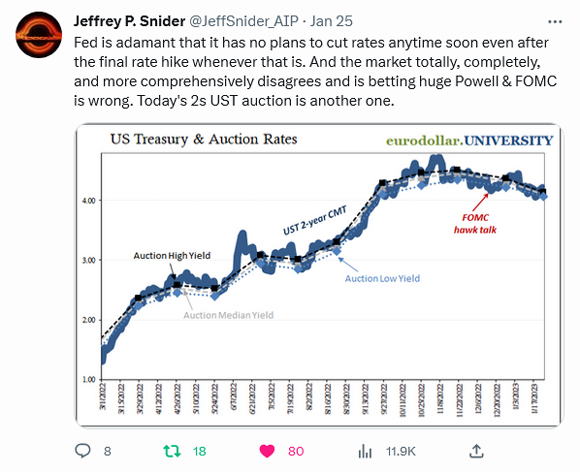
The market is clearly starting to price in a big recession. A recession that’ll only worsen if the Fed ignores reality and hikes too far for too long.
Is the Fed starting to see this too?
Or will they double down on their current path and raise rates regardless?
We’ll find out this week.
What they do, and how the market reacts, could set the tone for the next few months.
Good investing,
 |
Ryan Dinse,
Editor, Money Morning


