



A new asset class is rising. And it wants to know whether you think France will win the World Cup, or if Bitcoin will hit US$150,000 by Christmas.
Prediction markets were once a niche hobby. Now they’re one of the fastest-growing corners of finance.
|
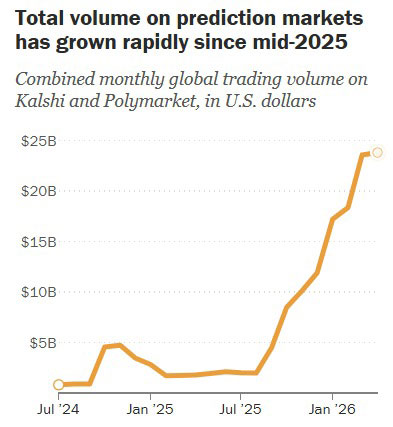
Combined monthly trading volume on Kalshi and Polymarket climbed from under US$5 billion in September last year to roughly US$24 billion by April.
Then the FIFA World Cup arrived. Macquarie estimates the sector topped US$50 billion in trading during June alone. This is no longer a fringe product.
At the same time, Kalshi’s valuation climbed from US$2 billion to US$22 billion in a year.
Intercontinental Exchange, the parent of the New York Stock Exchange, has committed up to US$2 billion to Polymarket to bring it further mainstream.
Who’s really winning
The pitch behind these platforms is simple. There’s no ‘house’ setting the odds. Users trade against each other, and the market price becomes a running probability.
A recent report from US think tank The Roosevelt Institute complicates that pitch.
It analysed Kalshi’s trading data and found that ordinary retail users have lost roughly half a million dollars since 2021. Most of that came from sports betting.
The pattern holds on Polymarket too. The Wall Street Journal reviewed more than a million accounts. It found that over 70% of traders lost money, while just 0.1% of accounts captured 67% of all profits.
Kalshi disputes the findings, arguing poor data collection. But that doesn’t explain why profits look just as concentrated on Polymarket.
In my opinion, both platforms reflect a reality about modern trading.
Professionals with better info and faster algorithms are capturing most of the value. Everyday users are largely providing the liquidity and are left holding the bag.
Insiders everywhere
Wall Street has noticed the tension. Goldman Sachs, Morgan Stanley, JPMorgan and Bank of America have all updated staff trading rules this month.
Employees are now restricted from trading contracts linked to financial markets, elections, or their own industry after a number of insider trading snafus.
These products sit close enough to inside information to need the same guardrails as equities. Two recent prosecutions back this up.
A US soldier allegedly earned US$400,000 from bets using classified military movements. And a Google engineer was accused of trading on internal search data.
Now, financial engineers are packaging this appetite for speculation into more familiar wrappers.
An actively managed ETF from Subversive Capital and Tidal Investments is awaiting SEC approval. It would hold a portfolio of 40 to 80 sports event contracts. A companion fund would do the same for macroeconomic and policy bets.
The Aussie question
Australia has kept prediction markets at arm’s length. The Australian Communications and Media Authority (ACMA) has banned Polymarket as unlicensed gambling. While Kalshi excludes Australian users under its own terms.
ASIC has gone further, warning that the products are high-risk, speculative and that no operator currently holds a local licence.
That hasn’t stopped demand. Aussies are increasingly routing through crypto exchanges such as Hyperliquid, which offer betting contracts without identity checks.
Our watchdogs have noticed. Its website was geo-blocked here last month, but determined users are still reaching it through VPNs.
There’s also a formal push underway. FEX Global, a financial futures house, has been pitching regulators and investors on what it bills as ‘Australia’s first regulated prediction market’.
Backers include former politicians Jason Falinski and Larry Anthony, with billionaire Clive Palmer publicly spruiking the idea.
Whether that’s genuinely useful is the harder question.
Prediction markets can be legitimate forecasting tools. A Federal Reserve paper found Kalshi’s pricing correctly called every Fed rate decision since 2022, beating both economist surveys and futures markets.

Source: Federal Reserve
[Click to open in a new window]
And while I’m not a gambler, I do visit these sites often to gauge market sentiment.
But forecasting value and investing value are two different things. Australians already lose more per capita on legal gambling than anyone else in the world (totalling ~$32 billion a year).
Adding another loose market on top of that before a solid protection framework exists looks like the wrong order of operations.
For now, the safer path for local investors is watching this trend through listed exposure.
Robinhood’s event-contract volume hit a record US$8.8 billion in the first quarter, and its share price has closely tracked that growth.
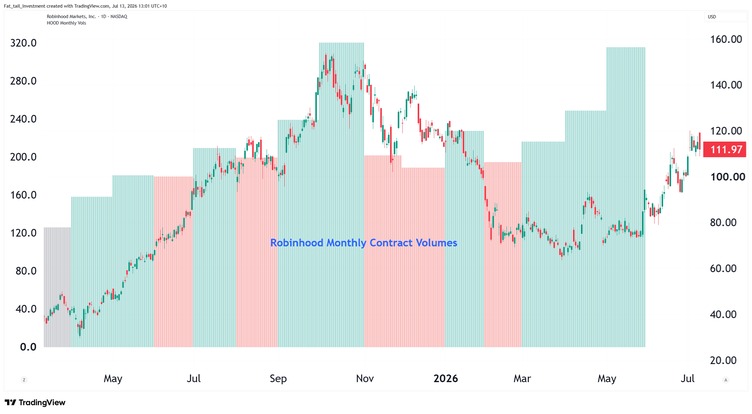
Source: TradingView
[Click to open in a new window]
The exchanges themselves may eventually list too. That gives investors a regulated way to back the industry’s growth, without needing to punt.
In my opinion, laying a bet is a different risk altogether. It means trading against people whose data, speed and information you can’t see.
And as we’ve seen already, those are some very murky waters.
Regards,

Charlie Ormond,
ATLAS and Altucher’s Investment Network Australia




Comments