




For a few years now, I’ve been running a service dedicated to junior mining stocks.
And a key feature of that service is our global focus, meaning we aren’t just looking at ASX opportunities.
You see, commodities are traded in international markets, with some regions far more endowed with certain minerals than others.
In Australia, iron ore, coal, gold, lithium and natural gas dominate.
Meanwhile, African projects tend to be dominated by copper, zinc, gold and platinum group metals. Central America is dominated by silver. Canada is dominated by uranium, gold, oil, and gas. You get the picture.
To hunt down the world’s best projects, you need to look beyond your backyard.
That’s why, of the 22 stocks sitting in our model portfolio, around half sit outside of the ASX.
And here’s the thing: that’s giving our portfolio major support this year.
Over the past several months, our international stocks have vastly outperformed our local ASX positions.
And that trend goes well beyond our portfolio.
What do I mean?
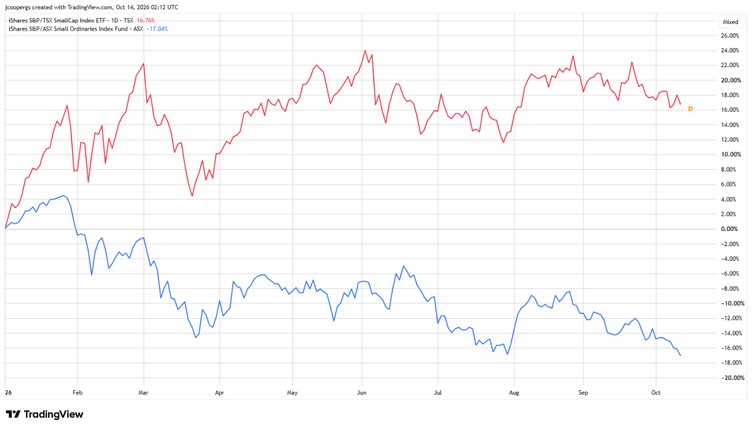
Here’s a chart I shared with my paid readership group last week…
It shows the year-to-date performance between Australia’s small-cap index (blue) versus Canada’s (red):
[Click to open in a new window]
Both markets share similar commodity-reliant economies, with a small-cap market dominated by junior mining stocks.
So, in that sense, the Canadian small-cap index offers a decent comparison to our own. And here’s the rub:
Canada’s small-cap index is UP 16.76% this year.
Australia’s has FALLEN 17%.
Two similar markets, but two VERY different performances this year. And that highlights why our internationals are strongly outperforming local picks.
So, why is there such a divergence?
Jurisdictional risk has many faces
A small African nation nationalising a mine owned by a foreign corporation.
A Central American country hiking royalties to unmanageable levels.
Either way, shareholders take on big risks by investing in overseas projects.
But as you’ve seen, Australia isn’t risk-free either…
Recall the wrecking ball that the Federal Government brought down on Australian investors earlier this year.
In my mind, that has similar consequences.
Small-cap stocks are especially reliant on tax incentives to justify the added risk investors take and the need to retain a larger share of their profits to offset positions that don’t work out.
Losing more of those gains to capital gains tax reduces the overall reward with NO reduction in risk.
It’s certainly possible that the Aussie small-cap index is being impacted by these tax changes. And may explain the wide divergence in small-cap performance between Canada and Australia this year.
But what about the tax exemption (known as the carve-out) created by the Federal Government to shield start-up companies from these sweeping tax changes?
Well, that’s limited to just technology and biotechnology companies.
Junior mining: excluded from carve-outs
In a recent media release, AMEC, the peak national industry body representing Australia’s mineral exploration and mining sector, had this to say on the damage it could do to Australia’s future (emphasis added):
“Excluding an industry that finds the mines of the future from carve-outs will hurt future discoveries and reduce productivity for Australia’s most important economic driver.
“This is a kick in the guts for the entire mineral exploration industry and those who invest in it.
“To include start-ups in the carve-outs but ignore exploration is quite frankly ridiculous, given we are Australia’s original start-up and develop projects in the exact same way.
“And it’s hard to understand why the advantage will be given to wealthy Venture Capitalists and Angel Investors in Tech, but not Mum and Dad retail investors in mineral exploration.
“This is an own goal of epic proportions for the Australian Government, given its ambitious critical minerals agenda.”
Couldn’t have said it better myself, and kudos to AMEC’s chief, Warren Pearce, for telling it like it is.
Not that the government paid any attention. Mineral exploration remains strictly excluded from the Federal Government’s Innovative Business CGT Concession carve-out.
And that’s despite a concerted, multi-month effort by AMEC and the Minerals Council of Australia detailing how disastrous this is for our country’s future prosperity.
So, what can you do?
Thankfully, as investors, we have the flexibility to choose our investments.
And luckily, commodities are an international market priced in US dollars, with projects located on just about every continent.
While we can’t escape our personal tax regime, we can select companies that fall outside this local trap.
And for the most part, that means shifting towards a more international focus.
Bottom line: you should be targeting the best global projects, regardless of where they sit. And on the back of the latest moves by the Federal Government, it proves that no region is risk-free, including Australia.
Now’s the time to build a list of quality international resource companies.
If you’re looking to find out more, you can do so here.
Until next time.
Regards,

James Cooper,
Mining: Phase One and Diggers and Drillers
PS: Monday. 4:15pm. ATLAS 1.0 fires up. An AI built to read the ASX, with Fat Tail’s fingerprints all over it. Attendance at the demo is free for all paid Fat Tail readers. You just need to register here.




Comments