



The AI side of the market is getting panicky. Chip stocks have shed about US$1.6 trillion in value over the past six sessions.
It’s been a trickle of bad news for markets. Hot US inflation of 3.7% has again pushed Treasury yields as high as 5.32% this week, bleeding into both the AI valuations and their growing debt piles.
Locally, we’ve seen the Firmus IPO pulled and everything even vaguely linked to AI face heavy selling.
On Tuesday, Lachy outlined what he calls the ‘debt-hyper-complex’: a tangle of giant borrowers all chasing the same pool of lenders. Now those lenders are pushing back.
The Sharp End
CoreWeave, the Nvidia-backed company that rents out AI chips, shows where the pressure lands first. Its shares fell 15% on Wednesday, but the bigger pressure is in its huge debt pile.
Its 2032 bonds, sold at 100 cents on the dollar four months ago, now trade below 78 cents, and their yield has climbed from about 9.4% in June to 14.8%.
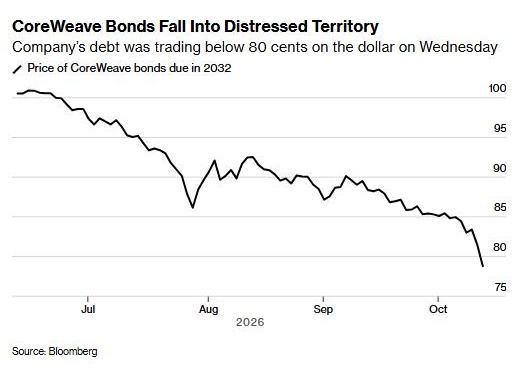
Source: Bloomberg
[Click to open in a new window]
Credit default swaps now imply a better-than-even chance of default within five years.
If CoreWeave is the warning, Oracle is where a real AI meltdown would do the most damage. Its borrowings reached US$130.1 billion at the end of May — up 40% in a year.
It has also signed US$260 billion of data centre leases that haven’t started yet.
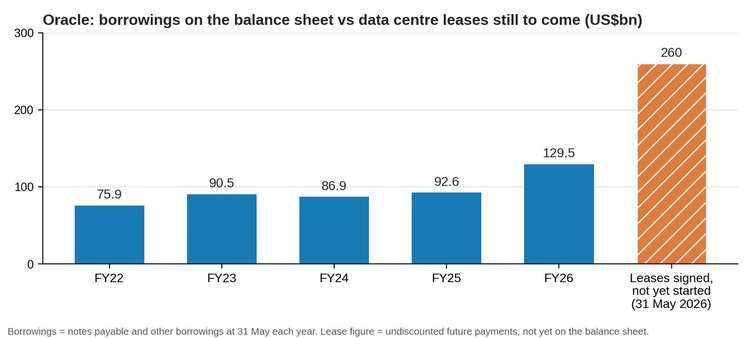
Source: Oracle Form 10-K filings
[Click to open in a new window]
This extra hanging debt is what concerns me. Because Oracle isn’t alone.
A daisy chain of letters of intent, leases, and off-balance-sheet backlogs is what justifies these gargantuan loans and buildouts.
Company A commits to B, who borrows from C to build out for A, and around it goes.
A Nikkei study back in July showed that off-balance-sheet, or ‘shadow borrowing’, among the US tech giants had increased eightfold over four years.
In July, estimates for that shadow borrowing were around US$1.65 trillion.
Two months later, they were over US$3 trillion.
Here are the biggest four tech names, and everything hidden below the waterline (off-balance-sheet obligations in blue):
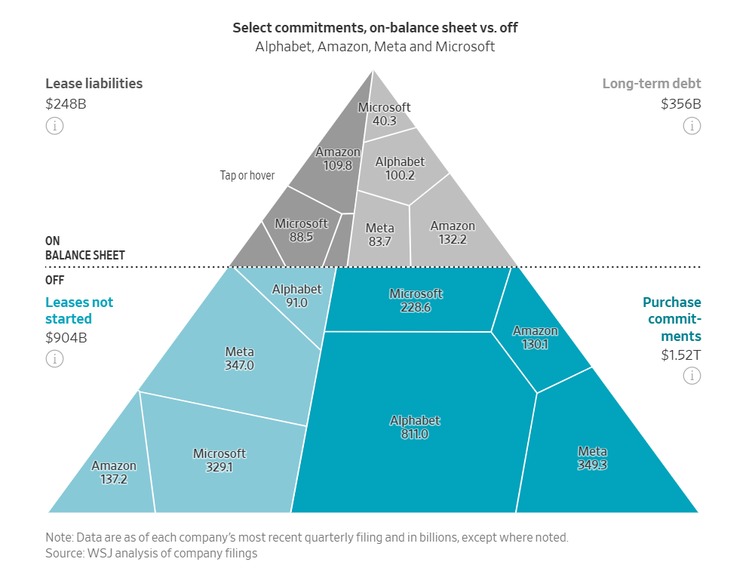
Source: WSJ
[Click to open in a new window]
As scary as this looks, the sharp end ultimately comes down to the two major AI names: OpenAI and Anthropic.
The first domino in the most recent sell-down was the revelation that OpenAI’s revenue this year would be US$20 billion lower than previously flagged.
Following that daisy chain back to Oracle, you can grasp why that’s a problem, given that around half of their US$664 billion order backlog is tied to OpenAI.
S&P rates Oracle BBB-, one notch above junk. Insuring its debt against default has cost more than US$2 a year per US$100 since July, a record.
The hyperscalers’ dollar auction
To see how the AI builders got here, consider a game Yale economist Martin Shubik described in 1971, called the dollar auction.
A dollar goes up for auction and the highest bid wins. The catch is that the runner-up also pays their bid and gets nothing.

Source: Andy Warhol | The Guardian
Say you’ve bid 95 cents and your rival bids a dollar. Stopping now costs you 95 cents, so bidding $1.10 makes sense, since winning would leave you only 10 cents out of pocket.
Your rival faces the same logic, and the bidding climbs well past the dollar until someone runs out of money.
Early networking technology rewarded that kind of escalation. Network effects in the digital age turned the winners into generational giants like Microsoft and Google.
Many assumed AI would follow the same path.
The idea, often called ‘foom’ or a rapid takeoff, was that the first to reach a much smarter AI would see its gains compound until customers had nowhere else to go.
OpenAI’s lead after ChatGPT launched in late 2022 seemed to prove the point.
What we’re seeing instead is something I’ve warned about for years. Intelligence is becoming a commodity.
In other words, it’s standardised and widely available, so it faces market pricing.
The AI tools we build here at Fat Tail (like those of every AI engineer I talk to) sit inside a layer that can plug in any model.
Businesses such as OpenRouter already offer services that switch between AI providers task by task.
That means there’s no moat that can justify OpenAI charging much more than a cheap Chinese model.
So, returning to the dollar auction, these hyperscalers are bidding as if the prize is Google-style lock-in, when, in my view, it may prove weaker than a messaging app on your phone.
That is how a dollar auction ends, with bids far above the prize and the losses settled when the capital runs out.
Bitcoin’s shrug
Against this backdrop of selling, it’s interesting to see that Bitcoin fell no more than 2.3%, in a week when silver dropped 6% and CoreWeave lost 15% in a day.
As Lachy described it this week, Bitcoin seems to be running on two clocks.
On the short clock, it trades like a risk asset, and on the long clock, it hedges against the debasement of the Dollar. The short-clock selling this week was surprisingly mild.
That long clock is where the debt-hyper-complex comes back into play. After all, strain like this is the backdrop Bitcoin’s long clock is built for.
Lachy has spent weeks on what this means for crypto, and his full report lands in your inbox this weekend.
Regards,

Charlie Ormond,
ATLAS and Altucher’s Investment Network Australia




Comments