




I finished Netflix’s East of Eden last night – all seven episodes of the remake of John Steinbeck’s 1952 classic book.
It’s a great, if confronting, series to watch.
Like all Steinbeck novels, it leaves you weighing big moral questions.
I won’t spoil it for you, but one scene was very relevant to our wheelhouse!
And, as I’ll show you shortly, that same market is now telling you exactly where oil heads next (Hint: it’s not what the headlines are saying).
Here’s the lowdown…
It’s 1917…
Cal Trask, the son nobody loves, borrows some money and quietly buys soybean futures – contracts to take delivery of beans at next year’s harvest, at a price agreed today.
Beans fetch 3 cents in the field. The futures price sits at 5 cents. Cal buys $5,000 worth at 5c.
Then America enters World War One. The army suddenly has millions of hungry mouths to feed.
Soybeans, which don’t spoil easily, go ballistic. Cal sells out at four times what he paid.
He hands his father, Adam, a birthday gift worth $15,000. Adam refuses it. He wants no money made off the war.
Fast forward to today…
Oil prices are spiking higher again as conflicts in Russia and the Middle East grind on.
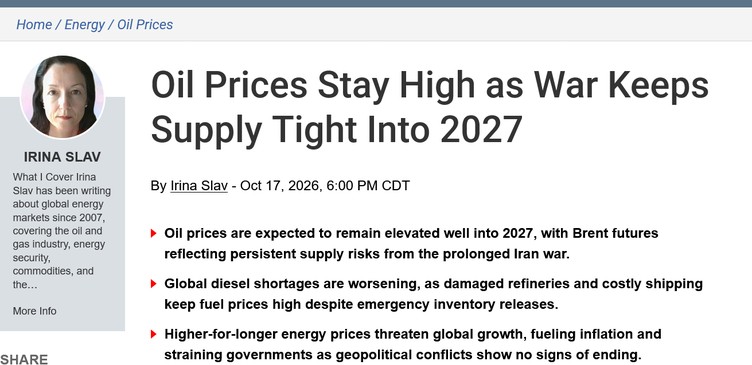
Most headlines I’m reading say oil prices will remain higher for longer.
Here’s one example:
Source: OilPrice.com
[Click to open in a new window]
I’ll admit it’s an easy conclusion to reach.
But one part of the investing world says it’s dead wrong.
Let me explain…
We’ve already seen the spike
Give the oil bulls their due. Middle East fighting has disrupted Hormuz flows all year.
The EIA counts 4.8 million barrels a day of Gulf production still shut in.
Inventories drained 1.9 million barrels a day in the third quarter. US East Coast diesel stocks sit 32% below their five-year average.
And Russia and Ukraine still seem to be engaged in tit-for-tat strikes on oil refineries.
No doubt, like me, you can see the effect of all this at the bowser.
Brent averaged $114 in September and touched $131 on the 15th, after an attack on Saudi Arabia’s East-West pipeline.
Brent trades near $105 as I write, and the press treats the number as permanent.
Cal Trask would recognize this price move. It’s his bean market wartime move all over again.
But Cal never believed the war price would last. So, he sold into it.
The oil curve now runs the same math. The spike has already paid out the easy money.
Here’s the riddle the oil market asked itself last week
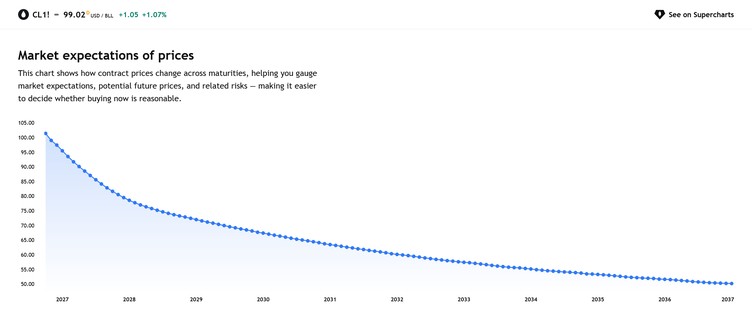
Backwardation is the word on oil traders’ lips. In plain English, it means today’s oil costs more than tomorrow’s.
Here’s what that means in practice.
Last week, traders paid about $98 for a barrel of West Texas crude for delivery in November.
For a barrel they could get in 2031, they paid about $61.
Same commodity. Same molecules. Same tankers. A $37 gap between them. That gap is the futures curve’s own forecast, and it speaks louder than any headline.
Here’s how it looks on a chart:
Source: Trading View
[Click to open in a new window]
This chart shows the weight of hundreds of billions of dollars of real money laid down. It’s not just some ‘off the cuff’ opinion.
And it clearly says oil is scarce today and plentiful later.
The financial press disagrees. It screams “higher for longer,” pointing at war, tanker attacks, and a stretched Strait of Hormuz. Somebody in this trade is wrong.
My money says it isn’t the curve.
Here’s why…
First up, American shale oil
The EIA forecasts 13.8 million barrels per day of US output for 2026, a fresh all-time high, with the Permian Basin (the highest-producing oil field in the US) alone at 6.8 million.
April’s monthly print hit 13.9 million, the highest on record.
Meanwhile, $105 oil is the best subsidy US shale explorers ever had. As Trump put it in his 2024 election campaign, it’s time to ‘drill, baby, drill!’
Secondly, substitution
In August, battery-electric cars outsold pure petrol cars in Australia for the first time ever. 27,078 EVs to 25,824 petrol cars.
In China, that’s old news. China’s EVs and hybrids took 67% of its September car sales.
This trend adds up to less demand for oil over time.
In fact, think tank Ember ran the numbers. They estimate between March and August, electric cars in oil-importing countries skipped 200 million barrels of crude oil.
That’s roughly US$20 billion less demand compared to a world where EV’s didn’t exist.
Lastly, workarounds
Washington just suspended sanctions on Russian diesel for six months to buy supply – a pragmatic, if embarrassing, backdown.
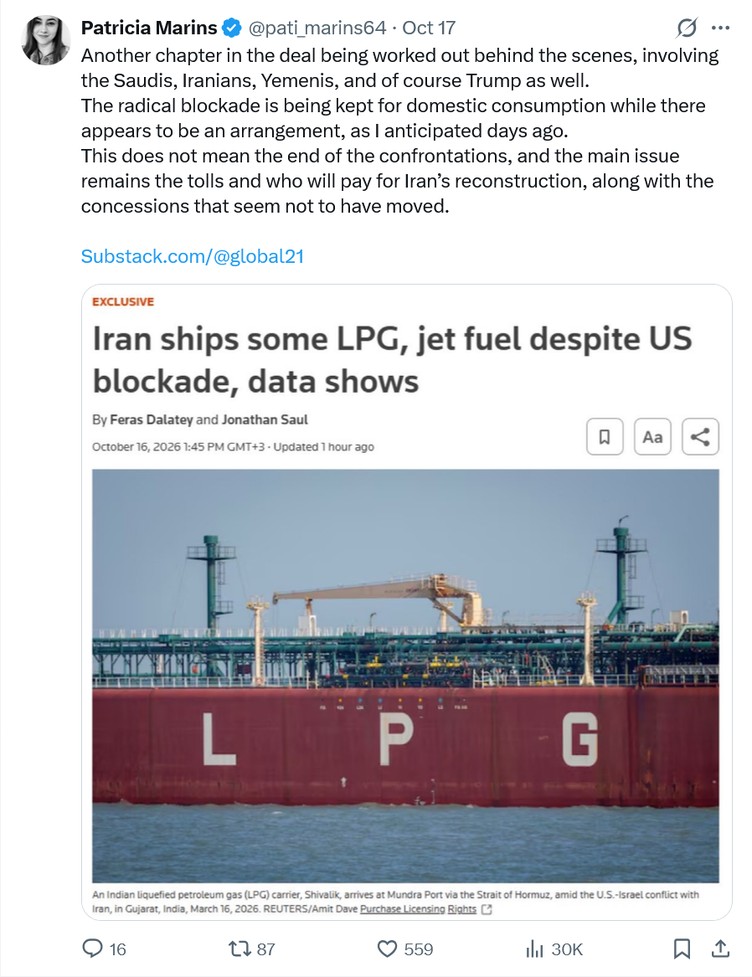
And in the Middle East, we’re getting signs of de-escalation too.
As defence analyst, Patricia Marins noted yesterday:
Source: X.com
[Click to open in a new window]
Also of note is that Saudi Arabia restarted its repaired East-West pipeline on 22 September. The IEA says Gulf exports already nearly reached pre-war levels in September.
Add the 400-plus million barrels governments pledged from strategic reserves in March, and it’s clear there’s more oil flowing than many think.
Add it all up
East of Eden ends on one Hebrew word: timshel – ‘thou mayest.’
It represents the concept of free will and the fact that the future is unwritten.
It’s a point worth remembering. Even futures markets get it wrong.
But for my money, they beat the headline writers most weeks. And the signal here is definitive: oil is going lower.
So, if you’re long oil, it might be time to bank some profits – like Cal Trask did.
Speak soon…
Regards,

James Cooper,
Mining: Phase One and Diggers and Drillers




Comments