



I’m taking a day off today.
What follows is an abridged version of what I shared with members of Australian Small-Cap Investigator last Friday. All figures are accurate as of Friday.
In my paid small-cap advisory service, we recently banked a gain of around Atlantic Lithium [ASX:A11] for a gain of around 35% after a Chinese company made a takeover offer, and Meteoric Resources [ASX:MEI] for around ~39% after Lynas agreed to buy it.
If last week’s AI trade jitters across Firmus, Maas Group and the ASX data centre industry were anything to go by…
I think the path ahead for the Australian economy and the ASX will be very bumpy.
Last week gave us a taste of what’s to come.
So today I’ll cover what drove the latest small cap sell-off. And why it has me thinking about going shopping.
The following is an abridged version of a note I sent to my subscribers to Australian Small-Cap Investigator last Friday the 16th of October. Enjoy.
***
What spooked the market
It’s been a nasty fortnight for ASX juniors.
A big part of the story is Firmus.
Firmus is the Nvidia-backed AI data centre builder that was set to be Australia’s biggest float since Telstra in 1997. It asked investors to pay $11 a share, valuing the business at roughly $44 billion.
Demand faded while the books were open. So the bankers tested lower prices.
That didn’t work either.
On Friday 9 October, Firmus withdrew its listing and said it would seek private funding instead.
The fallout was swift.
Maas Group [ASX:MGH], which tipped $100 million into Firmus earlier this year, saw its shares fall around 45% in a week.
We used to hold Maas in ASI and exited at the right time, phew!
I suspect Maas isn’t the only one caught out by Firmus’ flop.
Small cap fund manager Regal Partners [ASX:RPL] first invested in Firmus more than five years ago, when it was a little-known bitcoin miner. The AFR reports Regal made around 30 times its money on part of that stake.
We used to hold Regal too, and our stop loss locked in a gain of around 41% in November 2025. Double phew!
A float is usually the moment an unlisted stake becomes easy to sell.
My hunch is that the market expected funds like Regal to reinvest their Firmus gains into other small caps.
Now that this wave of cash isn’t coming, those share prices fell instead.
We also saw a sharp late sell-off in data centre stocks last Tuesday. It looked like a fund telling its trading algorithms to dump positions at any price.
I can’t prove the link, but the timing fits.
Zoom out, and AI enthusiasm has done a lot of the heavy lifting for markets this year.
That support is looking shaky.
Last week, US-listed CoreWeave, one of the biggest renters of AI computing power, fell about 15% overnight.
The yield on its unsecured bonds spiked to around 15%. That’s a sign lenders want a much bigger reward for the risk.
When the AI story wobbles, the selling tends to spill into anything that looks risky. ASX juniors are near the top of that list.
The widest gap I’ve seen
Now to commodities.
In my eight years in markets, I have never seen such a divergence between commodity stocks and the spot prices of the commodities they produce.
The spot price is simply what the raw material sells for today.
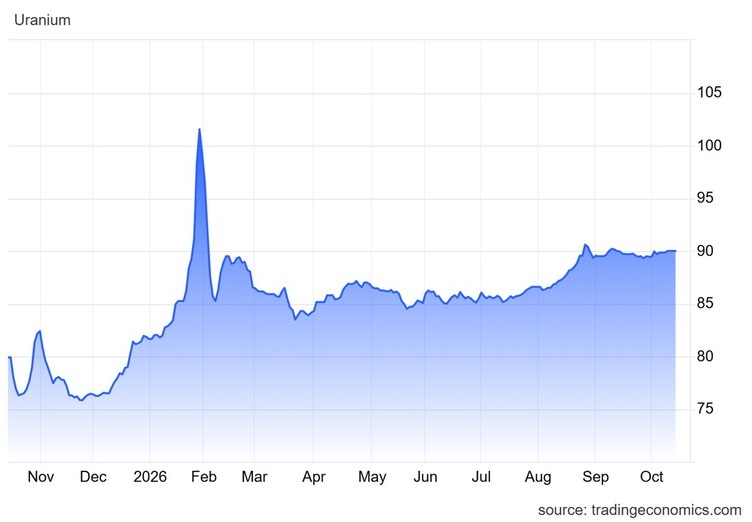
Take uranium, which is holding around US$90 a pound, its strongest run since a brief spike in February.
Source: Trading Economics
[Click to open in a new window]
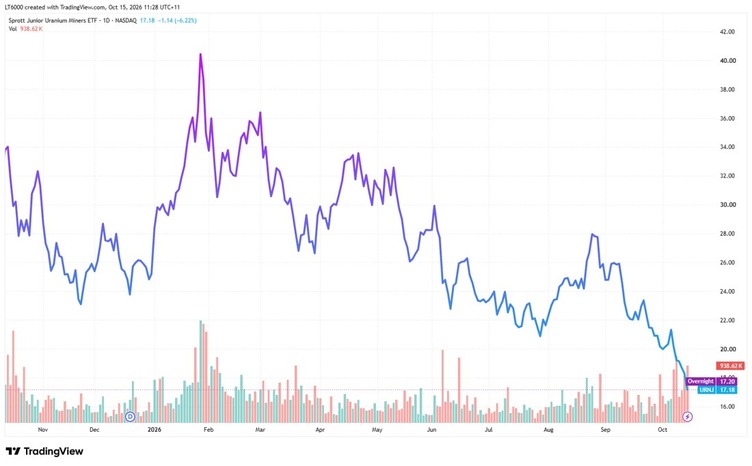
Now compare that with the Sprott Junior Uranium Miners ETF, a US-listed fund holding a basket of smaller uranium companies.
Source: TradingView
[Click to open in a new window]
The fund has roughly halved over the past year. Over the same period, the uranium price is up around 12%.
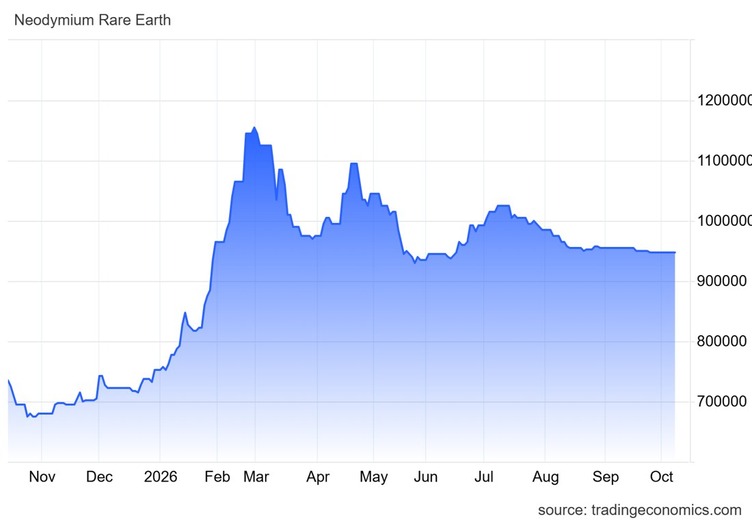
Rare earths show the same gap.
Source: Trading Economics
[Click to open in a new window]
Neodymium, a key ingredient in the magnets used in electric motors and robots, has been steady since August. It remains close to 30% higher than a year ago.
Yet rare earths stocks have taken a hammering.
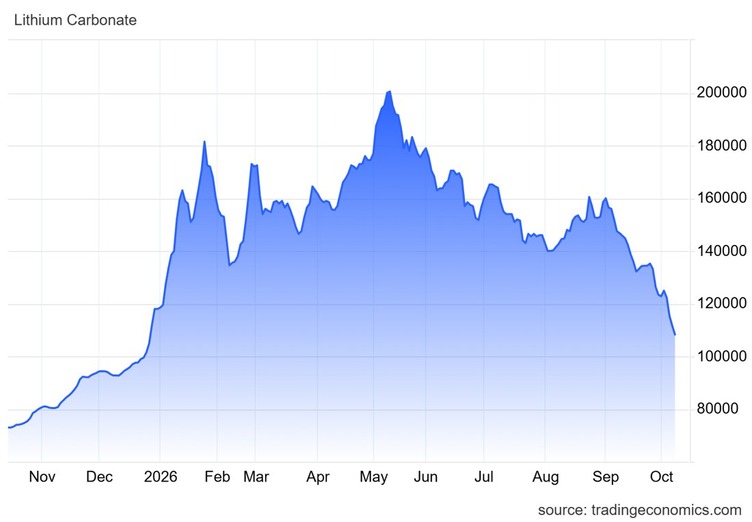
Lithium is the one commodity here where the spot price has fallen hard.
Source: Trading Economics
[Click to open in a new window]
Chinese lithium carbonate prices have almost halved since their May peak.
Even so, they’re still around 40% higher than a year ago.
Critical minerals stocks are clearly taking a beating, even though the demand story is intact.
Back in early September, I said two home truths would remain once the dust settled after any panic.
- Commodities are well established as an inflation hedge
- More raw materials are needed to bring inflation down
Nothing about last week changes that.
When raw material prices hold up while investors sell off the stocks that produce them, I think that gap could narrow over time.
If you take a long-term view, it may soon be time to go shopping.
Where you dig matters
Jurisdiction, meaning the country a company operates in, can make or break a small cap.
My colleague James Cooper put together this chart comparing Canadian and Australian small caps in 2026.

Source: TradingView
[Click to open in a new window]
The iShares fund tracking Canadian small caps is up around 17% this year. The equivalent ASX fund is down around 17%.
Both are resource-heavy markets, so a gap of more than 30 percentage points says a lot about policy.
Put simply, Canberra keeps making it slower and more expensive to build things in Australia.
Meanwhile, Canada’s Prime Minister Mark Carney is pushing major projects and speeding up permitting.
Brazil is the other jurisdiction I’m following closely.
Brazil heads to a presidential runoff on 25 October between President Lula and Senator Flávio Bolsonaro, the eldest son of former President Jair Bolsonaro.
Flávio topped the first round, and recent polls have him narrowly ahead, though within the margin of error.
In my view, a Flávio win would be bullish for rare earths developers in Brazil.
In March, he told a US conservative conference that Brazil could help America break its dependence on China for critical minerals, especially rare earths.
Lula has taken a more nationalist line, insisting that rare earths be processed inside Brazil.
Markets have noticed.
My colleague Charlie shared this chart of Brazilian small caps against our Small Ordinaries index.
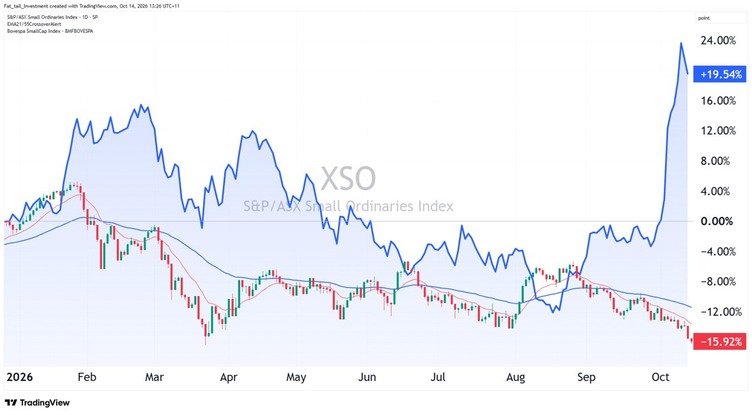
Source: TradingView
[Click to open in a new window]
Brazil’s small cap index is up nearly 20% this year, much of it in a sharp run since the first round of voting.
Our Small Ordinaries is down almost 16%.
Two rare earths developers in Brazil remain in my Elon’s Final Moonshot portfolio theme. As I mentioned at the start, we sold a third, Meteoric Resources, for a gain of around 39% after Lynas agreed to buy it.
As a Fat Tail Daily reader, you can click here to view my latest presentation, where I cover how we banked that win and the companies remaining from that cohort of recommendations.
Upbeat into the new year
The last few weeks have been grim for ASX small caps. Even so, I remain upbeat through to the new year.
I do see an economic slowdown coming in Australia. And let’s be honest, it’s largely being driven by a government that is almost palpably hostile to business and the aspiration to create wealth.
I’ll keep my chin up and stay chipper despite that, and I hope you do too.
One thing keeping me chipper is a project close to my heart.
Alongside Australian Small-Cap Investigator, I run James Altucher’s Early-Stage Crypto Investor Australia.
I’ve just released a big new report for it, “2027: Crypto’s New Rules and 22 Coins for the Next Cycle”.
Trust me, it’s a lot more fun to read than my PhD thesis on blockchain governance.
It introduces a concept of mine from last week, that I call the ‘debt hyper-complex’, which ties directly into the debt stress in today’s note.
Woody, our publisher, is so passionate about crypto’s long-term future that he’s put together a steeply discounted offer for you to join.
If recent market moves have you wondering where all this debt leads, I think the report and the service are well worth your time.
(Offer ends TODAY at 11:59pm)
***
Tomorrow, I’ll be back with the latest.
Have a great start to your week.
Warm regards,
Dr. Lachlann Tierney,
Australian Small-Cap Investigator and Fat Tail Microcaps





Comments