



Yesterday I flagged the widest gap I’ve seen in eight years in markets.
Commodity prices are holding up, while investors dump the companies that produce them.
Today I want to zoom out.
That gap is a symptom of something bigger.
Namely, that we’re approaching peak chaos.
That’s the moment when markets throw out such a cacophony of contradictory signals that most investors stop trying to read them.
Bonds are flip-flopping
The US bond market is just as confused.
For seven months, hot inflation and a flood of borrowing, much of it to fund the AI boom, pushed 10-year US government bond yields to their highest level in more than two decades.
A yield is the return investors demand for lending money to a government.
When fear rises, investors usually pile into government bonds, which drags yields lower.
Last week, that old reflex finally kicked back in.
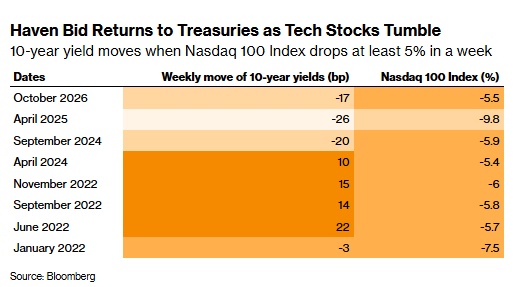
According to Bloomberg, the 10-year yield fell about 0.17 percentage points while the Nasdaq 100, home to America’s tech giants, slumped 5.5%. The last time both moved that much in the same week was the April 2025 tariff turmoil.
Source: Bloomberg
[Click to open in a new window]
So bonds are behaving as though a slowdown is coming.
Yet inflation ran hotter than expected last week, and traders still expect another US interest rate hike before year end.
Oil keeps surging on the Iran war, and Fed Chair Kevin Warsh is keeping his cards close to his chest.
One fund manager channelled Mark Twain, telling Bloomberg that reports of the death of US Treasuries were “greatly exaggerated.”
I tend to agree, but as for if there’s life in the bond trade, amongst the analysts is it…
Dead? Half-alive? Who knows?
Copper’s two-horse race
Copper is stranger still.
Copper on the London Metal Exchange, the global benchmark, hit a record near US$15,000 a tonne last month.
Much of that run came from traders shipping copper into the US ahead of possible Trump tariffs, draining stockpiles everywhere else.
With the US midterm elections approaching, that trade is starting to wobble.
Macquarie reckons copper could crash toward US$10,000 a tonne if Trump rules out tariffs, or rally as far as US$18,000 if he delays them.
It’s currently trading around US$14,400.
Have a look at the spread in forecasts below:

Source: Company forecasts compiled by Bloomberg News; LME
[Click to open in a new window]
Seriously…in the short term, everyone is just guessing.
Fear is doing the pricing
When signals clash this violently, fear does most of the pricing.
At the smaller end of the ASX, fear has been very busy.
The Small Ordinaries index, which tracks smaller ASX companies, is down almost 16% this year.
Many small-cap resource stocks now trade as though their commodities have collapsed, even though things like rare earths prices remain well higher than a year ago.
That kind of dislocation is what deep value territory could consist of.
It’s where share prices trade well below what the underlying assets appear to be worth.
Toes first
In moments like this, the only sensible strategy is often to start carefully dipping your toes in with some of these heavily sold-off commodity stocks.
I take comfort from the long history of markets mean reverting across many of the macro themes these companies give you exposure to.
Mean reversion is simply the tendency for prices that stray too far from their long-run trend to drift back toward it.
I’ll admit that’s cold solace right now.
The big indices, dominated by a handful of giant companies, are soaking up most of the defensive buying.
They also hoover up passive ETF flows, the money that pours automatically into index funds.
Over the coming weeks and months, I expect plenty of grim headlines.
A strategy measured in years gives these macro themes and the best selected small-caps the time they need to play out.
Warm regards,
Dr. Lachlann Tierney,
Australian Small-Cap Investigator and Fat Tail Microcaps





Comments