




Last week, US Treasury Scott Bessent announced that the Treasury would double the capacity of its long-dated bond buyback program from 9th September. Individual operations would increase from US$2 billion maximum to US$4 billion minimum. This was a response to the US 30-year Treasury yield rising to its highest levels since 2007. Given the high amount of debt in the markets, rising borrowing costs could cause distressed companies to default on their loans and trigger a market crash.
The bond yield dipped shortly after the announcement before bouncing back within a day:
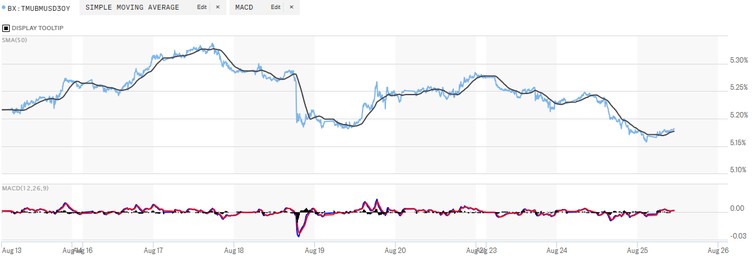
Source: MarketWatch
[Click to open in a new window]
Financial commentators quickly published their opinions, stating that Bessent’s strategy had already failed. They didn’t need to wait a month, or even a fortnight, to conclude this. He failed, period.
However, it’s been only a week since the announcement. Moreover, the program hasn’t even begun! We’re still a fortnight away. Not a single bond is bought yet.
Herein lies the issue of news headlines and commentary. Reporters try to get ahead of the story by inviting financial pundits and experts to comment on the announcement. Some experts jump to conclusions as the reporters press them to take a view or provide some forecasts. What often happens is that there is little or no follow-up later. That’s because the media news window has moved on. The event will play its course over time, sometimes deviating from the accepted consensus view.
It becomes more problematic when some people not only absorb the expert commentary but also use it to inform their investment decisions. These can sometimes deliver losses, even catastrophic ones.
Therefore, what drives clicks and views may prove incorrect and costly later on.
In today’s article, I’ll address this issue in the context of the US-Iran conflict, exploring some calls made by pundits as the saga unfolded.
Examining US$150-200 oil forecasts
When the US-Iran conflict erupted in late-February 2026, WTI oil jumped from almost 40% from US$67 on 27th February to US$95 on 9th March, or just over a week. The Iranian regime quickly declared the Strait of Hormuz closed, potentially stopping 20% of the world’s oil and 25% of gas supplies through the narrow passage. This placed an incredible strain on the global supply chain, because it wasn’t just oil and gas, but also the important chemicals necessary for industries and agriculture.
The US forces destroyed most of the Iranian navy and air force, plus coastal installations as an attempt to reduce the threat against vessels sailing through. However, the damage was done. Insurers and shipping companies were reluctant to place lives and property in danger. Therefore, shipping volumes plunged and remained depressed even today.
The conflict has been on-again-off-again. Brent crude oil spiked to as high as US$120 a barrel in early and late April. However, the Trump administration and the Iranian regime negotiated back and forth on a potential ceasefire from April to May. They signed a Memorandum of Understanding on 17th June. During this 60-day ceasefire, there were further talks about control over the Strait of Hormuz.
Several financial and oil analysts began to present strongly bullish forecasts for oil as they expected the conflict to continue. This included the Chief Economist of Rystad calling for oil to rise to US$150. Meanwhile, Macquarie Group was forecasting US$200 oil if the conflict were to be prolonged until June, an estimate that the CEO of Onyx Capital Group independently provided.
As we know, from May onwards, Brent oil began to pull back to less than US$100. I mentioned this in my The China Capitulation – Part 10 article in late-July. It spiked temporarily above this level in July as the US and Iran were about to resume missile and drone strikes. It currently sits at around US$88:
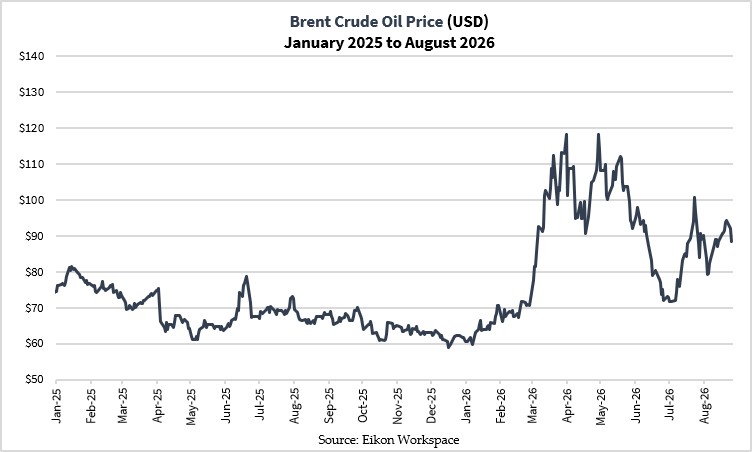
[Click to open in a new window]
Many investors took these bullish forecasts in the past few months and invested heavily in oil futures and oil stocks. As you can imagine, some took heavy losses, especially if they didn’t close out their positions before oil plunged below US$100.
Recent oil forecasts have become more conservative. JP Morgan’s research report in mid-July sees Brent averaging US$86 in the third quarter, falling to US$80 in the fourth quarter and ending the year at US$78. The US Energy Information Administration (EIA) provided a similar forecast for oil, expecting the Brent to trade between US$78-85:
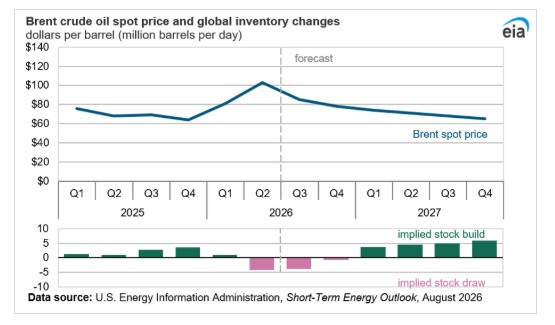
[Click to open in a new window]
Despite these more moderate forecasts, it’s important to note that the world faces a challenge not so much in oil but in petroleum products. However, that hasn’t provided much relief for investors who ran with the bullish oil forecasts and took the corresponding positions.
So why did oil not rally higher than its April peak and the May spike? Let’s explore this now.
Complexities reveal themselves over time
An event may have far-reaching consequences on the economy and markets. However, the impact may also reveal the complexities of the system that we live in. Some things are known only after the fact. Furthermore, the participants respond to the shock and their behaviour can offset each other. Therefore, predictions that sound reasonable and logical may end up falling short when reality reveals itself because no one knows how they would behave until it happens.
This is exactly what occurred with oil. Initially, the price jumped rapidly and remained at elevated levels as the disruption constrained global oil supply. Businesses and households in countries without sufficient oil reserves lived through a fuel scare. Petrol prices spiked and some stations ran out of fuel, with fears of fuel rationing looming. However, by April, the US, China, Japan and other countries with significant fuel reserves helped alleviate the situation by shipping fuel to their allies, reducing imports or cutting fuel levies.
I recall that by around 20th April, petrol and diesel prices were falling by more than the 26-cent fuel excise cut from the government. Within a week, prices were at similar levels to that before the conflict. Not because the oil price had fallen back to pre-conflict levels, but because oil and diesel began flowing more normally. The shortage wasn’t over, as we know today, but the world was adapting.
How countries adapted to the disruption
While the world witnessed the blockade at the Strait of Hormuz, many countries and businesses adapted. They either changed their behaviour or devised plans to work around it.
Firstly, the release of strategic oil reserves by countries helped fill the gap left by the disruption at the Strait. The increased supply stemmed the rise of oil prices, preventing it from soaring higher. Countries also adopted as a national priority securing their energy sources. This meant providing funding and easing access for companies exploring and developing energy sources. Moreover, there was an orderly importing of oil by countries, especially large consumers like China, to prevent oil from soaring.
Secondly, the global economy had been in a fragile position since reopening after the pandemic. This was especially the case with China, which imported Iranian oil at a discount from which its economy enjoyed significant benefits. When the US blockaded Iran in response to the IRGC declaring the Strait closed, Chinese industries lost their access to this oil. Refineries reduced their capacity and the Chinese government drew down its strategic reserves. Faced with higher operating costs, factories reduced their capacity and laid off workers. This resulted in lower income and consumption. Other countries faced similar situations, but at varying degrees. Thus, demand destruction reduced the need for oil, partly offsetting the impact of supply disruption on the oil price.
Thirdly, vessels that had previously sailed the Strait of Hormuz temporarily halted their journey at the beginning of the conflict due to uncertainty. However, some resumed, as the US Navy provided cover for them to cross safely. Ships began to adopt the practice of shutting off their transponders, or ‘going dark’, to escape radar detection. As mentioned before, while traffic has fallen well below pre-conflict levels, around 200 ships have sailed past the Strait this month . This could increase as more ships sail through the Omani part of the Strait and the IRGC’s military capabilities decline.
As mentioned before, the economic challenges rest not in crude oil but diesel, petroleum products, sulfuric acid and fertilisers. These remain an issue. However, predictions of a 1970s Oil Crisis have not yet played out.
The bigger scare – Market crash
Compounding the forecasts of oil rising to US$150-200 was the fear that this conflict would cause a market crash. The logic behind this arose from how higher oil prices would push inflation higher, cause the US Federal Reserve and other central banks to raise interest rates, and trigger a wave of defaults to crash the markets.
What sounds logical doesn’t always play out that way, especially because there are institutions and policymakers who will intervene. Their impact may be temporary, and the consequences may or may not be what we had initially predicted.
The risk of a market crash was not insignificant, especially as the conflict shifted from military strikes to a standoff over the Strait of Hormuz and also Bab el-Mandeb. The US Federal Reserve was expected to cut rates into 2026 at the start of the year. This quickly changed to rate hikes when oil surged and inflation set in. Even until the end of July, the market was pricing at least one rate rise before the end of the year. However, the Federal Open Market Committee decided to hold rates at the July meeting, with nine voting to hold and three voting for a rate hike. Further economic data releases in August showed weak numbers, prompting markets to expect the rate hike to defer once more.
With last week’s move by Scott Bessent, the bond buyback program has put another backstop in the market. This could reduce the pressure on distressed companies while providing more liquidity to boost investor confidence. One can debate whether this is beneficial to global markets in the long term. That depends on how much of this liquidity goes to actual productivity, rather than to pump the financial markets and support unproductive or overvalued businesses.
The herd gets the story wrong
and pays a steep price
In summary, I believe that headlines and commentary coming straight after an event are often sensationalised and aimed at drawing attention. But they don’t always stand the test of time because there is little time to fully digest what’s happening. The bigger the event, the more likely unintended consequences and second-order factors are to affect the outcomes, sometimes causing them to deviate from what you would expect. No matter how experienced or sagely an expert is, no one can anticipate them in advance and therefore make the right call.
Getting the story wrong may be trivial to some. No one can predict the future precisely. If the narrative has moved on, few people will talk about it and pick up on your mistakes. Or they don’t even care.
However, if you invested based on these expert opinions, that’s when it becomes costly. Your conviction buys could blow up in your face and cost you dearly. Meanwhile, the expert gets their moment of fame, moves the markets with their opinions and never has to answer for it. Even if they changed their stance, you’re unlikely to hear about it and adjust your positions accordingly.
That’s why it’s more important for you as an astute investor to understand how the markets work, how participants behave, and what indicators to monitor. Rather than try to fit your preconceived views to interpret what is unfolding, let reality do the talking. It doesn’t mean abandoning your worldview and values, but rather about having an open mind and joining the dots.
Gold’s back in play –
Learn its true message
I admit that I sometimes will apply my worldview to interpret what’s happening, build my portfolio around it, and be slow to adapt to developments that counter my views. During this conflict, gold and precious metals assets tumbled and remained depressed until recently.
However, the reason I hung on during the selloff wasn’t a dogmatic belief that gold would rally to US$10,000 and silver to US$500 from a market crash. Nor did I sell in a panic to load up on oil futures, fertiliser and AI stocks that were rising. I had a thesis and was studying how the developments could impact my positions in the long-term. If you followed my articles these six months, you would see that my interpretation of the events allowed me to feel comfortable enough to endure the paper losses. I believed those setbacks were temporary.
Since the start of this month, things have become more favourable for gold and other precious metals assets. Last Thursday’s announcement by Scott Bessent boosted them further. For me, his strategy to push the 30-year yield curve down has so far benefited me, as well as other precious metals enthusiasts! If he’s failed (or so some claim), I’m not complaining.
But returning to the point of my article, I believe that it’s important to follow and understand major events even after others have moved on. This is because it helps you grasp how the system works. These insights will guide you in developing a more informed strategy for managing your portfolio and improving your potential gains.
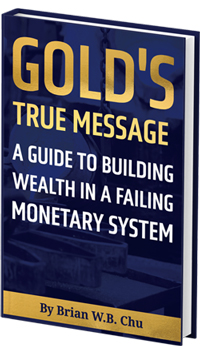
If you want to learn more about how the precious metals market works and how to build a portfolio with these assets, I invite you to click here. I’ve studied this market and the monetary system for almost 15 years, investing alongside it to build my family wealth. All these you’ll find in my book, ‘Gold’s True Message: A Guide to Building Wealth in a Failing Monetary System’, which I finished writing last year:
Even if the markets don’t crash and gold doesn’t soar to US$10,000 yet, now is the time to learn more about how the system works. You can build your positions and enjoy the rewards trading the gold price cycles.
That’s it from me this week. Enjoy the weekend ahead!
God Bless,

Brian Chu,
Gold Stock Pro and The Australian Gold Report




Comments