




Mineral scarcity.
Since starting at Fat Tail, I’ve touched on this theme many times.
For me, the idea was born from anecdotal evidence after years spent as an exploration geologist. Deposits are becoming harder to find.
But as the years pass, this so-called ‘scarcity problem’ is gaining traction among a wider audience.
You may have heard about the issues surrounding copper supply: Declining grades and aging deposits. These concerns could have a meaningful impact on global inventories.
But did you know that gold supply
faces a similar dilemma?
To show you what I mean, let’s step back to a time of abundance… The period 1990-99.
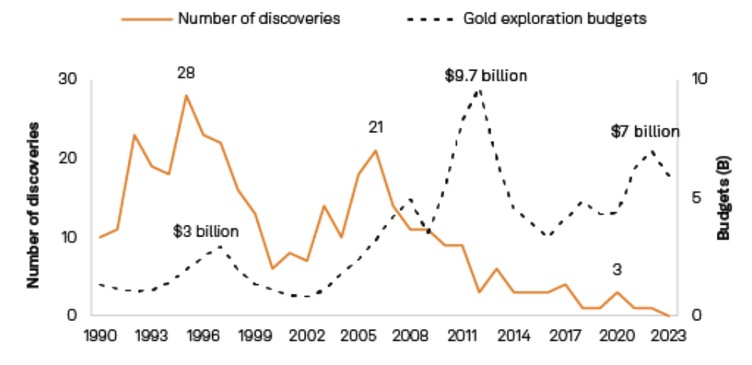
Over this decade, explorers uncovered no less than 183 ‘significant’ gold deposits across the globe.
According to official statistics, this added around 1,660 million ounces of untapped bounty.
But here’s the interesting part: those discoveries occurred against the backdrop of a prolonged commodities downcycle. Yet, the 90s were blessed with a plethora of quality gold finds.
In the years that followed, challenges emerged in the hunt for new gold.
Despite record prices and massive investment in exploration, the commodity boom period from 2000 to 2009 witnessed just 120 new gold discoveries.
That equated to around 900 million ounces.
A big fall from the decade prior, despite the surge in investment.
But get this: once the commodity boom began to wane (after 2011) and investment dried up, the rate of new discoveries collapsed.
The decade from 2010 to 2019 witnessed just 42 discoveries worldwide!
Adding a measly 312 million ounces of untapped reserves. That represented a major 70% drop from 20 years prior.
Despite many commentators coming out and challenging the idea of ‘mineral scarcity,’ these numbers don’t lie.
Minerals are, in fact, a finite resource.
If you have any doubts, check this out from S&P Global, showing the terminal decline of gold discoveries:
Source:S&P Global
[Click to open in a new window]
Gold was scarce 2,000 years ago, but it’s even rarer today!
But there’s another problem
Companies are already throwing vast sums at trying to uncover new gold deposits. Worldwide, rigs are spinning at record-high rates, yet discovery remains muted.
The payback for explorers is exceedingly poor.
So, what gives?
Have geologists lost their way? Are they even capable of finding new deposits?
Well, that could be part of the problem here.
You see, mining, especially exploration, suffers from severe boom-to-bust cycles.
And according to 40-plus-year industry veterans I’ve spoken to, the last down cycle, from 2013 to 2019, was among the worst.
A depressed employment market sent many veteran ore hunters packing and searching for new careers. Or just taking on an early retirement if they had the means.
And from what I’ve seen on the ground, young geos are being put in charge far too early in their careers.
There was a time when a senior exploration geologist required around 15 years of experience to get the job. Today, that’s down to just 3-5 years!
It speaks to the sector’s inexperience, generating a crunch moment for the mining industry as it attempts to replace ageing deposits with new supply.
And since deposits are becoming deeper and thus harder to find, more experience is needed now than ever!
Australia, not the discovery
centre it once was
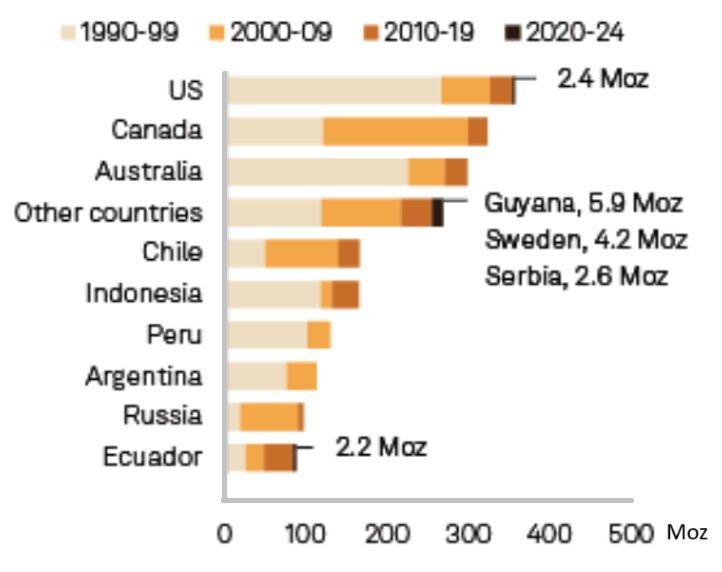
Digging into S&P Global’s latest data, Australia is clearly waning in its role as a hub for gold discovery.
The country’s ‘golden years’ were back in the 1990s.
Past success has kept Australia’s gold production strong today. Yet that can’t last against the long-term backdrop of declining discoveries.
It puts Australia’s role as a major gold producer under threat… A slow-moving train wreck. In contrast, Canada is one of the few jurisdictions revelling in new discoveries.
The country has tapped into new northern frontiers, including the richly endowed Yukon Territory—previously unexplored areas are now delivering rich rewards.
Yet Canada is an outlier; discoveries have been in steep decline worldwide since the early 2000s:
Source:S&P Global
No doubt, scarcity provides a floor that helps prices to rise over the long term. So, with all that in mind, it’s not likely we’ll see an oversupply of gold anytime soon.
Until next time.
Regards,

James Cooper,
Mining: Phase One and Diggers and Drillers
P.S. If you’re interested in learning more about this ancient monetary metal, I suggest checking in with our resident gold man, Brian Chu. You can find out more here.




Comments