




Two of the most important chokepoints in global energy have spent much of 2026 under direct threat. The world has focused on the Strait of Hormuz in the last four months. But attention has now turned to the Bab-el-Mandeb. With Iran openly floating a second front using its Houthi allies in Yemen, these two waterways carry almost a third of the world’s seaborne oil as well as marine transportation.
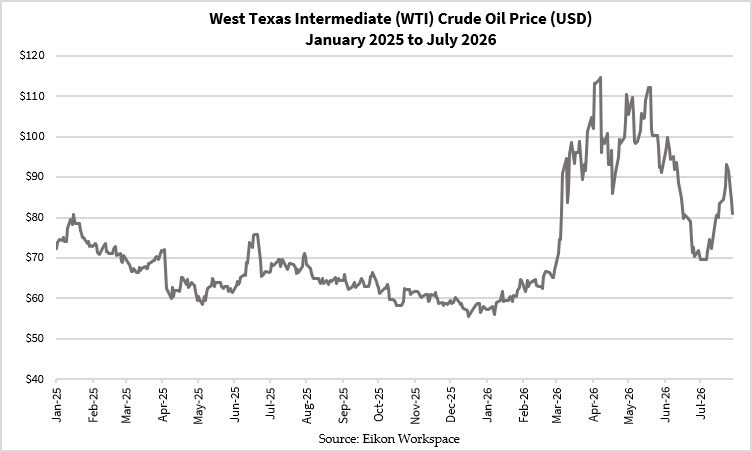
As expected, oil jumped again in the past week. Both the WTI and Brent headed above US$90 a barrel, with the latter nearing US$100:
[Click to open in a new window]
But crude oil prices are significantly below the US$120 peak in April. Moreover, petrol pump fuel prices have risen, though below that in March and April.
What’s the reason for oil trading at these levels and not higher? Part of the answer is China.
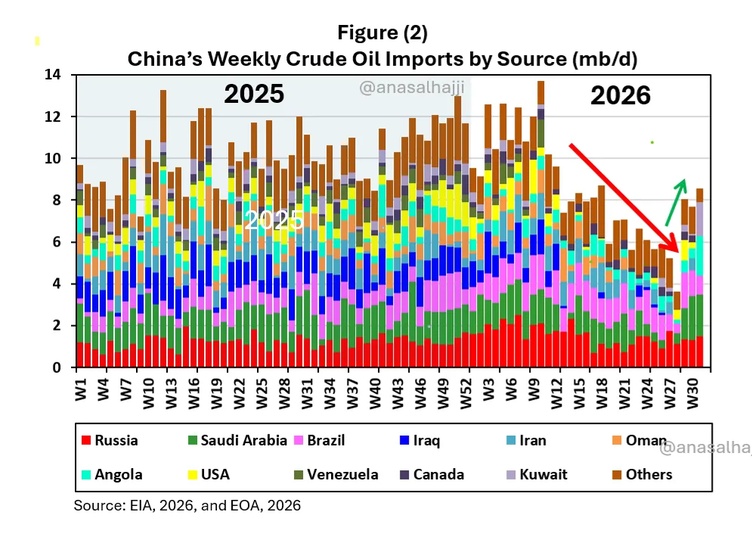
China is the world’s largest crude importer. But in recent months, it has quietly stepped back from the market — cutting fresh purchases, tightening its own refined-fuel exports, and drawing down existing inventories rather than bidding aggressively for cargoes at wartime prices:
Source: The Daily Energy Report
[Click to open in a new window]
Some reports put the drawdown at around 41 million barrels in June alone (notice the recent weeks where crude oil imports plummeted to 3-6 million barrels a day). Beijing effectively removed itself from being the world’s largest marginal buyer that sets prices.
Conveniently, this is happening exactly when the market needed that buyer least.
You may suggest this shows discipline. China built a war chest of cheap oil during 2023–25 and has enough to allow it to sit it out while missiles fly over the Gulf. Many credit China with playing the long game. It’s content to watch the West and the Middle East burn through the crisis while it sits on a stockpile estimated at well over a billion barrels.
It’s a talking point for many China bulls in the West, who believe that China is destined to overtake the US and become the world’s next superpower. This point may appear to reinforce that view.
Let us delve into this today.
THE NUMBERS BEIJING CAN’T SPIN AWAY
China isn’t sitting out this oil shock because it’s playing four-dimensional chess. There’s a less flattering explanation to this: the Chinese economy can’t absorb the cost of playing at all. When your own consumption is quietly collapsing, it becomes a lot easier to look disciplined about not buying more oil. Refining margins have been thin, forcing China to rely on discounted sources of oil. That was its competitive advantage for several years.
However, the recent oil shock caused domestic refiners to cut processing rates to some of their lowest levels in years. As refining margins compressed further, domestic oil production fell. Meanwhile, the Chinese people responded by buying more electric vehicles, thereby consuming less petrol and diesel. At the same time, industries substituted petrol and diesel for coal, gas and renewable energy sources.
But there’s more to this story than energy substitution.
The Chinese economy has slowed substantially. For months, the official published data have pointed to this. This is despite the government’s efforts to put on a front to the world and its own people that the engine is still chugging along. If you follow the right channels covering what’s happening on the streets, you’ll find a harsher and less glorious reality.
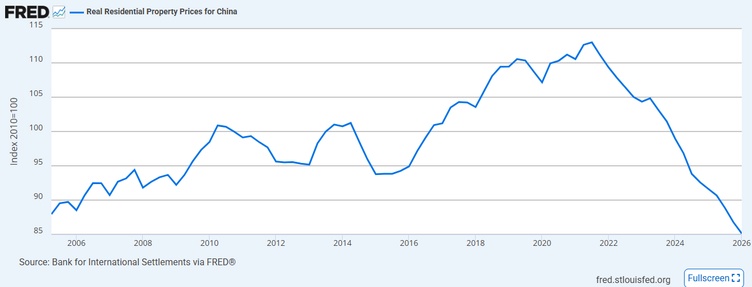
Let’s start with the property market, the storehouse of household wealth and bedrock of social stability. Below is a figure showing the inflation-adjusted price levels over the last two decades:
[Click to open in a new window]
Housing has fallen for four straight years. New home prices across the 70 cities the government tracks fell again in June 2026 — the 36th straight month of annual declines. The secondary market is worse: resale prices in China’s biggest cities are down close to 7% year-on-year.
But it’s how prices have fallen BELOW that in 2005 that you should pay attention to. Put simply, an entire generation’s household wealth, built into bricks and mortar, rose gradually over 15 years before giving back all those gains in the most recent four.
Not to mention that many paid interest on their loans. So they’re actually worse off.
Youth unemployment tells a similar story. The official jobless rate for 16-to-24-year-olds (excluding students) has oscillated in the mid-to-high teens for more than a year, after peaking above 21% in 2023 under the old measurement method. A record 12.7 million university graduates has just entered the job market this northern summer, competing for jobs in an economy where AI adoption is displacing white-collar work while factories face higher input costs because of oil’s spike.
You would expect that a combination of a strong manufacturing economy, energy preparedness, AI adoption, and increasing availability of young talent would boost prosperity and business confidence. In turn, productivity and consumption would accelerate to reflect the good times are in.
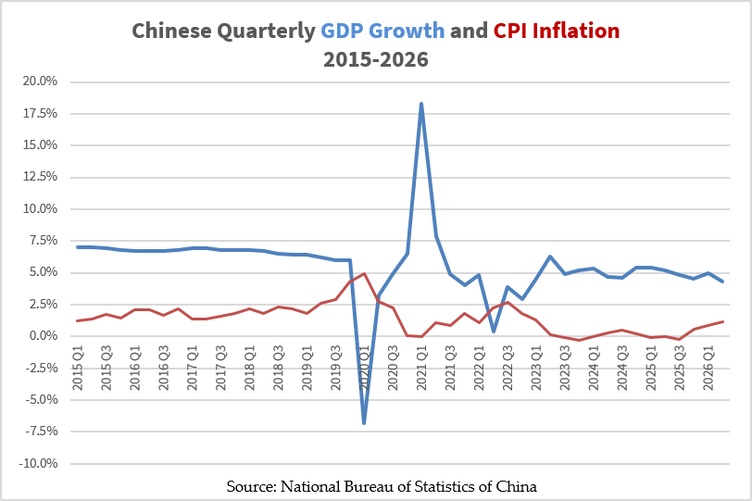
However, both have fallen in recent years, creating a concerning trend that even the data cannot hide:
[Click to open in a new window]
China’s consumer price index dropped significantly since it reopened in 2022 and has remained weak. The slight increase in the last two quarters hides the fact that the monthly CPI growth in June 2026 fell to 1%. People have recently been paying more for what they are buying but that’s because producer input costs jumped from oil’s spike. Remove that effect and deflation in everyday consumer goods remains.
It’s worth noting that these official figures are curated and massaged. The data clearly points to slowing growth and weaker spending patterns. If the numbers can’t hide the downward momentum, what does this mean about reality?
The narrative of a buoyant economy doesn’t add up.
Now it’s tempting to explain this away as culture — the old story that Chinese households simply save more than Western ones.
That’s a valid point, as I lead a similar lifestyle. But I think the deeper issue is structural, not cultural.
And it’s this.
HELD DOWN BY A STRUCTURAL PROBLEM
China’s most successful companies of the last decade — BYD, Pinduoduo, Meituan, have graced the global stage in recent years for being extraordinarily profitable businesses. Many believe that the success of these companies (plus others not mentioned) would propel China ahead of the US.
Yet the gains from that success are not shared in a way that would help China move forward. That’s because the benefits go disproportionately to the few at the top, namely executives, major shareholders, and party officials, through opaque insider dealing and political connections. The workers and delivery riders whose labour makes those profits possible get very little of the profit-share, if at all.
BYD’s reported average compensation per employee, estimated at around US$21,000 a year, sits at a fraction of what comparable US electric vehicle manufacturers pay their workforce, around US$90,000. Given China’s lower cost of living, the BYD employees are paid better than those employed in other industries. However, consider South Korea’s SK Hynix where employees share 10% of the company’s operating profit, market estimates they could receive bonuses ranging from US$200,000 to almost US$500,000. Clearly, the BYD employees are paid only a fraction of what they may have contributed to the company’s fortunes. It doesn’t measure up. For this reason, reports have surfaced of employees striking over pay at BYD plants and other large businesses.
Workers in China are often underpaid because they have so little leverage to bargain for a bigger share. Independent unions are effectively outlawed in China. The Communist Party’s official union federation controls any unions that are allowed, meaning they function as a mechanism of control rather than as a genuine agent bargaining for better pay and working conditions.
Until recently, Beijing’s newly announced protections for some 200 million delivery riders and ride-share drivers, are a tacit admission of how bad conditions have become. But even these protections route through Party-aligned channels, not independent worker representation.
This unique structure in the Chinese economy explains why for a long time it was competitive with other countries in terms of growth and resilience. Excessively profitable or barely holding on with razor-thin margins, businesses in China operate by squeezing input costs, whether physical or human capital. However, it is fast approaching a brick wall, as workers who don’t reap the benefits are unable to spend more to keep pace with the economy.
Deflation is no longer just an anomaly, but a trend cemented by policy and culture.
And that’s also why we’re seeing Chinese goods exported worldwide at a growing pace. This is excess supply, selling at prices Western competitors call dumping. It’s not just with electric vehicles but anything that the Chinese factories produce that its domestic population increasingly can’t afford to buy.
THEN THE SUMMER FLOODS CAME
As if the above wasn’t enough, nature has piled on. Nationwide flooding through May, June and into July has killed dozens (almost always understated), displaced tens of thousands, and swamped farmland in provinces from northeastern to southwestern China — right as wheat harvests were underway.
Not surprisingly, those hit hardest by these floods are, almost without exception, the ones with the least buffer to absorb the loss. The aftermath of these disasters will send food and staple prices higher in the months ahead. This will flow into the inflation figures. But don’t make the mistake of thinking that rising CPI in the coming quarter suggests that the broader deflation problem is subsiding. The numbers will merely mask another problem layered on China’s shrinking economy in real terms. It adds further pressure where it matters most — jobs, household wealth, and consumer confidence.
US, CHINA OR IRAN – YOUR PRIORITY IS PRESERVING YOUR WEALTH
I understand the appeal of the story that China’s resilience will take it to the top. China’s headline GDP numbers, its manufacturing scale, its dominance of supply chains for everything from batteries to rare earths, all look formidable on paper.
But I’ve shown you what’s underneath when you peel back the veneer. A property market that has erased two decades of real household wealth gains, a youth unemployment problem that persists no matter how the government massages the methodology, a consumption engine stalled by a system that won’t let ordinary workers share in the profits they generate, and now, a string of natural disasters compounding all of it.
Stories are powerful right up until the facts underneath them stop supporting the telling. We might be reaching that point.
However the war in Iran and the wider Middle East ultimately plays out, China is not emerging from it as a winner. Its restraint in the oil market looks less like strategic patience and more like it’s managing a structural economic problem at home. It’s not a simple problem either because it is rooted in their policies.
Unless workers start seeing a fairer share of the wealth they help create, all that extra industrial capacity goes to padding the headline numbers, flooding the world’s markets, and delivering little benefit both at home and worldwide. It’s a race to the bottom.
China’s foundation is rotting from the inside. That’s not unique. Other countries are facing a similar problem under our crumbling monetary system.
And this is the kind of environment that makes it so important for you to stand on firmer foundations. While the conflict in the Middle East persists and the country that many have pitched their hopes on being the quiet winner is cracking at its seams, you shouldn’t join them in this gamble. It’s even more relevant when both the US and China are key trading partners and our own economic fate rests delicately on their fortunes.
Owning a store of value outside any single government’s control, such as gold and silver, can offer you that peace of mind.
Interested in how I’m positioning around this theme and the challenges we face in Australia given the implications of our recent Federal Budget? You can also learn about how to build a precious metals portfolio to ride out the coming storm. Please click here to watch my presentation.
I hope you enjoyed this article. As always, have a good weekend ahead.
God Bless,

Brian Chu,
Gold Stock Pro and The Australian Gold Report




Comments