



On Thursday, I made the case that we are watching the wrong bubble.
The market keeps asking whether AI is 2000 all over again. I argued it’s closer to 2008.
2000 was an equity event. Too much optimism priced into thin balance sheets, then marked down and held for years. This cycle looks more like a classic debt cycle, just with new vehicles.
Take-or-pay compute deals. Loans secured against GPUs. Off-balance-sheet vehicles. Asset-backed notes sold to insurers. They are just one part of this huge debt-funded buildout.
But as I warned, if the buildout stretches on while the rate of gains slows, this could turn into a debt-refinancing treadmill rather than a share-price story.
One where building an ever-taller Tower of Babel is needed to stave off creditors and the depreciating assets underlying those deals.
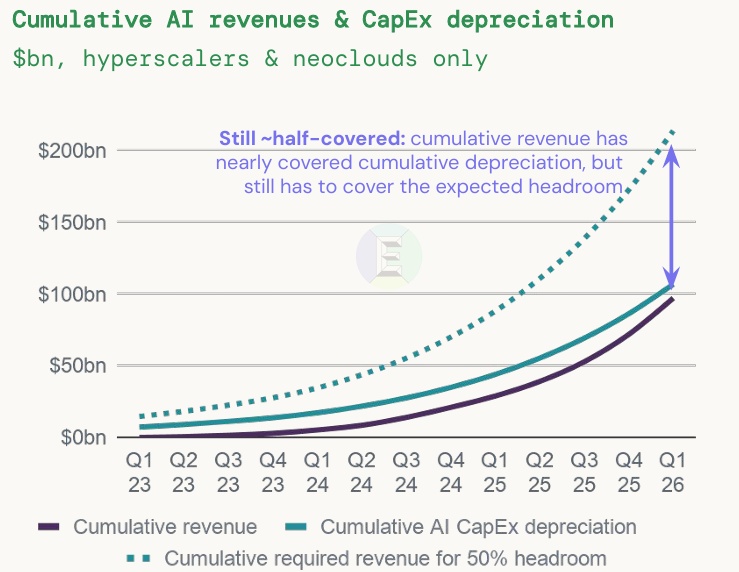
You can see that the gap between depreciation and revenue is closing, but the line is too thin for comfort. And many have questioned the legitimacy of those depreciation numbers.
Source: Azeem Azhar et al.
[Click to open in a new window]
Which leaves the question I closed on. If spending is pushing them farther out on the plank, why won’t they stop?
The dollar auction
If you listen to any earnings call of the hyperscalers, you’ll hear the same thing: demand is there — we’re building because people want more AI.
There is truth to that. For many of us, AI use is now a daily norm. AI is now scaling at three times the rate of any prior IT wave.
However, it’s worth recognising that the AI we use is subsidised. It’s made cheaper to promote this very demand growth.
Sam Altman of OpenAI has said in the past that OpenAI loses money on its US$200/month plan. That’s sustainable until it’s not.
Add to that, pressure from cheaper, open Chinese models, whose capabilities grow every quarter.
So then why would hyperscalers continue to grow blindly into this AI pricing uncertainty?
Many see this as an existential race for survival.
Yes, they are chasing profits, but there’s also a clear and present danger that AI could usurp their businesses. And ultimately destroy their tech platforms.
There’s a piece of game theory that explains the spending better than any demand forecast. A dollar auction.
In a dollar auction, someone auctions off a one-dollar note. The highest bidder wins it. The catch is that the runner-up also must pay their bid and gets nothing.
So, if you are bidding 95 cents and about to lose, paying $1.15 to win is cheaper than paying 95 cents for nothing. The auction then climbs above a dollar.
Every bidder is rational. Everyone pays to survive. The room ends up worse off.
That’s where the hyperscalers sit. Zuckerberg and Google’s Sundar Pichai have both publicly said that underinvesting in AI poses the greater risk.
They could be right. The problem is that all of them are right at the same time.
All are spending at incredible rates to hold and grow their market positions. But the loser’s costs could be dramatically more than the winner’s. Even if the winner vastly overspends.
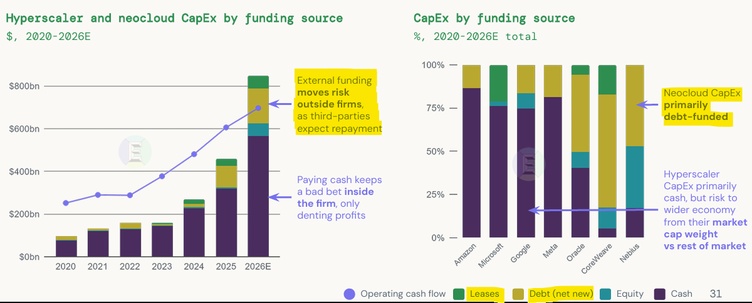
In the classic game, bidders use their own money. Now, every bid higher is increasingly being funded with debt.
You can see that below in green and yellow. More and more, each new dollar of infrastructure capex is borrowing from the future.
Source: Exponential View
[Click to open in a new window]
Where the bond market comes in
That is where this week’s bond moves connect.
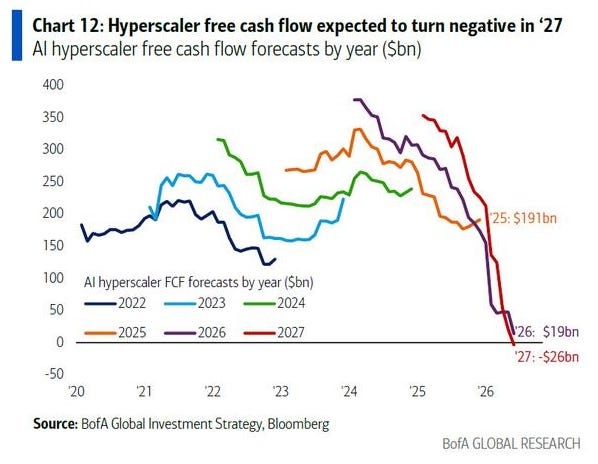
Capital spending is now overwhelming the hyperscalers’ free cash flow.
Google, for example, just saw its first quarter with negative free cash flow. The rest may soon follow suit.
Source: BofA Global Research
[Click to open in a new window]
Below that 0, every extra dollar of capacity either comes off the balance sheet or comes as a new loan. Both eat away at investor patience.
The fortress balance sheet story holds above that line; below that, we’re in new territory for these once capital-lite businesses as they turn to debt.
Morgan Stanley puts investment-grade leverage across the group at about 1.8x of gross debt-to-EBITDA, double where it sat a year ago.
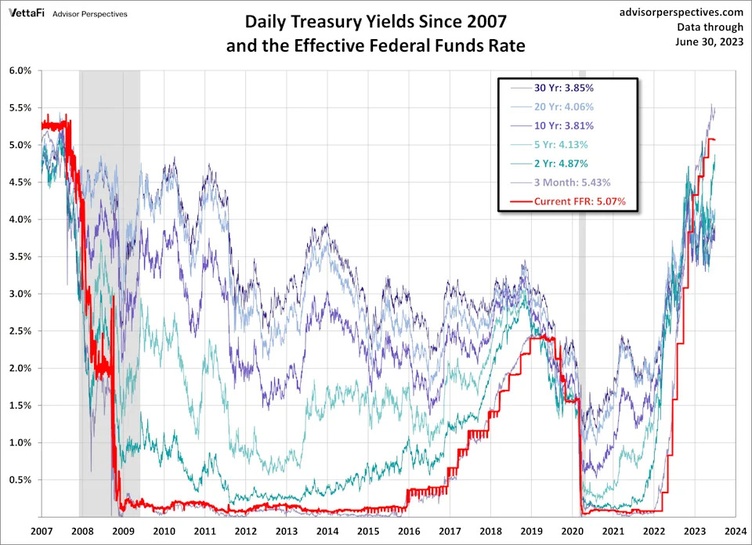
So, the build now leans on debt markets at the exact moment long-term credit costs the most since 2007. An auspicious date if you ask me.
Long-term yields at 19-year highs, harking back to the last major credit crunch, may be too simple a 1-to-1.
Source: VettaFi
[Click to open in a new window]
Maybe this is just the market correcting to this new Fed era, where the market takes the lead rather than the Fed.
Warsh made the point himself. He argued that rising yields between meetings had already tightened policy on his behalf.
But for a levered, refinance-dependent AI build-out, that tightening is not background noise. It could be the guillotine of this credit cycle falling.
What I am not saying
I am not calling a date. Nobody credible is.
The gap between the moment acceleration rolls over and the moment something visibly breaks can run on. The future is not always written in the past.
What is instructive from the past, however, is how every age anoints its defining technology as destiny.
The Saint-Simonian technocrats saw the railroad as the nervous system of a new civilisation. The rhetoric of the ‘electrical sublime’ imbued electricity with the aura of a divine force and a utopian future.
Now we face an algorithmic sublime. To deny it is akin to apostasy.
That rhetoric may change when the bill comes due… For now, watch the growth rates rather than the headline numbers. Watch whether the AI labs keep clearing higher marks.
And watch for the first hyperscaler to announce a spending cut and be rewarded for it by the market.
The moment that happens, others may take notice. Then the capex cycle unwinds.
Because that’s how a dollar auction ends. Not when the bidders run out of money, but when one of them finally stops, and the room decides he was the smart one.
Regards,

Charlie Ormond,
ATLAS and Altucher’s Investment Network Australia




Comments