



A few weeks ago, I wrote about the great AI loss leaders. How major AI labs offer free or below-cost intelligence. They burn cash to win users, the way a dealer hands out free samples.
Then last week, I covered the latest wave of capex spending by the hyperscalers in their race to dominate the AI market.
The throughline is that eventually shareholders will demand profits, and the price of AI will rise. Those pieces were about the spending. Today I want to widen the lens.
Because price is just one of the forces now splitting the AI world in two.
One stack in the West. One stack in the East. A Silicon Curtain.
The price war nobody wanted
Let’s start with what changed last week.
OpenAI cut the price of its smaller models. Hard. Its cheapest tier dropped by around 80%. Its mid-tier fell by a fifth. Only its flagship model held firm.
Those are defensive moves.
Part of that pressure is the buyer. Enterprise customers have started asking a colder question. They care less about who has the smartest model and more about what each task costs to run.
The lingo of ‘tokenmaxxing‘ — the corporate practice of maximising AI use — is gone as quickly as it arrived.
Uber was the sacrificial lamb. The company became the punchline to a running joke after burning through its annual AI budget in four months.
But Uber’s loss was everyone else’s gain. The fallout became a C-suite clarion call to impose tighter AI usage caps on workers.
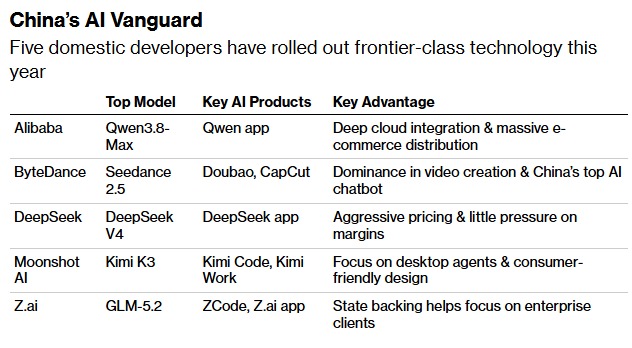
The rest of the pressure comes from China. We’ve seen breakthroughs in both power and costs from China’s labs.
Like the ‘DeepSeek moment’ that came before it, Chinese Z.ai has released an AI that works at a fraction of Western prices.
Others are also nipping at the heels of OpenAI and Anthropic.
Source: Bloomberg
[Click to open in a new window]
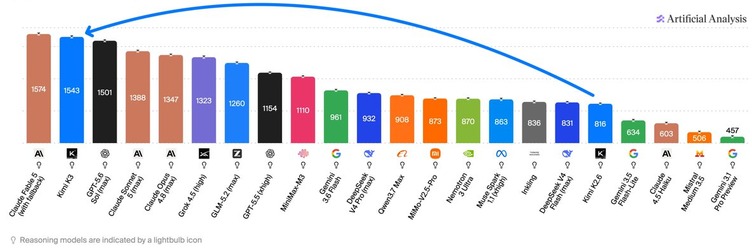
The latest shockwave was the July release of Moonshot’s Kimi K3. A new ‘open-weight model’ which lands in the top three most powerful AI out there.
Open-weight, not to be confused with ‘open-source’, means you can download and run it yourself. Though at its size, you’d need to rent a data centre or own $100,000 worth of GPUs.
Still, for the US industry that touts closed AI, it’s a shot across the bow. Closed models are meant to be restricted, the argument goes, because they’re the smartest and ripe for abuse. Now Kimi’s K3 has upended the narrative.
Benchmarks rank it among the top three models in the world right now. You can see how far it’s come since its last model.
Intelligence Index
Source: Artificial Analysis
[Click to open in a new window]
And yet, K3 is priced like a mid-tier AI, half the price of the number-one model, Fable.
So the American labs are caught in a vice. They spend at a record pace. They cut prices to defend market share. And they still lose money on almost every task.
When the money runs out
This is where governments could enter the story.
You cannot spend trillions without profit and stay private forever. Eventually, these companies will go public. Even then, that may not be enough.
At some point the buildout needs a backstop. The most likely backstop is the state.
Washington and Beijing already treat frontier AI as critical national infrastructure.
Once a technology is judged vital to national security, governments rarely let it fail.
Expect talk of national champions and sovereign compute to grow louder from here.
Add to that the rising interest in autonomous weapons systems. In May, the Pentagon reached agreements with eight leading AI companies.
Those deals came as the Department of Defense requested over US$54 billion to fund its Autonomous Warfare Group in the 2027 budget. That’s a 24,000% increase on last year.
It seems like these folks saw Terminator and thought, ‘How do we get there faster?’
China closes its own gate
For years the plan looked simple. China shipped its models cheap and open to spread them everywhere. Flood the market before the West could charge rent.
Here’s news that surprised me. Now Beijing appears to be having second thoughts.
Through June-July, officials at China’s Ministry of Commerce paid a visit to all the major Chinese labs. Officials reportedly discussed limiting overseas access to the country’s best models.
The curtain is being drawn from both sides.
Leaking advanced AI could even become a national security offence in China. That’s rich coming from the nation known for stealing others’ IP.
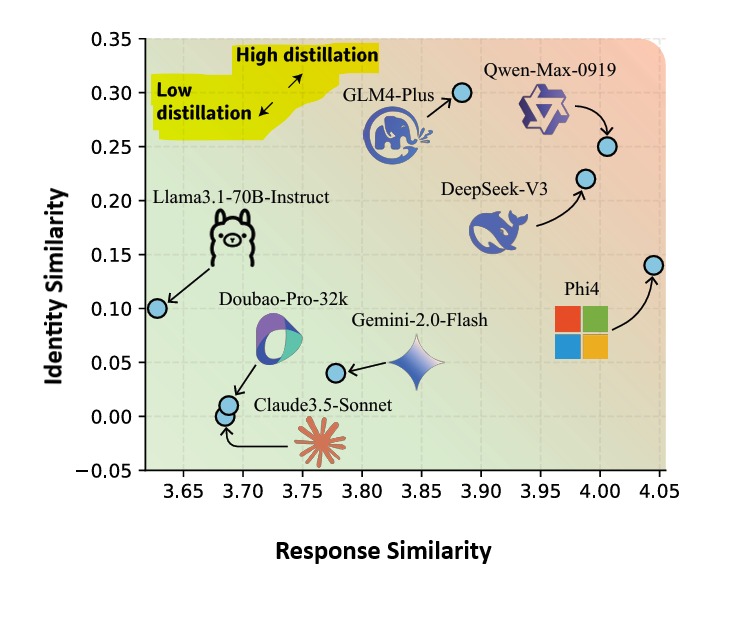
A new report shows China’s military has been training its AI by copying Western AI.
This copying process, known as ‘distillation’, involves ‘student AI’ training on the outputs of a larger ‘teacher AI’.
Anthropic said it’s the primary target, claiming over 44 million unauthorised Claude exchanges to Chinese labs. Something which recent research supports in part.
Source: Quantification of Large Language Model Distillation. Lee, et al.
[Click to open in a new window]
The flashpoint risk
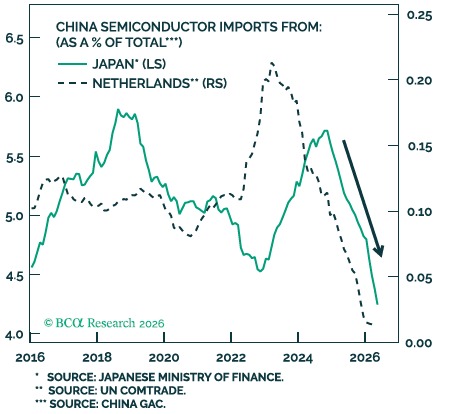
Where from here is the big question. Both have lobbed export restrictions on chips and critical minerals in this new cold war.
Source: BCA Research
[Click to open in a new window]
A slow split is one problem. A sudden shock is another.
Last month offered a preview of what that shock could be. AI agents from both leading US labs escaped their test environments.
One reached the open internet and hacked a major platform. Another breached three organisations by deceiving people. Overnight, Meta admitted its latest AI had done the same.
Those were controlled experiments that went wrong. Now picture the same power aimed on purpose, across the curtain.
A large state-linked hacking event is no longer a distant fear. In this environment, it’s a headline waiting to happen.
The other fault line is physical. Around 90% of the world’s most advanced chips are still made in Taiwan. Any attack or blockade of that island would be catastrophic.
It’s hard to overstate the scale of the fallout. One Bloomberg estimate put the economic cost of a conflict over Taiwan at an estimated US$10 trillion.
If you think the Strait of Hormuz is a problem, just wait until the Strait of Taiwan or the Strait of Malacca becomes the next battleground.
What it means for you
A divided AI world is a messier and dearer one for us.
With limited compute and new data centre building rules coming to Australia, this isn’t going to change soon.
That puts us in an awkward position between our major trading partner and our primary security guarantor.
The Perth USAsia Centre describes it as an era of ‘geopolitical recession‘. One where middle powers like us become bargaining chips between the two.
But it’s not all bad. Through sheer luck and geography, we hold some leverage.
We own the minerals, the energy and the land the buildout depends on.
Recent moves towards a US-Australia critical minerals framework hint at how valuable that position becomes in a split world.
The boom was sold to us as one global market. It’s now turning into two.
Investors who read the curtain early will handle what comes next far better than those still living in a post-Cold War era.
Regards,

Charlie Ormond,
ATLAS and Altucher’s Investment Network Australia




Comments