



The material is gallium.
It is a soft silver metal that melts in the palm of your hand at about 30 degrees.
It usually comes as a byproduct of the process that refines bauxite into aluminium, which is how one country ended up holding nearly all of it.
China produces roughly 98% of the world’s primary low-purity gallium.
The United States has not produced any primary gallium since 1987.
In December 2024, Beijing banned exports of it to America.
That ban is suspended right now, and the suspension runs out on 27 November this year.
Here is what the truce has not fixed.
Western buyers paid a record US$2,101 a kilogram in Rotterdam back in March.
Buyers inside China paid closer to US$250 for the same metal.
That gap is what Chinese export licensing does to a price.
Why anyone wants it
Gallium nitride switches and converts electricity faster than silicon, and throws away less of it as heat.
That has made it the power chip of choice for AI server racks, and Nvidia has signed partnerships with three separate chipmakers to build its power delivery around it.
A large AI data centre holds roughly 179,940 tonnes of metals and minerals.
Just 5.3 tonnes of that is gallium, thirteenth by weight, with no substitute at scale.
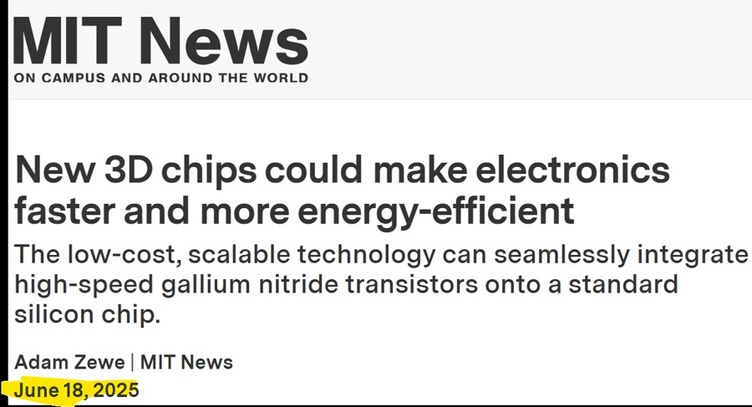
MIT worked out how to stack gallium nitride transistors straight onto ordinary silicon chips over a year ago:
Source: MIT News
Then there are the space applications.
Satellites run on gallium.
Radar, radio frequency chips, radiation-hardened electronics and space-grade solar cells all lean on gallium arsenide or gallium nitride.
Every launch is putting demand in place for another order for a metal America cannot currently make.
What I did about it
I had been following gallium closely for more than a year before I did anything about it.
A deep dive into an EU report on critical defence minerals got me interested in the first place.
I read the export control headlines, watched the price climb and kept an eye on what defence buyers were quietly saying about substitution.
By the middle of last year, the picture was clear enough to act on, and still quiet enough that almost nobody in this country was writing about it.
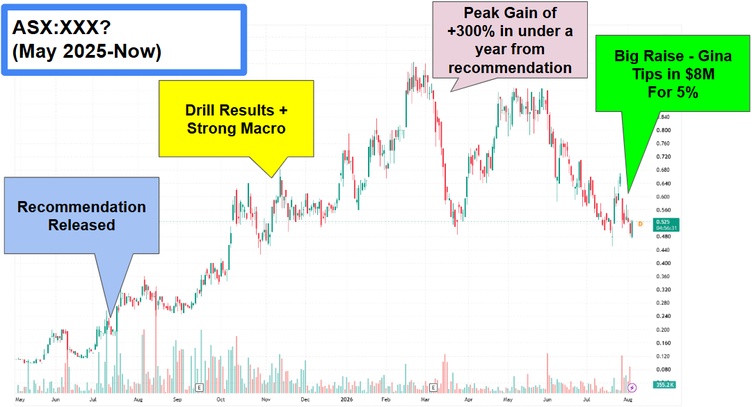
So in July, I put a micro-cap in front of readers of one of my services.
Source: TradingView
[Click to open in a new window]
It peaked at a bit over 300% in under a year.
Last week, Gina Rinehart’s Hancock Prospecting tipped in around $8 million for about 5% of the company.
The two things
As I said yesterday…
Being early and being wrong look identical from the outside, as I wrote yesterday.
What separates them is whether the company can stay alive long enough for the macro to turn up.
So again, I want cash in the bank, a share register that is not stacked with sellers, and a board that has raised money before without punishing the people already there.
Then I want a commodity that is off the market’s radar, but not for long.
When those two line up, you can get charts like the one above.
I do not always get it this right.
Plenty of my ideas go sideways for long periods, and some never work at all.
But that is the setup I go hunting for every time I put a stock in front of members of Australian Small-Cap Investigator and Fat Tail Micro-Caps.
On Monday, I said the analyst’s edge left in this market is judgement, and the stomach to look wrong for a while.
The chart above is what that looks like when it goes your way.
So that is the end of this particular trip down the rabbit hole.
The riddle took three days, and the answer was a metal that melts in your hand.
And 27 November is circled on my calendar.
Warm regards,

Dr. Lachlann Tierney,
Australian Small-Cap Investigator and Fat Tail Microcaps





Comments