




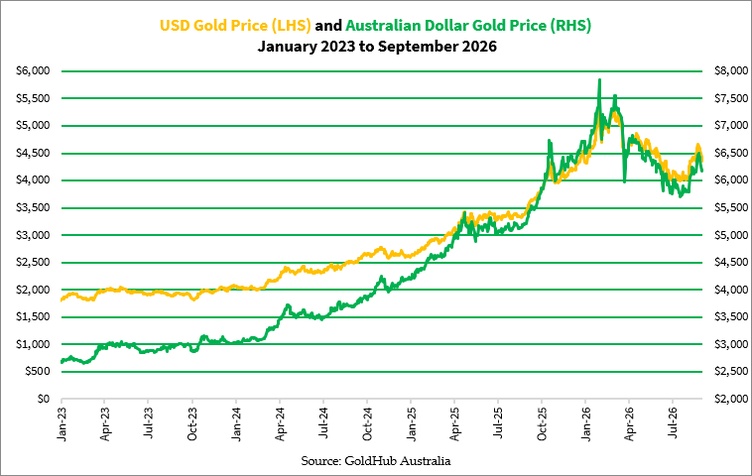
Gold has had a spectacular run in the last three years, setting new benchmarks and gaining momentum:
[Click to open in a new window]
It surpassed US$2,500 an ounce (~AU$3,730) in August 2024,
US$3,000 (~AU$4,720) in March 2025,
US$4,000 (~AU$6,050) in October 2025,
US$5,000 (~AU$7,210) and even US$5,500 intraday (~AU$7,700) at the end of January 2026!
Everything looked like it was setting up for an irresistible climb further. People were wondering when, not if, gold would rise above US$6,000. The prospect of US$10,000 gold didn’t seem to be merely a dream. All that’s needed is another 80% rally! Easy!
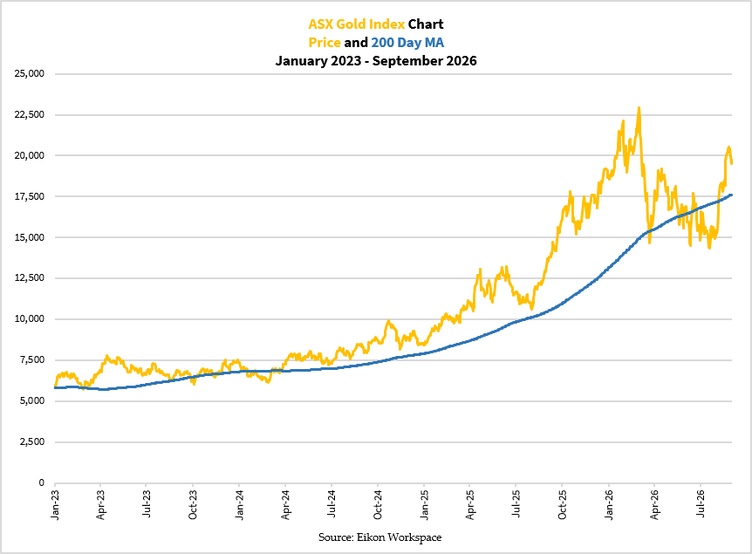
Meanwhile, gold stocks were on a rampage too, with the ASX Gold Index [ASX:XGD] making similar milestones over time:
[Click to open in a new window]
10,000 points in March 2025,
15,000 points in October 2025, and
20,000 points in late-January 2026.
Individual stocks were breaking new record highs too, with the value of major gold producer, Northern Star Resources [ASX:NST], surging to over $40 billion, large gold producer, Evolution Mining [ASX:EVN], to over $30 billion, and even mid-tier producers such as Genesis Minerals [ASX:GMD], Ramelius Resources [ASX:RMS], and Regis Resources [ASX:RRL] fetching over $8 billion at their peak.
Investors looking at their price charts would have similarly extrapolated that these companies would rise to the moon.
That’s what happened at the start of the year when gold, silver and gold mining companies nearly went vertical. Those who hinted at caution or suggested taking profits along the way faced criticisms and mockery because they were going to miss this life-changing run.
Many who were invested in gold stocks would never forget 30th January, and the subsequent week. The ASX Gold Index dropped nearly 15% in just six trading days. But that was just the beginning of a truly painful run that would last for almost six months. It came complete with sucker rallies, deeper corrections, followed by a grinding descent that eroded the confidence of even the most experienced precious metals investor.
Gold stocks weren’t the only assets to experience this. It was the entire precious metals space – gold, silver, platinum group elements (PGE), and gold stocks of all development stages.
The quick rebound in August suggests the most painful period could be behind us now. However, not many investors will learn the lesson or equip themselves to avoid reliving these episodes in the future.
Some will continue clinging onto the idea of a market or dollar collapse. They’ll let that outweigh the fact that many cycles can transpire before the system breaks down.
Today I’ll discuss how to avoid falling into this trap that can be costly to gold and silver enthusiasts. The more loyal one is to them, the greater the risk, so read on!
More than de-dollarisation
and market collapse
Over 13 years ago, I learned about the truth regarding our financial system, fiat currency, and gold. Realising that we were all carrying something that gradually loses purchasing power and that gold and silver were money turned my world upside down.
Many who read this article today would have come to this realisation at some stage of their lives. But our conclusion would almost certainly be the same – expect the day of reckoning for the petrodollar system soon, so build your wealth in the shiny metal now.
This day is bound to happen when all currencies will revert to their intrinsic value, zero. And whoever holds the most gold will win.
Beyond that, some venture further, understanding that gold and silver mining companies could deliver leveraged gains (and losses) in the metals. They venture into these mining companies and attempt to build substantial wealth.
They believed that a market crash or a dollar collapse was imminent, and historically gold, silver and gold mining stocks would deliver spectacular gains. Yet investing based on this belief often proved costly. They may sometimes get stuck in the quagmire as their mining stock portfolio takes them on a rollercoaster ride, with more descents than rallies. What adds to this frustration is that all the currencies are losing purchasing power over the long-term. However, their gold stocks may stagnate because the company may raise capital to dilute their shareholdings, experience setbacks in their operations, or a law could change their future potential to create value.
The key comes down to understanding that gold and silver are metals with no counterparty risk, whereas gold and silver stocks are businesses that aim to create future value through their operations. Metal prices are more reactive to macroeconomic and geopolitical factors. Meanwhile, company value varies depending on the market’s perception of their future potential.
De-dollarisation and market collapses will invariably benefit gold and precious metals assets. However, they happen infrequently. More often than not, investors are trading through gold price cycles that is volatile and come with wild ups and downs.
Unveiling the number that matters most
The lure of gold and precious metals assets is in the simplicity of the argument that our monetary system is unsustainable. However, the path to the outcome is windier than what many expect.
They can see the destination and the route to get there. They only realise there are many bumps and traps after they’ve travelled on it. They notice these more sharply if they’re heavily invested in this narrative.
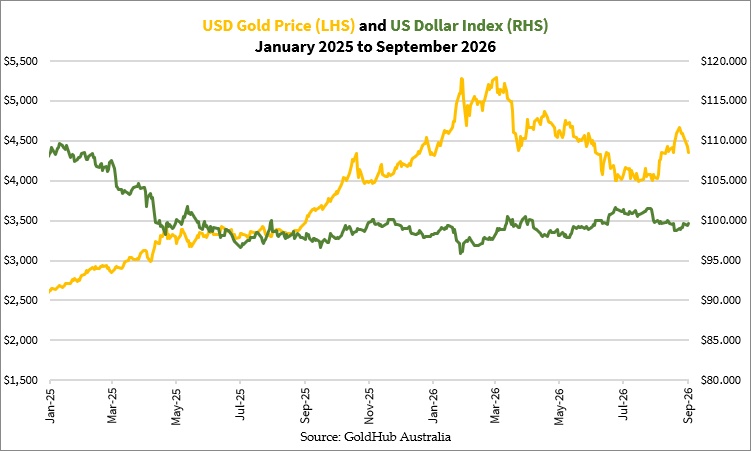
This year provided a powerful lesson. It started with the euphoria before market sentiment brought things back down to earth with the flash crash that lasted till mid-February. However, the US-Iran conflict took it down further as the price of oil surged. The market had expected the US Federal Reserve to cut rates later this year and this would provide further fuel to propel gold and precious metals assets higher. Within a month after the missiles and drones started firing, rate cut expectations gave way to rate hikes. This strengthened the US Dollar Index [DXY] at the expense of gold:
[Click to open in a new window]
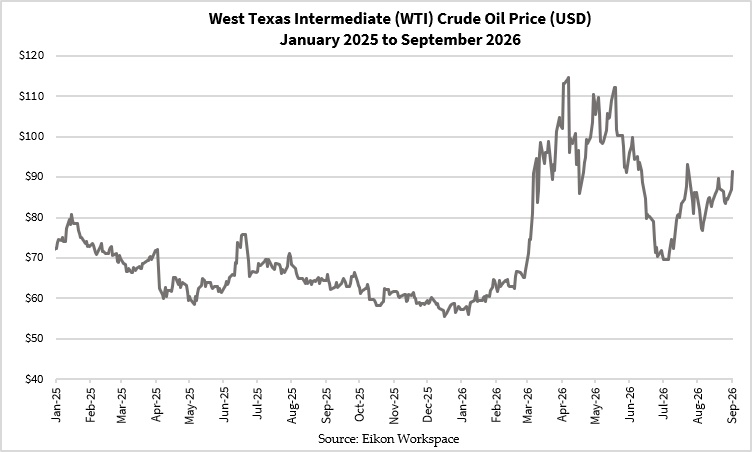
As oil spiked in March to May, inflation gripped the global economy and the market expected more rate rises, further suppressing gold and precious metals assets:
[Click to open in a new window]
However, oil eased ahead of the US and Iran signed a Memorandum of Understanding in mid-June and agreed to a 60-day ceasefire. There was a temporary resuming of hostilities in July, but these didn’t send oil to a new high.
The widely accepted view that gold and precious metals rally during war and periods of inflation clearly didn’t hold in this case. I’ve explained this in detail in an article back in June. What was missing is the dynamics between gold and the US dollar, driven by the economy and monetary policy. Central banks raise interest rates if they anticipate inflation to go out of control. Raising rates strengthen the US dollar relative to gold, and vice versa.
Moving to gold stocks, it’s undeniable that the market will become more interested in these when gold and silver are rising. However, this relationship doesn’t fully explain how gold stocks, especially producers, behave. As mentioned before, gold stocks are businesses and their value comes from future potential to generate cashflows.
Like other businesses, investors will evaluate gold producers based on how much operating cashflows and profits they can generate. Gold and other metal prices are half the equation, the other half are their expenses.
This is where oil contributes. The price of oil affects fuel costs, a pivotal quantity given mining operators use trucks and run machinery that consume much fuel. Furthermore, oil prices affect the economy more broadly, which flow to staff costs, reagents, equipment purchases, utility bills, etc.
Most mining stock analysts evaluate gold stocks using the same approach as with other sectors and industries. However, they place a lot of weight on the underlying metals price in valuing these companies.
My research helped me to realise that the gold-oil ratio, which measures how many barrels of oil an ounce of gold could buy, was a better metric for determining how gold producers would perform. This ratio roughly anticipates how profitable gold producers would be in the coming quarter or two. A high gold-oil ratio would imply that gold producers would receive more for their gold sales than their operating expenses, and vice versa. This worked well for me since I discovered this trend in late-2014, after oil nearly halved as the US underwent a fracking boom and global oil supply increased.
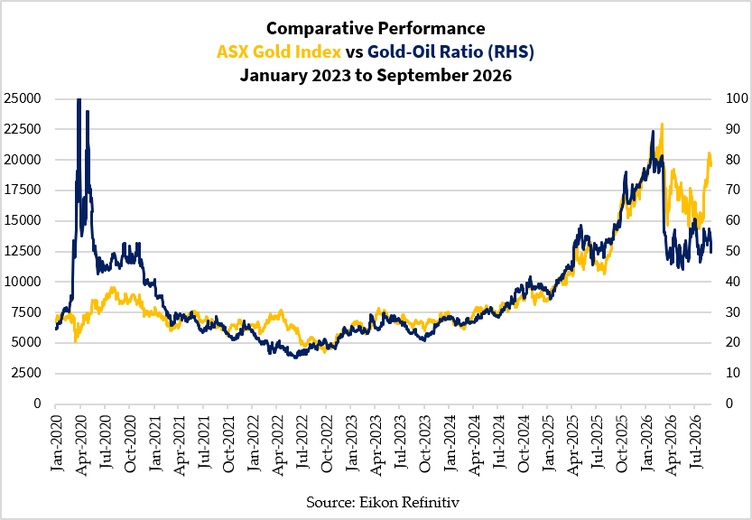
To show you how well this ratio has been in the recent bull market, the figure below plots the ASX Gold Index against it:
[Click to open in a new window]
The gold-oil ratio peaked at 90 just before the flash crash before pulling back to 80 in February. It plunged sharply with the eruption of the US-Iran conflict from 80 to around 50 within a month. The ASX Gold Index’s decline was less severe, although damaging nonetheless. It bounced in April as the US halted their most intensive bombing before plunged again as prospects of the Strait of Hormuz being open for safe and free passage quickly disappeared.
How the gold-oil ratio facilitated
well-timed trades
At this point, I want to show how knowing this ratio can help improve your performance. From last September to early January, readers who followed my work began taking profits from gold producers, including Black Cat Syndicate [ASX:BC8], Genesis Minerals [ASX:GMD], Pantoro Gold [ASX:PNR], Ramelius Resources [ASX:RMS], and Regis Resources [ASX:RRL], even some explorers and developers, such as Barton Gold Holdings [ASX:BGD], Investigator Resources [ASX:IVR], and Rox Resources [ASX:RXL]. We gradually reduced our stakes, selling between a half to nearly all of our holdings in these companies by the time gold and silver peaked. At the time, it felt like we were leaving the party too early. Some gold producers ran the most from Christmas, and then almost went parabolic in January.
However, we had secured some of our wins, some of which were in the triple digit percentage gains, by the time the flash crash came. The recovery in February was short-lived but it gave us a chance to take a little more off the table before the US-Iran conflict brought the entire precious metals space down.
I want to note that we didn’t sell everything at the top, nor did we intend to. The idea was to book some gains and have some funds sitting in the sidelines to buy back at a later time when the valuation was more reasonable. We gradually saw buying opportunities reappear during the selloff, which has delivered some rewards in the August recovery and beyond.
Getting back to the markets, the ASX Gold Index started surging in August to coincide with the US Treasury’s intervention to save the Japanese yen, announcing an increase in the limit on bond buybacks, and weaker US economic data for July led to the market expecting a delay in rate rises. Yet, oil hadn’t meaningfully retreated relative to gold, so the gold-oil ratio rose marginally from 50 to around 55.
Investors were quickly extrapolating that these market interventions would imply that the asset markets have found a low. They’re partly right. I’ve explained last week about why I believe a market crash is unlikely to happen this year. However, the relief rally in gold stocks was disproportionate to gold and silver.
With the US and Iran now returning to hostilities over the weekend, oil has jumped once more, taking gold and precious metals lower. Gold producers corrected heavily this week, as the gold-oil ratio fell. Developers and explorers, having lagged producers in last month’s recovery pulled back more moderately.
As I write this article, we don’t know whether this round of attacks will escalate further or a repeat of the past exchanges. However, there are signs suggesting that Operation Economic Outcast to isolate the Iranian regime from the global financial network is wearing down their resistance. The regime has publicly stated that their supplies are falling and the regime is increasingly divided, with some members of the civilian government seeking to return to the negotiation table.
A resolution to the conflict, in whatever form, should cause oil to ease back below US$80. However, the strain on the global economy from petroleum products, and certain industrial and agricultural chemicals, will persist. The market predicts lower oil prices but rate rises are expected this year, which is why gold and precious metals assets have pulled back.
Going for gold and beating the crowd
I hope that this article brought you new perspectives and insights into how gold and precious metals assets behave in this financial system. Now it’s up to you to decide what you’d like to do with it.
If I’ve moved you to take the first step in changing your dollar assets into gold and silver assets, that’s great. Then you may want to build a strong foundation by learning how to build a precious metals portfolio, complete with where to buy physical bullion, and how to invest in precious metals ETFs and different gold and silver mining stocks. I’ve prepared a detailed report for that in my precious metals newsletter service, The Australian Gold Report.
The service isn’t just focused on how to buy and sell gold and precious metals assets. I apply my research into the economy and geopolitics to help us understand what’s happening with the markets and their impact on precious metals prices. With gold mining companies, I developed my unique research into valuing these companies and interpreting market trends.
Learn more about this and my insights, all of which I documented in my book Gold’s True Message: A Guide to Building Wealth in a Failing Monetary System. I share stories about my past trades and lessons learnt across three gold price cycles:
I’ve prepared a presentation on all these for you, please check it out.
That’s it from me for this week. Have a good weekend ahead!
God Bless,

Brian Chu,
Gold Stock Pro and The Australian Gold Report




Comments