



If yesterday’s edition was a bit morbid, a slight mea culpa.
I went dark on purpose.
That’s because I wanted you to see how real and serious this rare earth fight has become.
Meanwhile, overnight, the AI bulls revved their engines again.
The Nasdaq looks to be moving again as oil slid to two-week lows.
So the attention goes back to the big tech titans, once more.
But I reckon the real answers sit under the literal surface of the earth.
The magnet maker in Xi’s back pocket
Xi Jinping touches down in Washington tomorrow morning, our time. His first US state visit in 11 years includes talks with Trump and a White House state dinner, with Elon Musk on the guest list.
Rare earths sit near the top of the agenda:

Source: Bloomberg
You see, JL Mag is the world’s top producer of high-performance rare earth magnets.
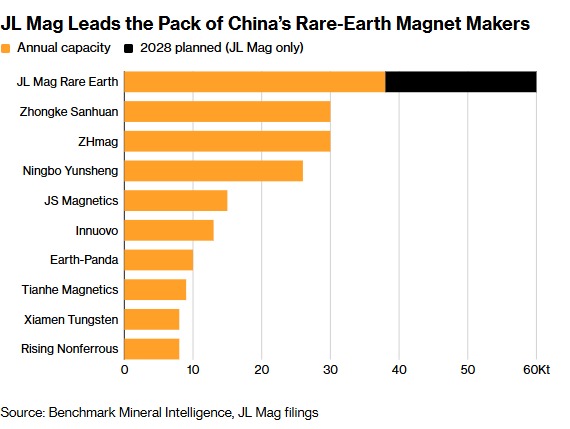
And a recent report says it has more than 10 times the capacity of its closest US rival.
Here’s the kicker.
Daiwa Securities identifies JL Mag as the sole supplier of motor rotors for Tesla’s Optimus robots.
So Musk will share a dinner with the leader of the country that builds his robots’ muscles.
You couldn’t script it.
JL Mag plans to lift capacity by another 50%, to 60,000 tonnes, by next year.
Its three closest rivals are also Chinese, as this chart shows:
Source: Bloomberg
[Click to open in a new window]
Meanwhile MP Materials, America’s great magnet hope, aims for about 10,000 tonnes a year once its new Texas plant runs.
If the US is lucky.
Greenland’s cold reality
Trump also signed his Greenland security pact at the United Nations overnight.
He claims it gives America “permanent control” over the island’s security and locks adversaries out of sensitive investments there.
Greenland holds around 1.5 million tonnes of rare earth reserves, the world’s eighth largest, according to CSIS.
All is not as it seems here.
Greenland has no operating rare earth mines, and one of its leading developers is targeting first ore around late 2028.
Even then, someone must separate that ore and turn it into magnets.
Demand curve – fast or really fast?
Here’s the key bit to focus on.
Whatever Trump and Xi agree on this week, the robotics demand equation stays the same over the long run.
Every humanoid joint runs on a magnet-powered motor.
Bloomberg reports demand for magnet rare earths outside China could climb 50% by 2035.
Existing and planned magnet projects would meet less than a fifth of that.
Research house Adamas Intelligence is even more bullish.
If anything, a rare earth truce could speed this up.
Steadier, cheaper magnet supply improves the economics of building humanoids at scale.
I think that could push robots up the demand curve much faster over the next two to three years.
Geopolitics simply opens a window onto how critical these materials are.
The demand itself looks set to grow drastically from here.
So Musk gets his seat at the state dinner later this week.
And the small ASX miners digging these materials out of the ground missed the guest list.
BUT: I suspect they could dine out on this boom for years.
So go on…have a watch.
In Elon’s Final Moonshot, I reveal four small ASX companies working at the raw materials end of the robot supply chain.
Click here to see my full briefing before the summit headlines land.
Warm regards,

Dr. Lachlann Tierney,
Australian Small-Cap Investigator and Fat Tail Microcaps





Comments