




When there’s war, gold goes up.
When inflation threats loom, gold goes up.
That’s the accepted convention of how gold moves. In turn, the way to profit from this is to buy gold when war breaks out and if inflation goes out of control.
Plain and simple.
But is it?
If you did that in the last three months, the results would have been disappointing.
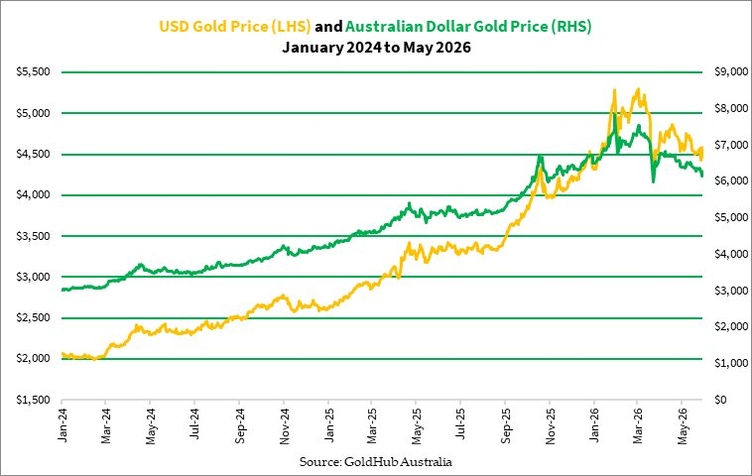
Let’s look at how gold performed. It had a spectacular run from March 2024 to late-January 2026, rising around 180% in less than two years:
[Click to open in a new window]
It hit all-time highs of around US$5,800 an ounce or almost AU$7,800. But since early March, gold is down by 20%. Moreover, a bearish trend is forming.
What’s driven this trend is a combination of gold’s correction after a parabolic run that ended in January 2026. Then the US, Israel and Iran went to war, resulting in a blockade at the Strait of Hormuz. This has disrupted shipping across a critical passage, threatening the global economy.
Yet, you would expect the conflict should send gold much higher than what it is right now. Maybe two thousand dollars higher, not US$4,450 (~AU$6,230)! The setup should be bullish, the opposite of what we’re seeing now.
This isn’t the first time gold has moved in the opposite direction to convention. In fact, the same thing happened in 2022 when the Russia-Ukraine conflict broke out.
While this conflict differs in many respects, the economic fallout is similar. Inflation can lift or tank the gold price. What is driving that inflation will determine the outcome on gold.
I’ll unpack this in today’s article.
Why gold fell when war broke out:
lessons from 2022 and 2026
The Iranian conflict has been unprecedented in terms of the ferocity of the strikes and a different form of warfare. We’ve witnessed decapitation strikes, heavy missile bombardment, and drone strikes. So far there hasn’t been a full-scale ground invasion.
Interesting, the strikes ended quickly. We’ve been watching a cold standoff in the last two months. The warring sides have declared that they would unleash more severe attacks that border on bringing an apocalypse in the region. Despite this, the US and Iran have gone against conventional warfare, focusing more on negotiations rather than carnage on the battlefield.
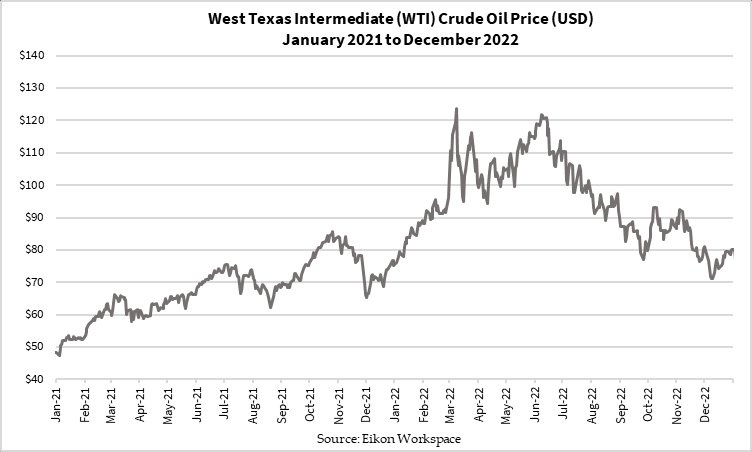
I want to highlight something similar between this conflict and what happened between Russia and Ukraine going back to 2022. Let’s look at how oil traded back then, noting that Russian forces launched their special military operation on 24th February:
[Click to open in a new window]
Notice the price spiked in February, shortly after the world sanctioned Russia’s oil, effectively cutting supply to much of the world. There was a smaller spike in March, followed by a rally from April to June before descending in the second half of the year.
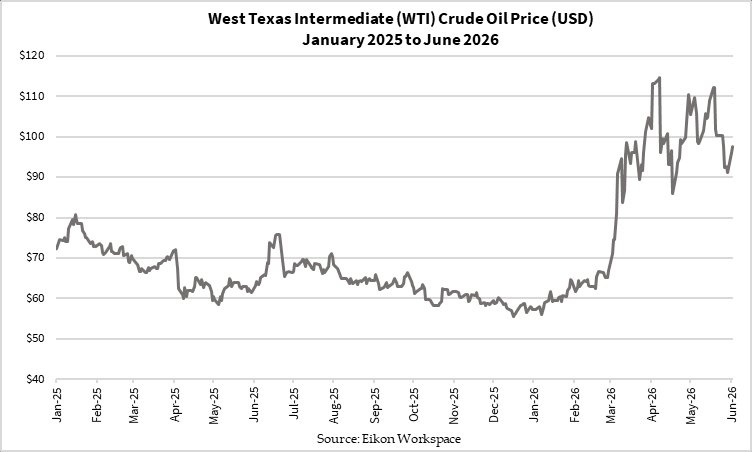
Let’s look at oil this year, noting that the Iranian conflict erupted on 28th February:
[Click to open in a new window]
Note how oil jumped sharply because of war, substantially disrupting the global supply chain. Many businesses faced more than just a rise in energy costs. A plunge in oil supply reduced the production of chemicals derived from crude oil, affecting their operations and productivity.
The inflation type that lifts
or tanks the gold price
How does this link to gold then?
Many believe that the gold price rises when there’s war and inflation. However, we have to unpack the relationship further.
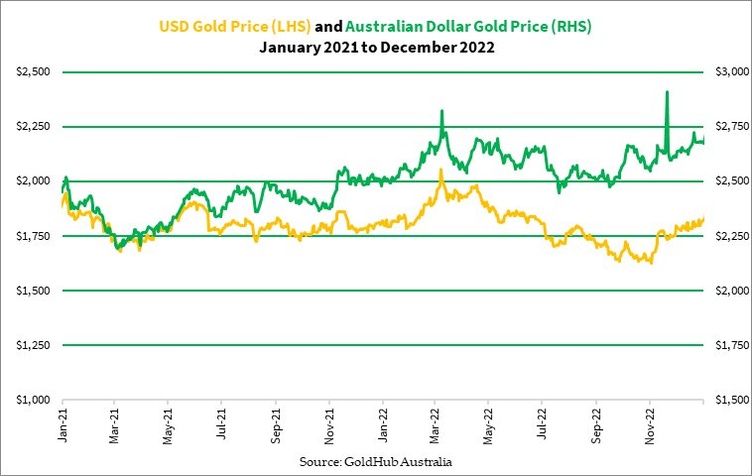
Let’s look at how gold behaved in 2021-22:
[Click to open in a new window]
And here’s how gold performed in the last two years:

[Click to open in a new window]
What’s clear from the above figures is that gold rises initially when war breaks out. People are fearful and seek refuge, selling risky assets and retreating to safe havens, which gold shares with the US dollar and government bonds.
However, a war will only temporarily boost gold.
Beyond this, investors look to government leaders to see what policies and plans follow. War can create scarcity as industries direct their efforts to defence, sometimes at the expense of living standards and supply. This is especially the case if the conflict leads to the destruction or loss of critical materials and manufacturing hubs.
This is where we examine the relationship between gold and inflation, something that many don’t fully grasp.
Gold can rise if central bankers decide they won’t (or can’t) step in to control inflation using monetary policy. What drives their decisions is whether their intervention will threaten economic stability.
In a weak economy, the central bank will reduce interest rates and increase the currency supply if there is capacity to drive greater business activity. This move spurs demand-side inflation, boosting the gold price.
However, wars can reduce supply in an economy, as mentioned above. This can drive up inflation because more currency is chasing fewer goods. Policymakers consider this supply-induced inflation to be unhealthy and undesirable. Thus, the central bank will increase interest rates and reduce the currency supply. That causes gold to fall.
Even though the US Federal Reserve hasn’t hiked rates during this time, the market is expecting a rise before the end of the year. This is a sharp change from the start of the year when the market expected one or more rate cuts.
Gold ran up substantially at the start of the year, possibly to overvalued territory. The correction in February brought it down to more reasonable levels. However, the Iranian conflict has led the US Federal Reserve to change direction. Gold is pulling back on expectations of a rate rise.
In short, the market dynamics show how war and inflation expectations affect the gold price. What matters isn’t how these events and drivers move gold, but how governments and central banks set policy. Supply-induced inflation places pressure on gold, while demand-driven inflation can benefit gold.
Understanding this should help you determine how to trade precious metals assets and currency-denominated assets to improve your returns. Given that gold and silver have pulled back significantly, this is your opportunity to buy into weakness. You could enjoy the rewards of a recovery in the coming months, beyond the standoff in the Middle East.
If you want to go deeper on this and build a precious metals portfolio that accounts for these dynamics, I’ve put together a presentation that walks through my full framework — drawing on over a decade of research into monetary systems and how gold protects against wealth-draining inflation. You can watch this by clicking here.
That’s it from me for the week. Have a good weekend ahead!!
God Bless,

Brian Chu,
Gold Stock Pro and The Australian Gold Report




Comments