




Fear is starting to dominate markets.
Check out this gauge of investor sentiment from CNN:

Source: CNN
[Click to open in a new window]
This fear is primarily driven by two issues: interest rates and oil. With a side of ‘AI bubble bursting fears’ thrown in for good measure.
Today, I’ll show you why I think what people are scared about is actually good for Australia’s mining sector.
First up, oil…
The war in the Middle East keeps broadening
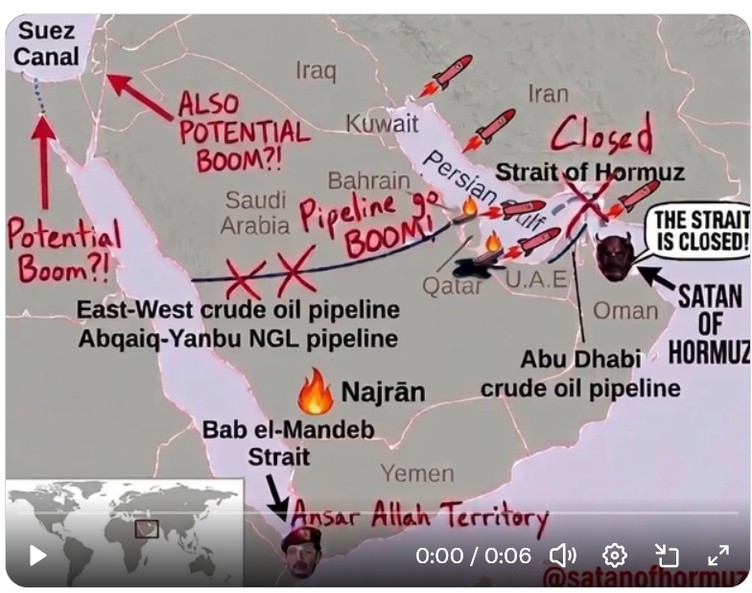
Last week, Houthi fighters swept across Yemen’s Red Sea coast and seized the islands that guard the Bab el-Mandeb Strait.
Iran-aligned forces now control two of the major oil chokepoints out of the Middle East: the Strait of Hormuz and the Bab el-Mandeb.
To top it off, drones from Iraq have knocked out the Saudi pipeline that Riyadh built as insurance for exactly this kind of event.
Until last week, it moved roughly five million barrels a day. Then drone strikes hit its pumping stations. Saudi Arabia shut the whole thing down as a precaution.
As someone crudely posted on X.com, this is the current state of things:
Source: X.com
[Click to open in a new window]
Oil surged past US$100 per barrel in response. Brent traded near US$110 at one point last week, before easing back below US$105.
The International Energy Agency says Saudi crude supply has now fallen to its lowest level in more than three decades.
And diesel prices – the lifeblood of the logistics industry – hit new highs in response. That’s bad news for inflation.
As if that wasn’t enough
The ‘plumbing’ of the financial world is going through its own kind of existential crisis, too.
Bond yields around the world keep breaking through highs we haven’t seen in decades. America’s 30-year Treasury yield just hit its highest level since 2004.
That ‘rise’ in yield is the result of bonds being sold off.
In other words, investors want to be paid more to hold government debt because they fear higher future inflation or even the slim chance of a default.
Either way, the flow-on effects are brutal.
Governments, corporations and households all have to pay more interest on their debts.
Which brings me back to AI
As we touched upon on Friday, a swathe of American AI companies suddenly announced they want to slow down the whole shebang because of ‘safety’ concerns.
This is bad news because the narrative is that AI will help the US grow its way out of its debt problems.
It started when a senior Anthropic researcher, Jacob Coxon, quit last week and accused the big labs of ‘gambling with our lives’.
Since then, Anthropic boss Dario Amodei has published an essay urging governments and labs to ‘pace the frontier’, and OpenAI says it will slow development of its most advanced models.
The more sceptical amongst us might suggest the timing has more to do with money than morality.
Open-weight models from China keep undercutting the economics of frontier AI. Investors keep asking where their returns are.
What returns!?
For every $1 they make in revenue right now, it costs $1.25. It doesn’t take a genius to see the problem here.
Of course, they’re all betting this equation changes at some point in the future, hence the data centre building frenzy.
But here’s the rub.
AI companies have been borrowing like crazy to fund that build-out phase. US$2.9 trillion will be spent on AI data centres by 2030, with half of that borrowed money.
So those higher interest rates we talked about before are an increasing risk for them. Oh, and they’re also energy hungry!
In short, there’s a lot for the doomsayers to gnash their teeth about right now.
But here’s the important point…
Markets know all this and are still holding up pretty well.
Especially commodity markets.
Copper is trading near multi-year highs (around $6.72/lb), up roughly 44% over the past year, despite softening this week.
Thermal coal prices have rebounded hard and remain elevated (Newcastle benchmark ~$140+/t).
And broad commodity indexes (GSCI, Bloomberg) are up around 8% this month, continuing the 30–40% over the past year.
Which makes sense.
Think about it…
If investors trust government debt less, that’s good for hard assets like gold.
If they fear inflation, commodities are a good hedge.
If the market is worried about energy security, that’s good for Australian oil, coal and gas, along with future energy sources like battery metals, uranium, and copper.
And the AI bubble?
As one analyst noted recently, the massive build-out is likely to remain fully funded by governments, no matter the economics for investors.
Mike Dolan wrote:
‘If cutting-edge AI is truly powerful enough to end humanity, it may already be too powerful to slow down. With the technology now locked in a strategic arms race tied to national security, warnings about its risks may only speed up the dash for hegemony — and bring far greater government control with them.’
AI isn’t just too big to fail. It could be too big to slow down too. So more copper, more aluminium and more energy will be needed.
In short, none of what the market fears is necessarily bad news for Australia’s mining companies.
Of course, nothing moves in a straight line
There’s always the chance we get a big sell-off soon, too.
Some sort of trigger that sees investors indiscriminately dump everything.
But in my experience, these things usually happen when no one expects them. Not when everyone is focused on them.
For me, the odds say ‘messy resolution’ over ‘coming crash’ is the more probable outcome. So, if the fear keeps ramping up, you could get some good buy-the-dip opportunities.
What’s more, as we’ll discuss later this week, the tailwinds behind the commodity bull market are a lot more than just AI.
They’re the result of a fundamental mismatch between supply and demand that is a recurring feature of the commodity cycle.
Regards,

James Cooper,
Mining: Phase One and Diggers and Drillers




Comments