



US optimism is again on display.
After an eleven-day winning streak, the Nasdaq closed at fresh all-time highs overnight, along with the S&P 500, which passed the 7,000 mark for the first time.
Sentiment has turned on a dime as the market expects peace.
The S&P 500 now sits at the 99.7th percentile of 10-day returns.

Source: 3Fourteen Research
[Click to open in a new window]
Early quarterly reports show Bank of America and Morgan Stanley are joining their banking peers in posting record stock-trading revenues.
The Magnificent 7 are back to meteoric gains.
Headline indices may be euphoric. But beneath the surface, the picture is less convincing.
The Equal-weight S&P 500 closed flat last night, up just 0.04%. The Dow fell 0.15%. Industrials, Materials, and Utilities all dragged.
This is a tech-driven rally riding on the shoulders of a narrow group of mega-cap names. The rest of the market is treading water.
It’s a familiar setup for those who remember trading in 2023.
Markets levitating on the momentum of a few mega-cap names while the real economy flashed warning signs underneath.
And for Australia, the most pressing of those warnings has nothing to do with tech multiples.
The Last Barrels
This week, Trump again promised the Iran war is ‘very close to over’.
A new round of discussions is underway, which may require extending the ceasefire.
Markets liked the sound of that. Oil dipped slightly on the headline.
But hope and barrels are two different things. The physical oil market is telling a different story.
The last tankers to pass through the Strait of Hormuz before the war began are now reaching their final destinations.
The final cargoes are expected to arrive in Malaysia and Australia by April 20.
After that, the pipeline of pre-war supplies is finished.
Asia sources roughly 80% of its crude from the Middle East. Most of those deliveries stopped around April 1.
Asian refineries have responded by buying record volumes of Atlantic Basin crude and drawing on their reserves.
This matters to us as countries like South Korea and Malaysia are major sources of our petroleum products.
In fact, around 90% of our refined fuels, like petrol, diesel, and aviation fuel, are imported.

Source: Riviera
[Click to open in a new window]
Meaning we sit at a very delicate moment. Even if a ceasefire holds and negotiations progress, reopening the Strait of Hormuz isn’t a matter of flipping a switch.
Insurance markets need to reprice risk. The tanker backlog needs to be refilled and transit. Refineries need to rebuild rundown inventories.
The physical lag between a diplomatic breakthrough and barrels flowing normally again will be measured in months, not days.
Australia, with its historically low fuel reserves of around 30 days, is in a very precarious position.
Then the Refinery Caught Fire
Into this environment, Australia just lost half its domestic refining capacity.
Overnight, a major fire broke out at the Viva Energy refinery in Geelong, Victoria’s only oil refinery and one of just two still operating in the country.
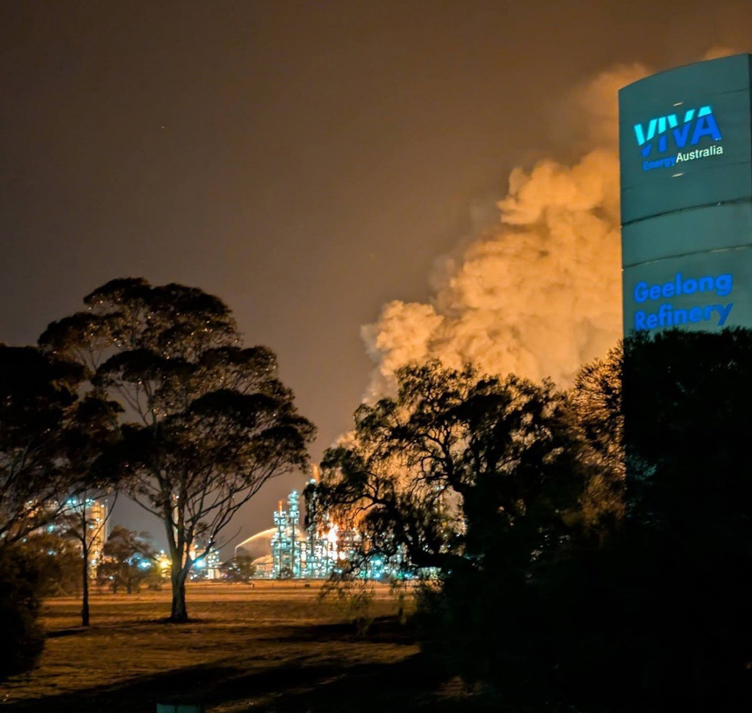
Source: Ben Young
Fifty firefighters began battling the blaze after reports of explosions and flames at around 11 pm.
Fire Rescue Victoria said the fire began in the motor gasoline section of the facility, likely triggered by equipment failure.
We’ll have to wait for an investigation into the final cause. That hasn’t stopped social media from filling with theories of sabotage.
To me, that’s just a signal of its importance in our minds at this moment.
The Geelong refinery has a throughput of around 120,000 barrels per day. It supplies roughly 50% of Victoria’s fuel and 10% of Australia’s total supply.
Critically, it is the country’s sole producer of aviation fuel.
Thankfully, early reporting indicates this section of the refinery is untouched by fire.
Jet fuel and diesel output continue at reduced levels as a precaution, but the main impact is on petrol production. How long the disruption lasts is still unclear.
This is worth pausing on. Six domestic refineries have closed in the last 20 years. Australia now imports 90% of its liquid fuel needs.
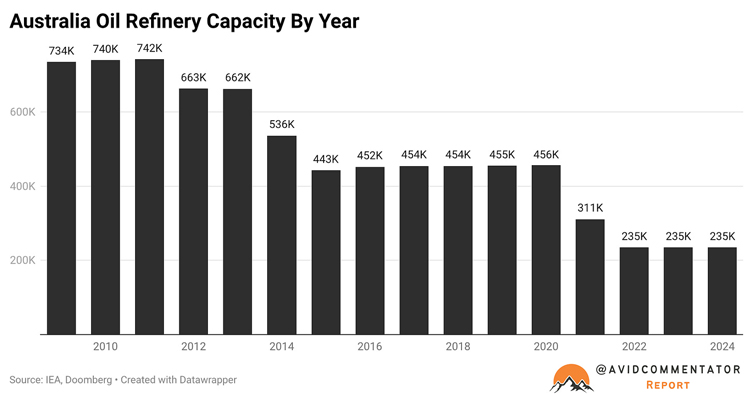
Source: Avid Commentator
[Click to open in a new window]
The remaining infrastructure is the Geelong plant and Ampol’s Lytton refinery in Brisbane. That’s it. Two refineries for an entire continent.
And one of them is now on fire during the worst oil supply disruption in economic history.
The Bigger Picture
Australia’s fuel vulnerability has been a known risk for years. Senate inquiries have flagged it, and defence analysts have warned about it. Yet here we are.
Ultimately, the closure of refineries in Sydney, Melbourne, and Perth over the past two decades was driven by commercial logic.
It was cheaper to import refined products than to process crude domestically.
That logic works fine in peacetime. It stops working the moment a major chokepoint closes.
If the Iran conflict drags on for much longer, the cascading effects for Australia are serious.
Fuel rationing becomes a real possibility, not a hypothetical. We’re talking about aviation fuel shortages and diesel supply constraints that could ripple through agriculture and freight.
While elevated pump prices could continue to rise, especially after this fire.
Wall Street might be at all-time highs. But the things that keep our economy’s engine running are under genuine stress.
Today, the ASX broke away from the US market uptrend — trading flat at the time of writing.
Until the Strait returns to normal, we may not be able to share the optimism of our Yankee cousins. And last night’s fire in Geelong just reminded us how thin the ice really is.
When your country has two refineries and one of them is on fire, the margin for error is zero.
***
My colleague Lachlann Tierney has covered the significance of global chokepoints in detail in his latest report.
If you want to learn more about the new geopolitical realities of our time, click here to see his latest presentation.
Regards,

Charlie Ormond,
ATLAS and Altucher’s Investment Network Australia




Comments