



‘All of humanity’s problems stem from man’s inability to sit quietly in a room alone.’
— Blaise Pascal
In early 1997, Warren Buffett sat down to write his annual letter to Berkshire Hathaway shareholders.
The US market had just delivered a second straight year of 20%-plus returns. Fund managers everywhere were churning portfolios to chase the rally.
Buffett had spent the year doing close to nothing. He wanted his shareholders to know it, too.
‘Our portfolio shows little change,’ he wrote. ‘We continue to make more money when snoring than when active… inactivity strikes us as intelligent behavior.’
The Man Who Mastered Doing Nothing
That line has followed Buffett around for 30 years. It deserves to, because doing nothing may be his most repeatable trick.
In 1969, he went further than fund managers would dare today. He shut his investment partnership entirely, telling partners he could no longer find bargains worth buying.
He returned the money and waited. The wait lasted years while the ‘Nifty Fifty’ glamour stocks inflated without him.
Then the 1973–74 crash cut the US market in half. Buffett went shopping, picking up a stake in the Washington Post for about US$10 million. That holding eventually grew to be worth more than US$1 billion.
He repeated the act during the dot-com bubble. As the Nasdaq doubled in the late 1990s, Buffett refused to touch tech stocks he couldn’t value.
Berkshire shares nearly halved between mid-1998 and early 2000. Barron’s mocked him with a now-famous cover asking, ‘What’s Wrong, Warren?’
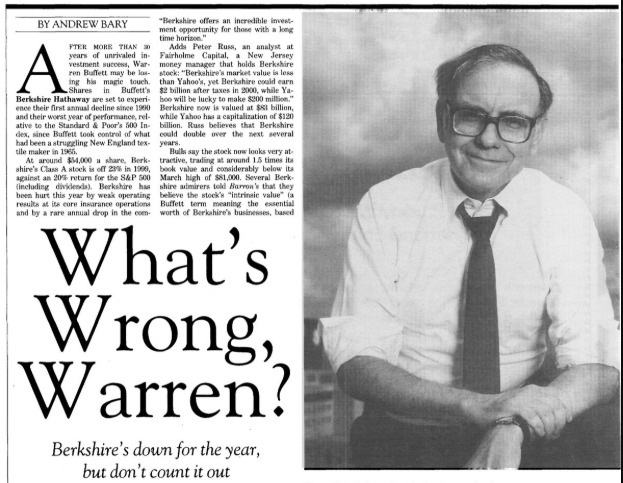
Source: Barron’s (27 December 1999)
Within months, the Nasdaq began to collapse, eventually falling 78%. Buffett had done nothing through the mania except hold his nerve.
And he closed his career the same way. Berkshire trimmed its stock holdings and built a cash pile above US$300 billion before Buffett handed the chief executive role to Greg Abel this year.
For Buffett, inactivity was never laziness. It was a deliberate position, held under public pressure, waiting for the moment when action would eventually pay.
The Ceasefire That Wasn’t
Which brings us to this week’s mess in the Middle East.
The ceasefire between the US and Iran collapsed on Wednesday. Iran attacked three commercial vessels in the Strait of Hormuz. The US answered with strikes on roughly 90 Iranian targets.
Trump then declared the ceasefire ‘over‘, calling further talks ‘a waste of time‘.
Iran fired back with drones aimed at sites in Kuwait, Qatar and Bahrain, plus missiles at a base housing US forces in Jordan.
There are also early, unconfirmed reports that some Gulf Arab states took part in the latest strikes on Iran. If true, that would mark a serious widening of the war.
Markets received all of this with yet another shrug.
Brent crude jumped over 5% to US$76. That sounds dramatic until you remember it peaked around US$120 earlier in the conflict.
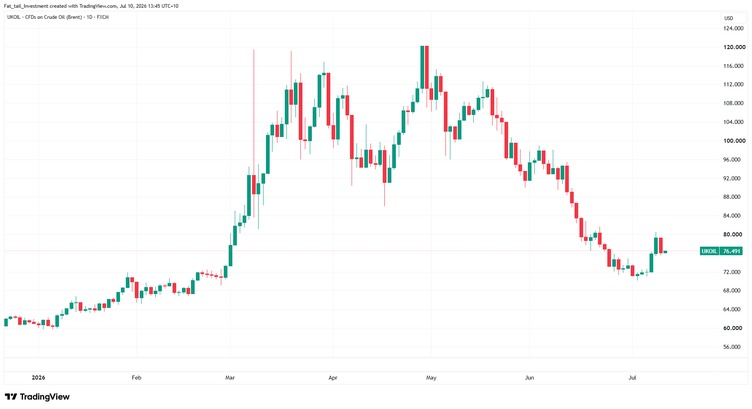
Source: TradingView – Brent Crude Prices
[Click to open in a new window]
In other words, markets aren’t viewing this as a real threat. Only history will judge if that’s misguided.
Nobody knows whether this week marks a return to full-scale war or a violent style of negotiation.
The market narrative now sits at a genuine fork. One path leads to US$100-plus oil, another Hormuz closure, and a fresh global inflation scare. The other leads back to the negotiating table and a rapid unwinding of the risk premium.
When the key input into asset prices is a coin flip inside Trump’s head, your forecasting edge is zero.
Your Best Move May Be No Move
Moments like this generate a powerful itch to act. Buy oil stocks before the next spike. Dump equities before the next barrage. Or conversely, chase the AI winners.
That itch is worth resisting. Positioning hard for one outcome here means betting on headlines nobody can predict, against professionals with faster information than you.
Value investing legend Benjamin Graham understood the itch a century ago:
‘Much success can be attributed to inactivity. Most investors cannot resist the temptation to constantly buy and sell.’
If you find yourself in the itchy camp, remember that sitting on your hands can still be an active strategy.
It can be something as simple as building a watchlist of quality names you want to own at better prices.
It could mean taking the time to learn more about a sector you avoid investing in because you’re unfamiliar with it.
Learn more about options trading and active hedging. Read a book, learn a technology, adopt a new mindset.
Invest in yourself rather than the market.
And treat your cash as a position rather than a failure.
The narrative will resolve, one way or the other. Until it does, the smartest play on the board may be the one you refuse to make.
Regards,
Charlie Ormond,
ATLAS and Altucher’s Investment Network Australia




Comments