



In February, Alphabet, Google’s parent company, sold a 100-year bond.
Read that again.
Investors handed over money they won’t get back until the 2120s…
…to help fund a building spree in AI data centres.
Now think about what’s going inside those data centres.
The chips doing the heavy lifting are usually superseded within a few years. Some get pushed aside in less.
|
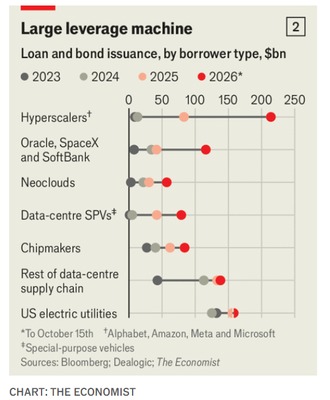
A century of borrowing, to buy hardware with the shelf life of a smartphone…
If you’ve read me for a while, you’ll know I’ve been uneasy about this for some time.
The numbers keep getting bigger.
Morgan Stanley expects AI-related debt issuance to roughly double this year, to around US$570 billion.
The big four, Alphabet, Amazon, Meta and Microsoft, have already borrowed approximately US$214 billion between them this year.
We’re starting to see the cracks I’ve been predicting for some time now.
Oracle’s bonds are trading close to junk grades, while CoreWeave’s bonds are at levels usually associated with financial distress.
US chip stocks sit over 20% from their June highs, and chip-heavy indices like the South Korean KOSPI are down over double that.
So let me be plain (again): I think there’s an investment bubble in AI.
I think a lot of the money pouring in will never earn a proper return.
And I think some of the people lending will find that out the hard way.
But here’s the thing…
Two opposed ideas
F. Scott Fitzgerald once wrote that the test of a first-rate intelligence is the ability to hold two opposed ideas in mind at the same time, and still function.
I think that’s the test investors face with AI right now.
Idea one: the financing is frothy, and some of it will end badly.
Idea two: the technology is real, it’s improving at a frightening pace, and it’s already changing how work gets done.
History says both can be true at once.
In the 1840s, Britain went mad for railways. Hundreds of new lines were approved in a frenzy of speculation. Then the bubble burst, and a great many investors were wiped out.
But the track stayed in the ground. Britain was left with a rail network that carried its economy for the next century.
The people who financed the boom lost. The people who used what it built did very well.
That’s the distinction I keep coming back to. Betting on who wins the AI build-out is one thing.
Putting the tools to work for yourself is something else entirely.
Why I don’t scare easily on this
Some of my scepticism comes from experience.
Years ago, I built machine-learning courses for Microsoft. Back when training a neural network was a niche skill practised by a small group of specialists.
So when this latest wave of AI arrived, I could tell fairly quickly what these models could genuinely do, and where the marketing was running ahead of reality.
The hype hasn’t changed my mind about the debt. But the progress has changed my mind about the tools.
Here at Fat Tail, we were experimenting with machine-assisted trading well before ChatGPT made AI a dinner-party topic.
In May, I said the technology had finally caught up with our ambitions.
What I didn’t expect was how fast it would keep accelerating from there.
A sector written off
Here’s a small example of what I mean.
Earlier this year, the market decided AI was going to eat software alive.
The fear was that if a chatbot can write code, who needs a software company?
ASX tech got hammered. By late March, the sector index had fallen almost 50% in six months. Even the market’s darlings, WiseTech, Xero and Pro Medicus, were cut in half.
Software was the place you weren’t supposed to be.
Then, on 4 August, ATLAS, the ASX-based AI system I’ve been developing, flagged a small software company. It was boring and profitable, with no drill holes and no exploration story. It was just solid, steady execution.
Two days later, the system ranked it the second-strongest stock in its universe.
A week after that, the company reported.
Underlying profit had more than doubled, and it announced a special dividend. The shares jumped almost 30% in three days. Brokers raised their price targets, and the stock blew straight through them.
Our AI, ATLAS, had no idea what the company would report. It doesn’t read results or headlines.
What it saw was money starting to flow back into tech, and into this stock in particular, before any pundit could tell you why.
That’s this year in miniature. A sector written off over AI one week, and the market piling back in the next. Most people only found out once the headline arrived.
I’ll name the company on Monday. You can be there when I do by registering here.
Where it’s heading
Since May, every signal ATLAS has produced has been logged and checked against what the market actually did next.
That includes the misses as well as the hits. The big AI labs call this kind of testing ‘evals’. It’s how they stress-test a model before trusting it with anything that matters.
My team and I have taken everything those months taught us and used it to refine the system. That’s work done by people, not a machine teaching itself.
I’ll walk you through how it works, show you that software stock and what happened next, and finish by revealing the 10 stocks at the top of its latest rankings.
Have a notepad ready.
If you can, keep a list of what you already own nearby. The most useful thing might not be a new idea at all.
It could be seeing how your own holdings stack up against what a machine with no ego, and no attachment to your portfolio, can see.
The AI bubble may well pop — I won’t be surprised if it does.
But the tools aren’t going back in the box. The real question is whether they’re working for you.
Regards,

Charlie Ormond,
ATLAS and Altucher’s Investment Network Australia
PS: Monday. 4:15pm. ATLAS 1.0 fires up. An AI built to read the ASX, with Fat Tail’s fingerprints all over it. Attendance at the demo is free for all paid Fat Tail readers. You just need to register here.




Comments