




On Tuesday, our Treasurer Jim Chalmers told the country that a spreadsheet containing inflation rates is easier to calculate than a single number.
That number is 40%.
What am I talking about?
Let’s roll back the clock around six months ago when Jim, or Dr Jim to be precise, unveiled the Federal Budget that he claimed would “level the playing field for workers and first-home buyers, and support investment in productive assets”. Among several changes, he highlighted how most future property investors would no longer be eligible for negative gearing, investors and businesses would lose the 50% discount on capital gains tax for assets held for more than 12 months, and discretionary trusts would pay at least 30% tax.
Some of the measures have already passed, namely the removal of negative gearing for future property investors and a replacement of the 50% discount on capital gains tax for investment assets with an inflation-adjusted indexation of the purchase price. The Senate is now debating a measure to provide small start-up businesses with a concession on capital gains tax, or the Innovative Business CGT Concession, and a minimum 30% income tax on discretionary trusts.
An Independent MP, Allegra Spender, suggested a 40% discount on capital gains tax on active business assets as an alternative to the indexation treatment. Her view is that a single number could help simplify the calculations used under the method suggested by the Treasurer.
Dr Jim’s reply was that her suggestion ‘risks introducing more complexity, not less’ and ‘it would be neither simple nor straightforward’.
You might wonder how he came up with this. Given his PhD in political science and his ambition to emulate the former Prime Minister Paul Keating, the subject of his PhD thesis, he can see more than the ordinary Joe or Jane.
Let’s delve into this in today’s article. I’ll provide a brief spoiler – they had already complicated the system by passing some reforms into law. This might just complete the picture by ensuring the complexity is consistent and that the productive pay more to subsidise a bloated bureaucracy.
The art of ‘simplifying’ the world’s
most complex tax system
Let’s briefly explore the proposal known as the Innovative Business CGT Concession, or IBCC. This lets founders, staff and early investors in qualifying start-ups keep the 50% discount. To qualify, a company must stay under a $50 million turnover ceiling, meet age limits, pass an innovation test and clear an 80% active asset test. Eligibility is subject to a three-year holding period.
Someone must review the assets to determine whether they qualify as ‘active’. This criterion is subject to loopholes and exploitation. One can attempt to transfer certain investment assets into a business structure to qualify for the concession. That’s the first complication.
The others include checking the other three criteria. This involves more work, more experts, and higher expenses to tick the boxes. None of these adds to the nation’s productivity, only bureaucracy.
Allegra’s proposal would be to retain only the active asset test but apply only a 40% discount on capital gains. This means business assets used for operations, plus shares and options in active businesses. Investment properties and passive assets would remain under the indexation treatment.
So, Dr Jim’s simplicity requires four criteria and a long checklist. Allegra’s complexity is to take one of the four criteria and check that it complies.
Get it? Good!
Single number bad, complex spreadsheet good
Next is the discussion on the tax treatment of capital gains. I know that Parliament has reintroduced the indexation treatment and will phase out the 50% discount on capital gains. However, I want to vent my frustration, and likely yours, over what was done. Plus we can run some numbers to unpack the implications.
As an aside, the Coalition and One Nation have both indicated that they would repeal all these changes should they return to power. Let’s hope that 2028 is when that might happen!
Anyway, back to indexation. Under this tax treatment, one pays tax on capital gains from investments by calculating the difference between the sale price and the index-adjusted purchase price if there is a gain. It sounds straightforward until you do the calculations.
These are the steps you need to take:
- Index each element of the cost base separately, from the date that money was spent. Purchase price, stamp duty, brokerage and capital improvements each get their own CPI factor. Holding costs aren’t adjusted for inflation.
- Treat every dividend reinvestment parcel as its own asset, with its own date and factor. Ten years of half-yearly reinvestment in one stock is 20 separate calculations.
- For anything you already own, split the gain in two. The portion accrued before 1st July 2027 is subject to the 50% discount, with the portion accrued thereafter being indexed. One needs to calculate the value at 30th June 2027, which most people will have to estimate using a formula.
- Calculate losses differently from gains. Gains are measured against the indexed cost base, but losses only against the original, nominal one. If the sale price lands between the two, you have neither a gain nor a loss.
- Check whether the 30% minimum applies to what’s left.
Let me confess something to you here. I only really grasped how this works while researching to write this article! The details within these five steps have left me frustrated by the unnecessary complications, but relieved that I didn’t pursue a career in taxation accounting.
What Jim wants to create is a more complicated system! Yes, the Australian tax code is already among the most complex, according to many tax and legal professionals worldwide. He is suggesting that his method is simpler than a single number!
Way to go!
When you see the implications, you’ll be jumping out of your seat and cheering for this change – NOT!
Rewarding mediocre outcomes by taxing the outstanding ones
Let us use a hypothetical example where someone invests $100,000 and holds it for 10 years. Inflation is 2.5% p.a. flat throughout. The investor’s marginal tax rate is the top tier, at 47% (Medicare levy included). We will compare the tax rate on capital gains for different annual returns under the 50% discount on CGT, Allegra’s proposed 40% discount on CGT, and Jim’s indexation treatment:

Source: Internal estimates
[Click to open in a new window]
The crossover rate is around 4.6% for the 50% discount and 5.5% for the 40% discount. In other words, should an investment deliver annual returns below these crossover rates, the indexation treatment results in lower taxes. At 10% p.a. annual return, the investor would pay 38.7% of their gains as tax, which is substantially more than under the two discount on CGT treatments.
The indexation method means paying the same tax rate for each unit of incremental real gain. For investments that earn a positive return that is slightly below or slightly above inflation, the investor would pay a lower tax rate than under the discount-on-capital-gains treatment, which considers only nominal gains. However, the indexation method calculates losses in nominal terms. Therefore, when one invests and makes a real gain on one asset and a loss on another, the loss isn’t indexed for inflation. Hence there’s no tax offset for the inflation component, meaning the investor ends up paying more tax on capital gains.
This method sounds fairer on paper. However, the fairness hides something that’s destructive to our economy. Economic prosperity and societal advancement come from excellence and productivity. Fairness doesn’t come into that equation, at least not in how productive or profitable an investment is (subject to moral and legal bounds of course).
Yet our government is mandating fairness on outcome, not opportunity. The indexation treatment is discouraging outstanding businesses and investors by telling them they will pay more for their success. Meanwhile, mediocre outcomes are subject to less redistribution.
The moral of the story here is – do well and lose more, do poorly and pay less. What motivation!
Staying ahead in a topsy-turvy world
Since the world closed down over the global virus outbreak, many things haven’t made sense. Worse still, we’re all paying more for it, whether it’s groceries, fuel, housing, healthcare, education and of course, taxes.
They’re all interlinked in some ways – inflation, incompetence and waste. Currencies are losing their value while things that matter and have physical form cost more.
Perhaps we are prone to nostalgia but I can’t help thinking that as bad as things have been in the past, there was a floor in the absurdity. That is until recent years. Governments making bad decisions or breaking promises isn’t new. People headed into the 2025 election believing the government would not touch negative gearing and capital gains tax discounts. However, it broke these promises a year later with this Federal Budget.
Those who are well-off are now told to give up more of their gains, the younger generation who are promised a fair go find that the tax rules don’t really benefit them, and only the bureaucrats and tax professionals stand to pocket more as middle-men and paper pushers. This is a resounding slap in the face of Australians, whether they voted for the government or not.
At least until 2028, we can only stiffen our upper lip and pay that extra share of our productivity until we get the chance to show our displeasure. Whether Allegra Spender’s proposal is incorporated or not, our country must live through the consequences of our vote. We faced a poor dichotomy.
But looking beyond this, I believe tax reforms shouldn’t change our game plan. We can adjust our strategy slightly to try to minimise the negative outcome. However, we should never abandon the ways that helped us win. Moreover, history shows that people do vote on their wallets. This government has definitely sought to take more than its fair share, and Australians will eventually push back against that hand.
One thing that won’t change though. The purchasing power of our dollar, and currencies worldwide. Eventually you’ll need more of them to buy the same thing. And not many realise that they have trouble keeping up with the rising cost of everything by playing the same game.
Look at this figure below; it shows how much a household spends in Australian dollar terms and in gold ounces over the last three decades:

Source: GoldHub Australia
[Click to open in a new window]
While many Australian households are finding it harder to make ends meet or downgrade their living standards over time, you can maintain or even upgrade that. It doesn’t involve taking wild risks or sophisticated trading strategies. You change your thinking and begin buying some gold to build your base wealth.
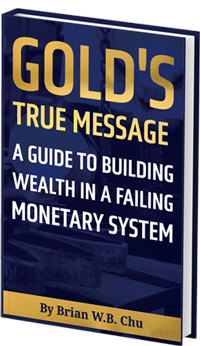
To learn about how gold can protect your purchasing power and grow your wealth, I invite you to check out this presentation here. You can also learn about my personal experience and investment insights through my book Gold’s True Message: Building Wealth in a Failing Monetary System:
You may not have a political science PhD as our Treasurer does. And whatever unfolds in Parliament over the details of our proposed tax reform, let’s focus first on safeguarding your wealth, even as bureaucrats want to take more of our share.
Take care and enjoy your weekend ahead!
God Bless,
Brian Chu,
Gold Stock Pro and The Australian Gold Report




Comments