



This week, Trump revived Trotsky’s political slogan to describe the situation in Iran.
‘No War, No Peace’.
The shooting hasn’t stopped. But it hasn’t escalated either. Five and a half months on, the Strait of Hormuz is still a chokepoint.
It’s a ‘situationship’ — as the kids would put it. Both sides are now hoping for internal pressure to shift the other.
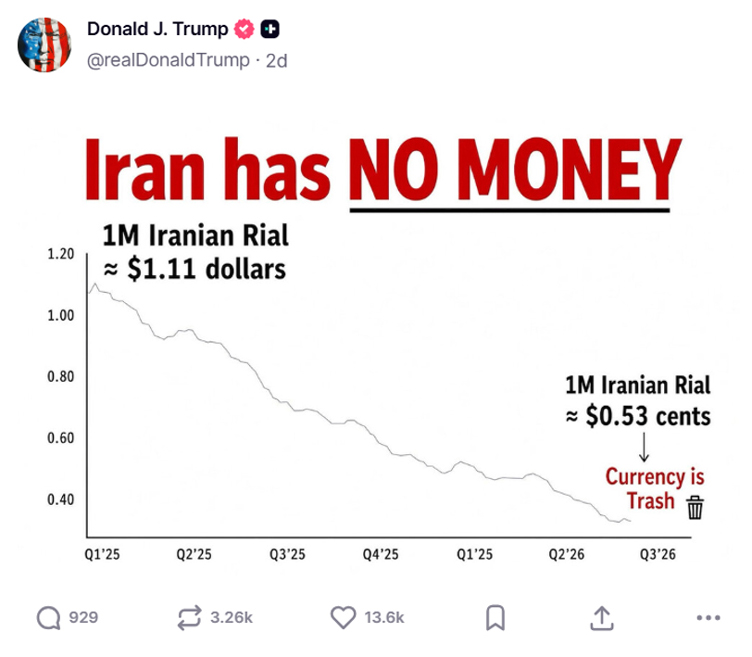
For the US, the hope lies in Iran’s deteriorating financial position and its need to keep oil flowing.
This wait-and-see approach combines stepped-up economic sanctions and a hard naval blockade of Iranian ports.
A Pentagon assessment put the cost of the blockade’s first phase at around US$4.8 billion in lost Iranian oil revenue.
Trump thinks it’s only a matter of time before they crack.
Source: Truth Social
[Click to open in a new window]
Iran is presenting a similar narrative to the world. Patience is the game.
In their calculation, the slow trickle of oil will eventually pressure economic conditions to defang Trump in November’s midterms.
‘Trump will not reach an agreement with us,’ commented Iranian negotiator Majid Shakeri, ‘we are getting along with him until his term ends’.
The fact that Trump was smuggled out of Air Force One in a catering container yesterday shows that efforts are underway to hasten that end.
It’s a bold bet from Iran that a deeply unpopular war will prevent troops landing on their shores.
In their eyes, Iran doesn’t need to win this. It just needs to outlast it.
The regime doesn’t face an election. Trump does. Their clock has more time than his.
You can see it in the propaganda. On regime channels, a notable revival of a Zoroastrian deity known as Ohrmazd or Hormoz has been the latest flavour.
Said to be where the Strait gets its name, it’s a tale of a deity who withstood 9,000 years of pressure from an adversary before ultimately overcoming.
For both sides, these entrenched positions may hold. For global markets and those heavily reliant on foreign fuel, like Australia, the pain is ramping up again.
The Diesel Problem
The latest Aussie earnings season has shown how it has stopped being a foreign policy issue and has become a portfolio one.
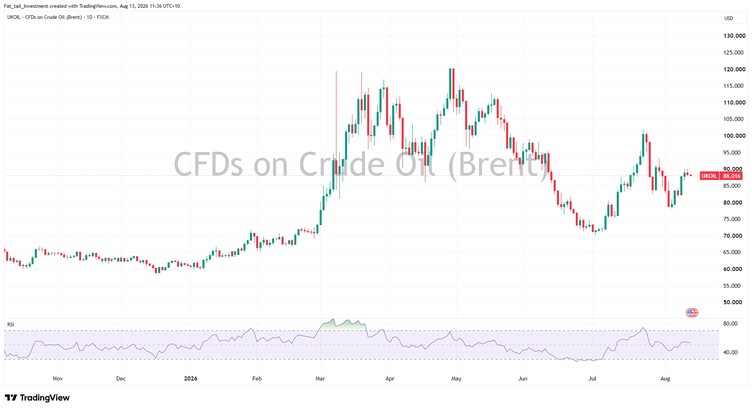
Brent is currently in the twilight zone. Above US$90 on Tuesday, back under US$87, settling near US$88. High but unremarkable.
Source: TradingView
[Click to open in a new window]
The International Energy Agency’s latest outlook has Brent averaging about US$85 this quarter, easing through to US$69 in 2027 as flows recover.
I’d treat that path with caution. It assumes a resolution nobody has negotiated.
The more telling number is inventories. The IEA expects global stocks to draw down by roughly 1.8 million barrels a day this quarter.
That physical shortage is now showing up in refineries. And it’s sharpest in diesel.
Crude and diesel are not the same trade. Crude can be rerouted. Refined product can’t, and the Gulf refineries that turn sour crude into distillate for Asia are damaged or unable to ship.
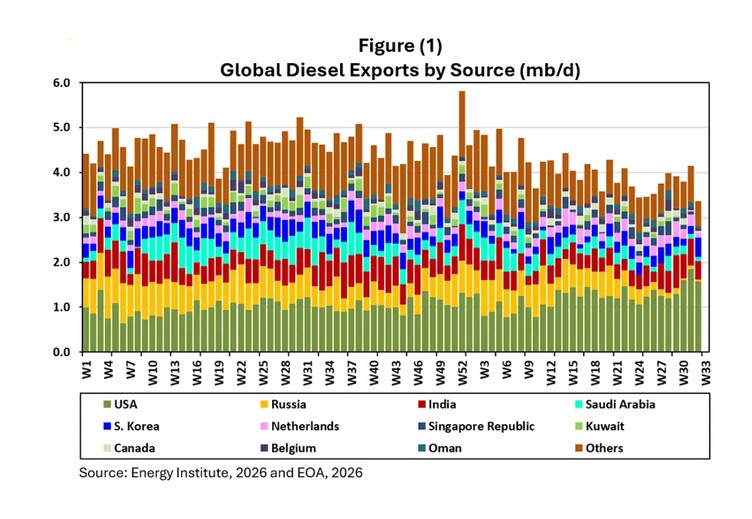
Last week saw the lowest diesel exports of the year. Most of that from a choked Middle East.
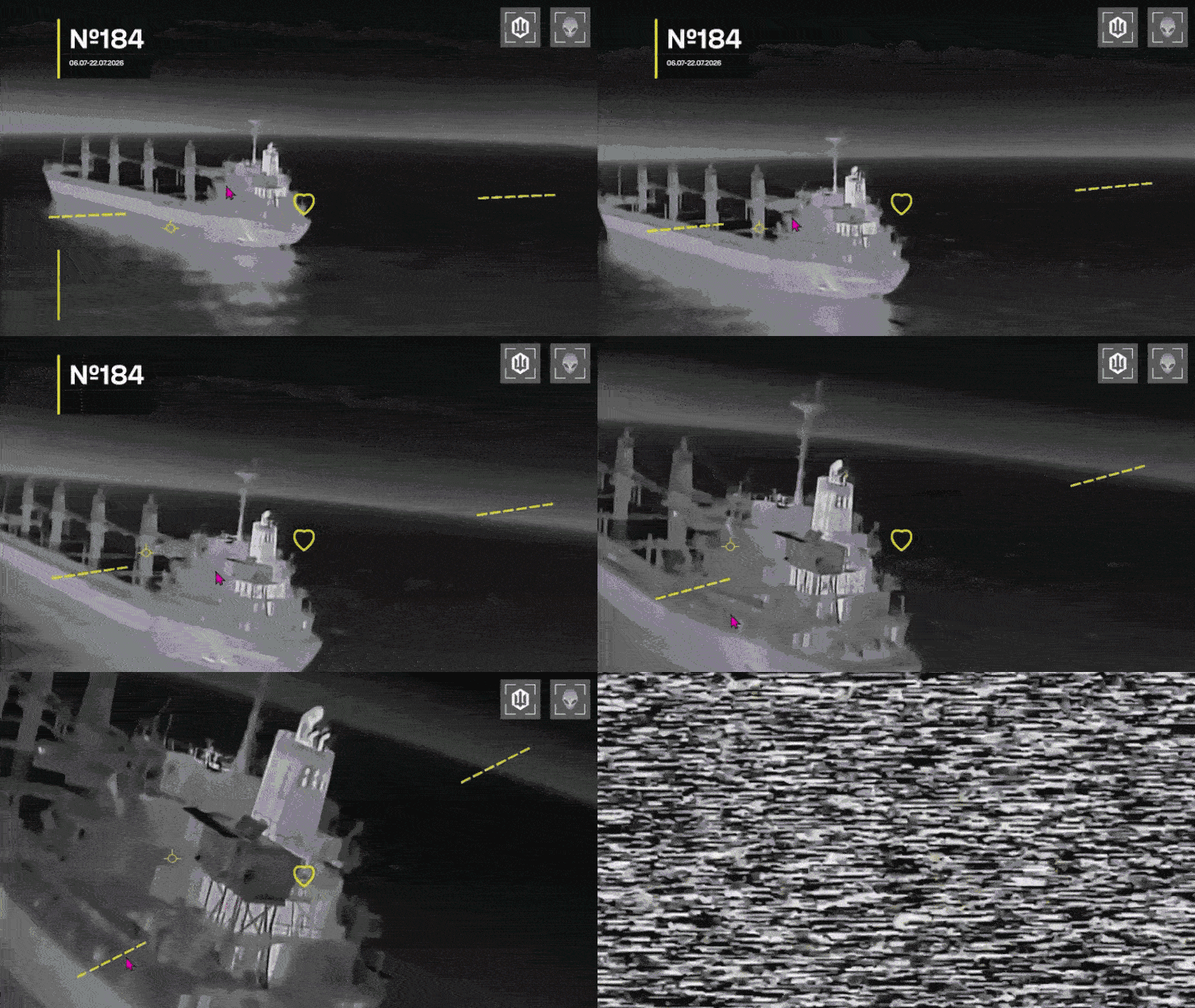
However, shortages have also been felt from China’s fuel export ban and Ukraine’s drone pressure campaign in the Black Sea.
Source: Defence of Ukraine/X
[Click to open in a new window]
You can see the impact of that below on Russian exports in yellow. But also concerning for us is the sharp pullback in Singapore’s exports.
Source: Daily Energy Report
[Click to open in a new window]
This refining squeeze even prompted JD Vance to request a halt to Ukraine’s drone campaign. Crucial Kazakh medium-crude is needed to bring diesel back from the brink.
They know diesel is the fuel of the real economy. Trucks, trains, ships, generators. And for us, our mining fleets.
Australia refines almost none of its own fuel now. Roughly 85% of our diesel arrives by ship, most of it from Asian refiners running Gulf crude.
So when the Gulf can’t export, our haul trucks feel it.
We’re already seeing it. All-in sustaining costs have crept higher across Australian miners this reporting season.
Diesel and freight were the two named culprits each time.
For an open-pit operation, diesel can be 10–15% of operating costs. Add contractors, explosives and trucking, and the exposure widens.
Which brings us to capex.
Boards approve projects on cost assumptions. When diesel doubles and stays high, projects get pushed out. Studies get revisited.
That’s the damage of a stalemate for us. Not a crash. But a repricing of what’s worth building.
Where We Are Today
Yesterday, Trump declared the US has ‘total control’ of the Strait.
‘I THINK WE WILL KEEP IT,’ he wrote on Truth Social. Iran’s Persian Gulf Strait Authority disputed it within hours.
Same rhetoric, different day. This monotony is now part of the story. The world is bored with the ‘Iran show’ and is tuning out the risk.
‘The crisis of today is the joke of tomorrow,’ as H.G. Wells put it.
Reuters tracked eight transits through Hormuz yesterday. A three-month low.
Before the war began, roughly 130 vessels a day made the crossing.
And on Tuesday, Houthi rebels killed six crew on a vessel in the Red Sea.
That’s the key alternative route for the Saudis. I wouldn’t be surprised if the UAE’s key alternative route out of Fujairah was next.
Something Has to Give
The optimistic read is that a frozen conflict freezes prices. Range-bound. Boring. Priced in.
I don’t buy it. A stalemate isn’t a steady state. It’s a slow drain on inventories that eventually forces the market’s hand.
For Australia, prolonged diesel shortages do real damage. They lift costs, keep central banks cautious, and shrink the margins and pipeline of projects our miners will fund.
Markets can ignore this for a while.
Just not forever.
Regards,

Charlie Ormond,
ATLAS and Altucher’s Investment Network Australia




Comments