



My father sometimes has a cheeky dig at my mother about the old picks and shovels in a gold rush.
Dad’s relatives were out in the gold fields of Victoria, chipping away at rocks.
Mum’s family had a warehouse and were merchants of actual mining tools in Bendigo.
And then here we are today, on a day where Nvidia’s financing leverage leads us back to the exact same conundrum.
We’re going to need some rocks.
Now, yesterday I promised more thoughts on positioning in the current market rollercoaster.
Just like the late 1800s, every gold rush gives you two ways to make money.
You can dig, or you can sell shovels to the people doing the digging.
Nvidia has sold the shovels for three years running.
This week, it started lending the diggers the money to buy them.
Half a trillion dollars of new
friends (and they wear suits)
A headline on Bloomberg reported that Jensen Huang has lined up a coalition of Wall Street firms, including BlackRock and Goldman Sachs, to put more than US$500 billion behind the AI build-out.
Nvidia will guarantee as much as a quarter of some projects.
Credit markets liked it, and the cost of insuring Nvidia’s debt dropped away:
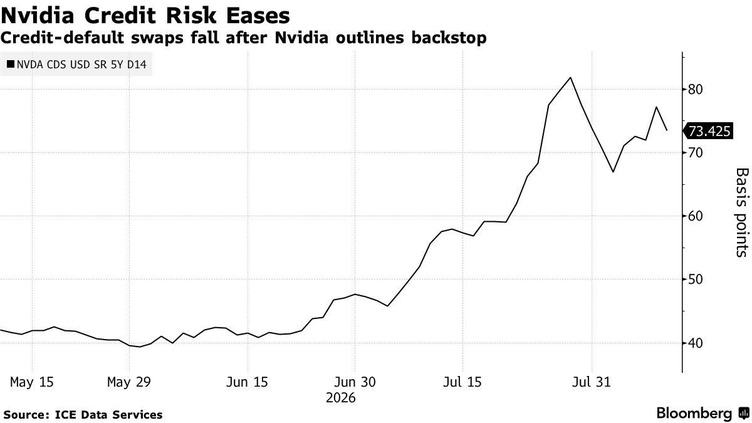
Source: Bloomberg / ICE Data Services
[Click to open in a new window]
Look at the left side of that chart.
Nvidia’s credit risk gauge almost doubled in under three weeks before Huang stepped in.
It doubled for the most insidious and powerful of reasons.
Fund managers finally started asking about circular financing.
This is a topic we’ve covered extensively at Fat Tail Daily.
The pub test tells us this stinks.
People can sense shadiness when you lend your customer the money to buy your product.
And then the banking types start to get a bit fishy on how good that revenue really is.
One analyst called the AI rollout “panic capital expenditure”.
What that tells me about timing
Now for sure, the AI demand story is still very much alive.
For example, AI cloud darling CoreWeave just reported a US$104 billion backlog, and the shares jumped about 15%.
But this is my primary concern:
Once financing behind a trade becomes the main topic of conversation, the easy money at the top end has already been made.
Everyone has to get paid somehow.
In small caps and micro-caps, my focus is on the early money, which gets paid for taking a risk nobody else wanted.
I jokingly refer to my job as “Aloha Finance” because Hawaiian shirts are acceptable in the office.
In stark contrast…
The late money, though, has to put on a suit because late money gets paid for structuring, guaranteeing and underwriting somebody else’s risk.
Serious stuff guys — Morgan Stanley and other regal-sounding names abound in this field.
But the bigger point I’m making is this…
Retail investors rarely win when the suits come in for the second game.
Which brings me back to the rocks
Data centres swallow enormous amounts of copper.
New chips are likely going to need more gallium, and the grid feeding all of it needs uranium and silver, to name just a few commodities.
Australian companies dig up a fair chunk of that shopping list, often in ground well outside Australia.
And the best part?
Nobody is arranging US$500 billion of Wall Street guarantees for a small explorer in WA.
But if the bond market and the AI trade collapse at once, we’re still going to need more physical stuff to get prices down.
To get inflation down.
To get the bond market to stop freaking out.
To make people not worry about Nvidia’s credit pile.
Full circle.
Checkmate suits.
Thanks for the shovels Mum.
Warm regards,

Dr. Lachlann Tierney,
Australian Small-Cap Investigator and Fat Tail Microcaps





Comments