




Today, I’m taking a deep dive into the ill-fated nickel market.
If you’re a close follower of commodity markets, you probably know the problems afflicting this sector.
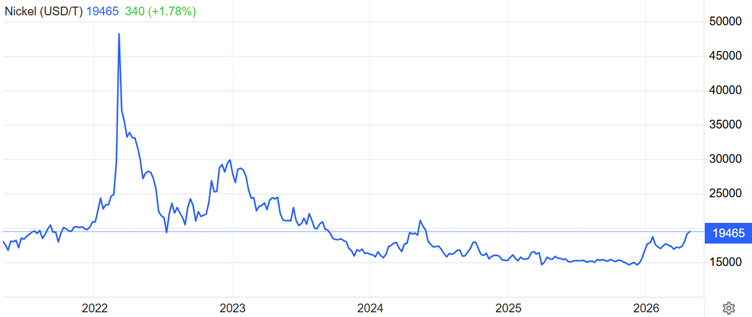
Let me show you how it’s been traded over the last five years:
Source: Trading Economics
[Click to open in a new window]
Surging output from Indonesia’s nickel laterite mines flooded the market with new supply in recent years, leaving this commodity behind in the broad-resource rally.
In response, Australia’s nickel mines shut up shop.
Andrew Forrest’s Wyloo Metals closed the door on its nickel acquisition in Kambalda, Western Australia. A project formerly owned by Mincor Resources.
Meanwhile, BHP’s Nickel West operations were shut down in October 2024.
The global response to nickel oversupply was predictable and unanimous. Operations shifted into care and maintenance.
But over time, these events are destined to take supply off the table.
Single Point Supplier
Turning commodity supply gluts into undersupply takes time. But recognising the problems that will take us there are important. Let me explain…
One issue: Concentrating supply in a single region makes the sector less responsive to demand increases. Reliance on fewer suppliers means less capacity to ramp up output.
It also exposes the nickel market to sudden production cuts.
As mines close abroad, the country has free rein to cut back its own supply and influence prices. It’s why some have dubbed Indonesia the OPEC of nickel.
But there’s more than meets the eye when it comes to this important industrial metal.
So let’s tap into the nitty-gritty first, before unpacking possible opportunities.
Nickel geology: a brief overview
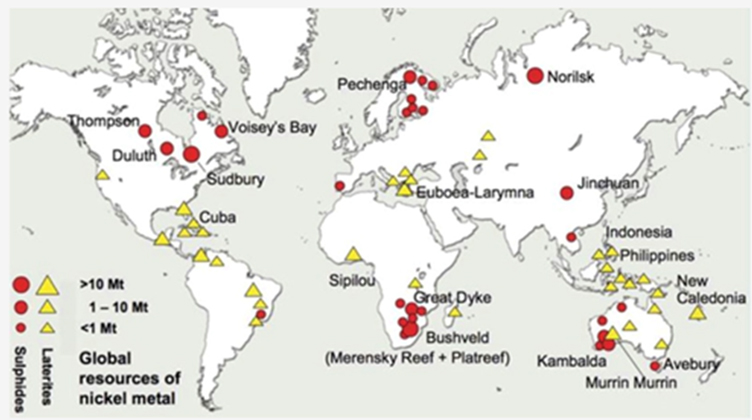
Nickel deposits come in two forms: hard-rock sulphide deposits, consisting of the nickel-bearing mineral pentlandite, and nickel laterite deposits.
Sulphide deposits are scattered worldwide, from northern Europe to South Africa, Canada, and Western Australia.
We then have the laterites, which typically form in high-rainfall equatorial regions.
As rain dissolves and removes minerals and elements from the soil, it leaves behind immobile elements such as nickel, iron, and aluminium.
That leads to a natural concentration of nickel in these regions.
On the map below, you can see the laterite deposits (yellow triangles) clustering around the equator.
Source: Bernhard Schulz
[Click to open in a new window]
Yes, they’re outliers. Shifts in the global climate over geological history have enabled places like arid inland Australia to form laterite deposits.
This region was once bathed in tropical rainfall and lush jungle.
But of the two sources of nickel, sulphides are far easier to process and refine into a high-purity product… The ideal choice for EV battery materials.
For this reason, sulphide miners have retained a competitive edge.
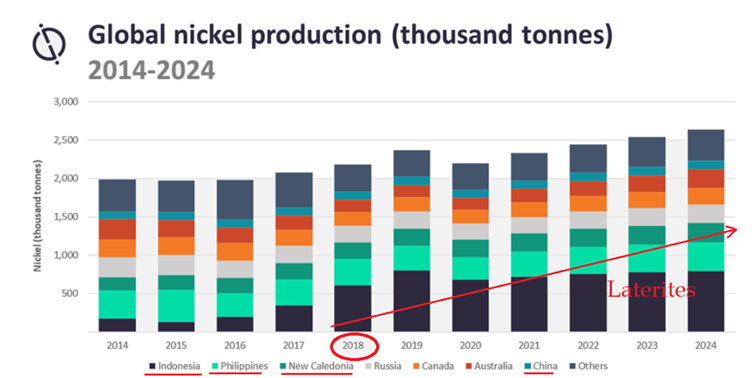
But that started to shift in 2018 when the world’s largest nickel producer, China’s Tsingshan Holding Group, announced a $700 million plan to produce battery-grade nickel from nickel laterites.
Processing laterite ore to produce high-purity nickel uses a process known as High-Pressure Acid Leaching (HPAL).
The innovation unlocked a swathe of new supply. You can see what I mean, below.
Source: GlobalData
[Click to open in a new window]
Indonesia’s nickel output exploded after integrating HPAL technology in 2018.
So, where does that leave investors?
No doubt, Indonesia sees an opportunity to capitalise on its supply dominance for this important industrial commodity.
After throwing supplies into the market and forcing international operators into care-and-maintenance, the country now has a window to benefit.
And that’s exactly what it’s doing, cutting production in a bid to send prices up…
The country controls roughly 60% of global nickel output but has aggressively moved in recent months to restrict 2026 production quotas.
Key actions include slashing the 2026 production target to roughly 260–270 million tonnes.
That’s a 30% reduction from its 2025 levels, alongside targeting major nickel mines like Weda Bay for massive output reductions.
Bottom Line: Understanding where commodity prices are heading can be murky. But right now, nickel has a very clear price trajectory… The country that successfully engineered price collapses a few years ago is now looking to do the opposite.
Until next time.
Regards,

James Cooper,
Mining: Phase One and Diggers and Drillers




Comments