




When we delve into the world of materials crucial for future technologies, Defence, and AI…
Headline minerals like Rare Earths, Gallium, and Germanium tend to dominate.
But did you know there’s a host of obscure minerals waiting to be unearthed by investors?
One of those is High Purity Alumina (HPA), for short.
So, what is it, and why is it crucial
for high-end manufacturing?
HPA is an ultra-refined form of aluminium oxide with a purity exceeding 99.99%.
Unrefined aluminium tends to contain small amounts of trace elements such as silica and iron. This gives it vastly different properties from HPA.
But once these ‘impurities’ are removed, the magic of HPA begins to emerge.
High transparency, chemical inertness, high thermal conductivity and resistance to thermal shock… these are some of the properties that make HPA ideal for semiconductor manufacturing.
The material is used to build the tiny wafers and insulating layers that surround the chips.
Yet, this is not the only market for this unique commodity.
It is transparent like glass but has far superior strength. This means it’s used for optical lenses, medical equipment and specialised windows.
In fact, purified alumina is so strong that it’s used as ‘transparent armour’ for the military.
Meanwhile, it’s perfect for making scratch-resistant camera lenses and smartphone screens.
But the applications are broader, still.
HPA plays a critical role in lithium-ion batteries.
Here, it acts as a ‘separator.’
It is a thin, porous membrane that divides the positive and negative electrodes (anodes and cathodes) in a battery cell.
While separating the electrodes, it also allows free flow of ions during charging and discharging battery cycles.
This is critical for preventing short circuits in EV batteries, thereby eliminating the problem of spontaneous explosions that have plagued electric vehicles.
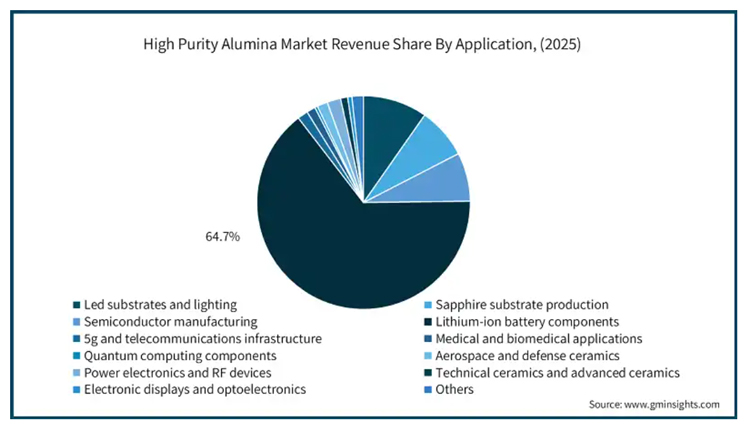
Yet, the largest driver of demand for high-purity alumina is the LED sector. And accounts for around 64% of the overall demand.
You can see the full breakdown below:
Source: Global Market Insights
[Click to open in a new window]
As you can see, it has a wide variety of demand drivers.
From AI and tech, telecommunications, industry, electronics, renewables, aerospace, defence and medical!
So, are there still opportunities in niche commodity markets?
What’s unfolding today is similar to the early 2000s, when commodity prices lifted many boats at once.
However, given the leaps in technology and advances in materials science, formerly unheard-of minerals have been pushed into critical components.
And that offers a big change from the last commodity cycle.
Back in the early 2000s, the focus was on bulk-tonnage iron ore and base-metal operations feeding a hungry Chinese infrastructure boom.
As I’ve detailed in previous updates, I believe that these traditional metals will still play an important role as this cycle unfolds.
But there are key differences…
Niche commodities are featuring prominently, and that separates this era from previous cycles.
For investors, it opens up broad opportunities but also monumental challenges.
Like trying to uncover which mineral could fall under the spotlight (next) or is simply hype, riding on nothing more than a short wave of speculation.
HPA is one example of a resource with diverse and fundamental reasons to be a key focus; yet it still sits on the sidelines as a relatively unknown commodity.
On that note, my colleague, Lachlann Tierney, has been deep in the weeds, linking future tech with the next wave of minerals likely to benefit.
And highlighting specific companies that might deliver more than just headlines over this cycle.
If you’d like to check out his latest presentation, you can do so here.
Until next time.
Regards,

James Cooper,
Mining: Phase One and Diggers and Drillers




Comments