



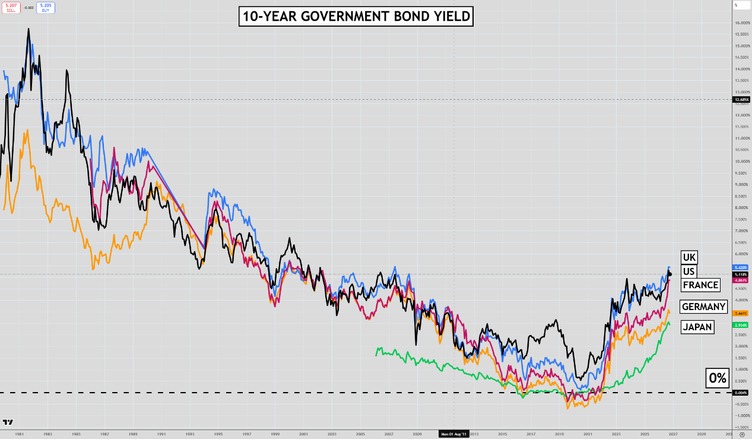
The big money is wading back into bonds. Last week’s US 10-year Treasury auction cleared at 5.30%, the highest auction yield since 2000.
Both foreign and institutional buyers turned up in force despite the fears that roiled September.
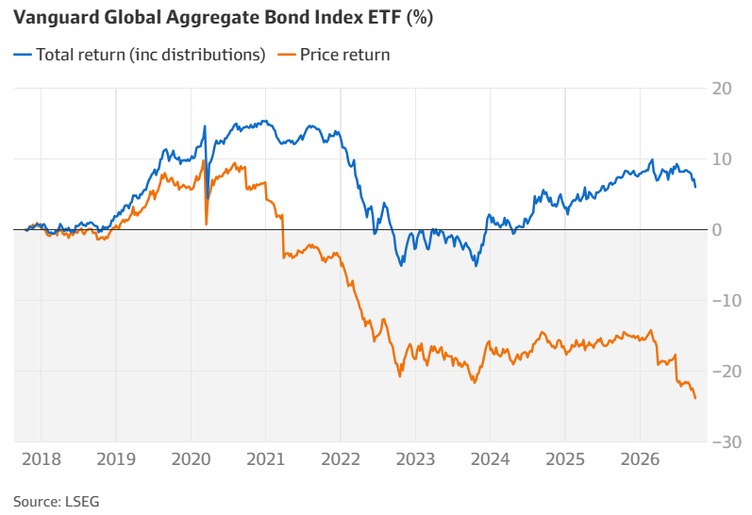
The logic is simple enough. Bonds have had a terrible stretch over the past decade.
If you bought US bonds in 2022, for example, you’re down 18%. But bad times don’t last forever.
Source: AFR
[Click to open in a new window]
Measured against the past 15 years, yields like this look like an aberration, one an efficient market will eventually sort out.
After all, like any asset class, there’s a great buying opportunity once it’s bottomed out.
That view rests on an assumption we’ve all had drilled into us.
The Hedge That Worked for Decades
The classic 60/40 portfolio puts 60% of your money in shares and 40% in bonds. When the economy is growing, shares do the heavy lifting while bonds sit in reserve.
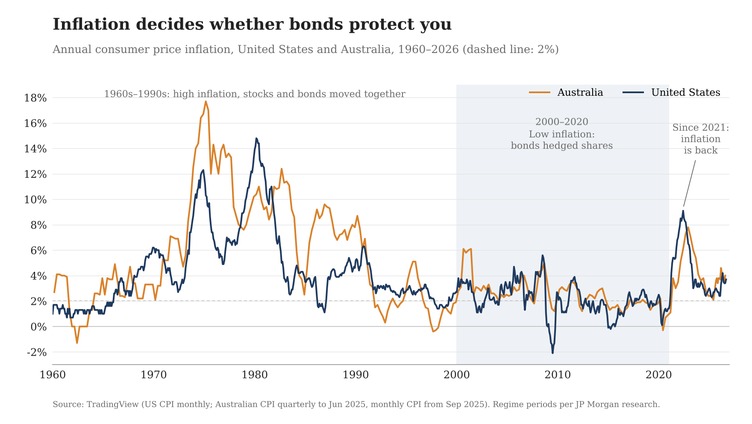
You can see below that in Australia and the US, that regime has held for decades in a low inflation environment.
Source: JP Morgan | TradingView
[Click to open in a new window]
This stock vs bonds hedge works in certain regimes because as growth fades and shares pull back, central banks are expected to step in. They cut interest rates to get people borrowing and spending again.
That reflex is so entrenched in central bank thinking it now comes with a Nobel Prize.
On Monday, Americans Robert Hall and Michael Woodford won this year’s economics prize for their theoretical work which underpins central bank policies designed to help smooth out booms and busts.
That’s the same policy reflex that saw the 2008 bankers bailed out — lest the system rupture.
Because bond prices move inversely to interest rates. When rates fall, older bonds paying higher coupons become more valuable, so demand and prices rise in the secondary market.
As your shares fall, your bond 40% of that 60/40 nest egg rises to cushion the blow. In 2008, as US shares cratered, 10-year Treasuries returned about 20%.
So far, so orthodox.
But this regime only holds as long as the market’s main worry is growth.
It falls apart when inflation takes over.
If inflation is the problem, central banks raise rates to slow borrowing. That hurts shares and bonds alike, so both halves of the portfolio fall together.
|
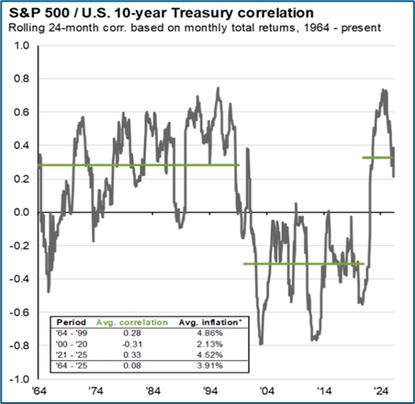
That is what happened in 2022, on some measures the worst year for a 60/40 portfolio since the 1930s.
JP Morgan research going back to the 1960s supports that the stock-bond link ultimately depends on inflation.
From 2000 to 2020, with inflation near 2%, the two moved in opposite directions. Either side of that window, with inflation above 4.5%, they tended to move together.
That is just what we mere mortals have been playing at, though.
The big institutions moved on long ago.
The Yale Model
In 1985, Yale’s endowment chief, David Swensen, decided the 60/40 mix wasn’t good enough.
His reasoning was sound. After all, a university is in a special position. It doesn’t need the money back for a very long time.
So he targeted what he called the ‘illiquidity premium’. The extra his university fund could gain from higher-risk private investments that wouldn’t see that capital return for a long time.
And thus, the modern private equity beast was born.
Yale’s endowment grew from US$1.3 billion in 1985 to US$31.2 billion by 2020, and the ‘Endowment Model’ became the template for big investors everywhere.
Then 2008 supercharged it. Post-crisis banking regulations such as Dodd-Frank and Basel III made risky lending far more expensive for banks.
And so that risk moved out of the regulated banking system and into private funds, where it’s far harder to see.
Global private credit has since grown from roughly US$240 billion at the end of 2008 to close to US$8 trillion by most estimates.
But this system is creaking under the same assumptions as the 60/40.
Private markets thrived on cheap money and steady growth. Over the past three years, Yale’s endowment has fallen to the second-worst performer in the Ivy League.
While behind that opaque wall of private credit, things are starting to weaken.
Fitch’s US private credit default rate hit 6% in April, the highest since it began tracking in 2024.
Both models assume we still live in a world of low inflation. I don’t think we do.
A New Regime
In my view, we’ve entered a new market regime. It’s only just beginning, but it’s defined by persistently higher inflation and rising walls between nations.
Call it populism, the end of the neoliberal order, or the death of globalisation. Whatever the label, the market regime we’ve had since the 80s is now in the early years of transition.
Source: TradingView
[Click to open in a new window]
It’s a tougher, more dangerous world where old structures are breaking down.
The once-strong connection between nations is now frayed.
Global institutions are increasingly (and often deservedly) ignored.
Trade is defined less by shared interest and more by geostrategic liability.
This year, Hormuz showed how quickly one chokepoint can push oil up, and with it the cost of everything else. I believe we’re moving towards more of this risk.
This isn’t a macro-economic inevitability, so much as it’s a historical cycle.
Something akin to the Thucydides Trap meets debt cycles. The great turning.
Canadian Prime Minister Mark Carney summed it up at Davos in January:
‘We are in the midst of a rupture, not a transition… great powers have begun using economic integration as weapons, tariffs as leverage, financial infrastructure as coercion, supply chains as vulnerabilities to be exploited… We know the old order is not coming back. We shouldn’t mourn it. Nostalgia is not a strategy.’
Carney is right about the rupture, but he points to a different beginning.
The real trigger is an event most of us are trying hard to forget.
We’re Still Living in the Shadow of COVID
Three entangled stories explain where we are.
The first is the spending. Governments committed around US$16 trillion to the pandemic in its first year, according to the IMF.
That flood of money helped light the fuse on the inflation that exploded as Russia invaded Ukraine in 2022.
The inflation they promised was transitory clearly wasn’t.
The second is the backlash. In 2024, every incumbent party facing an election in a developed country lost vote share. That’s a first since records began.
The cost of living topped voters’ concerns almost everywhere.
The third is what came next. Populist governments swept the world and raised the drawbridge.
A new US-led tariff regime pulled supply chains closer to home and added costs to us all.
Each story feeds the next. Together, they keep central banks focused on inflation rather than growth.
Which brings us back to the headline. So is the 60/40 hedge dead, dying or gone?
This month we’re seeing it quickly revive.
But if the next fall happens sooner rather than later — I’d argue those bonds are going down with the rest of private equity.
That’s not to say completely ignore them. Bonds paying 5% can still earn their keep as income.
But while inflation remains the market’s main worry, investors shouldn’t count on them to catch the fall when shares drop.
The shadow of COVID suggests that worry won’t lift any time soon.
Regards,

Charlie Ormond,
ATLAS and Altucher’s Investment Network Australia




Comments