


• Skip to primary navigation
  • Skip to main content
  • Skip to primary sidebar
  • Skip to footer
  • Home
  • Latest
  • Videos
  • Series
  • E-Newsletters
    • Fat Tail Daily
    • James Cooper’s Mining Memo
    • The Daily Reckoning Australia
  • Categories
    • Commodities
    • Macro
    • Market Analysis
    • Small Caps
    • Technology
  • Investment Guides
  • Premium Services
  • Editors
  • About
  • Contact Us
Fat Tail Daily
Subscribe
  • Home
  • Latest
  • Videos
  • E-Newsletters
  • Premium Services
Latest

AI Built on Borrowed Money

Like 1

By Paul Dichiera, Wednesday, 24 June 2026

The AI build is running on borrowed money, and on Tuesday, the markets noticed. The chip-wreck was a reminder that the builders carry the debt and the risk.

It was a stormy night for international markets.

The last few months of market narrative have centred on tech bubbles colliding with debt.

It’s like the dot-com-era debt machine is back, only this time the collateral is Nvidia chips. I recently covered that issue here.

The sell-off on Tuesday was the market turning on the debt-funded build layer of the AI boom.

The builders of the AI revolution carry the capital risk in this cycle, and Tuesday was their reminder.

Here’s what happened, why it ran so hard, and the one number that tells us whether it’s over.

What happened Tuesday

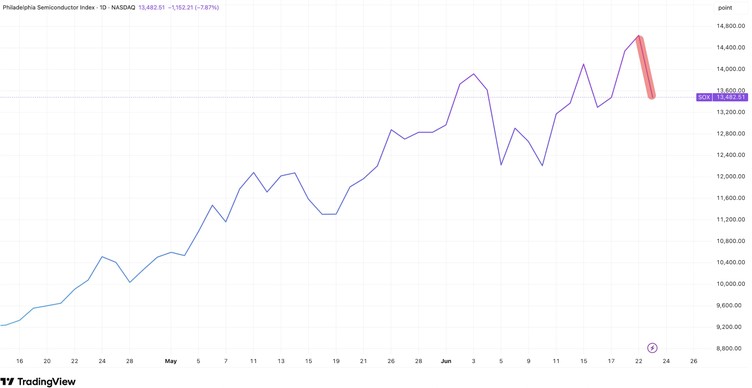
The Philadelphia Semiconductor Index fell 7.9%, and every one of its 30 members closed lower, led by Micron and Marvell.
Article image

Source: TradingView

[Click to open in a new window]

Both companies had been running hot, more than doubling this year, so they had the furthest to fall.

The Nasdaq and the S&P 500 both closed at more than one-week lows, and the iShares Semiconductor ETF dropped about 6%.

The selling began overnight in Asian and Korean chipmakers and thundered into the US session.

These markets have been on a tear; I’m not surprised the market is starting to wonder when the music stops.

What we saw Monday and Tuesday is investors shaking off a few weeks of hype and reassessing what they actually own.

Monday, the first domino fell

Tuesday did not come out of nowhere. Let’s look at the numbers leading up to it.

The selling started on Monday, the 22nd, when Alphabet fell roughly 10% on a $180 billion AI capex plan with no clear timeline for the cash to come back.

Palantir fell close to 9%, Amazon and Meta each lost about 4%, and SpaceX, not two weeks past its record IPO, dropped 16% after filing its first-ever bond offering.

There was a twist.

Memory chipmakers rose that same Monday, with SK Hynix, Micron and other memory names climbing ahead of Micron’s earnings this Wednesday — more on that later.

By Tuesday, the whole ship went down.

The AI trade is crowded; I have been vocal about it. And any wobble is an invitation to take profits.

So why go looking for a wobble in the future of computing? Debt.

The initial understanding was that this build-out would be funded from cash flow rather than borrowing; that is no longer the case.

Hyperscalers raised around $108 billion of debt in 2025, with projections of up to $1.5 trillion of new tech-sector debt in the coming years, as capex climbed to between 45–57% of revenue.

The real fear is that data centres being built today could be made obsolete by efficiency gains before they ever pay for themselves.

Nobody wants to be left holding the bag on those data centres if they go offline.

One weak link

Part of Tuesday was mechanical.

The leveraged semiconductor ETF, SOXL, fell nearly 20% before the market even opened.

Because it resets exposure daily, a falling market forces them to sell into the weakness, which drives more selling.

The chip businesses themselves did not change overnight.

We want proof

We will get a real signal soon.

Micron reports after the close on Wednesday the 24th, and its forward guidance on orders will tell us whether the AI spending cycle is still intact or starting to cool.

For perspective, the June 5 sell-off erased more than a trillion dollars in a single session, then recovered over the next two trading days.

The market judged it an overreaction rather than a change in fundamentals.

These dips have been bought back quickly so far.

The companies I have been writing about all month are the boring businesses that actually profit from AI; these sit a mile away from the chaos.

Next week, I’ll be digging further into these companies and why they succeed while the names that took a hit on Tuesday do not.

Until next time.

Regards,

Paul Dichiera,
Fat Tail Daily

All advice is general advice and has not taken into account your personal circumstances.

Please seek independent financial advice regarding your own situation, or if in doubt about the suitability of an investment.

Comments

Subscribe
Notify of
guest
guest
0 Comments
Paul Dichiera
Paul Dichiera is one of Fat Tail Investment Research’s analysts, focusing on technology and AI. He started in a small business advisory role at the ATO, moved into managing housing and construction, found his passion in technology, and later completed a Bachelor of Computer Science at RMIT. Few analysts bring that combination of government, real economy, and technical insight to the page. He approaches markets with a structured, systems-level lens. His writing connects the dots between sweeping technological shifts and the ASX-listed names positioned to benefit.

Paul’s Premium Subscriptions

Publication logo
Fat Tail Investment Research

Latest Articles

  • The Hunt for Yield Is On: Mining and Energy’s Income Plays
    By James Cooper

    Forget the miners doing the digging. Some of the fattest, most reliable yields in resources belong to the companies collecting the royalty cheque.

  • Selling the Signal
    By Charlie Ormond

    Trading firms can now pay the President’s company for millisecond access to the President’s posts. Most companies have to make a product. This one just makes news.

  • Greg Canavan Chats Markets on Closing Bell
    By Charlie Ormond

    This week, Greg Canavan joins Charlie to discuss the direction of the ASX, the valuations of some of our biggest players, China’s recent growth hiccups, and what they mean for our local commodity producers.

Primary Sidebar

Latest Articles

  • The Hunt for Yield Is On: Mining and Energy’s Income Plays
  • Selling the Signal
  • Greg Canavan Chats Markets on Closing Bell
  • Speculation Fades: Gold Accumulation Begins
  • Canberra’s Cover Charge

Footer

Fat Tail Daily Logo
YouTube
Facebook
x (formally twitter)
LinkedIn

About

Investment ideas from the edge of the bell curve.

Go beyond conventional investing strategies with unique ideas and actionable opportunities. Our expert editors deliver conviction-led insights to guide your financial journey.

Quick Links

Subscribe

About

FAQ

Terms and Conditions

Financial Services Guide

Privacy Policy

Get in Touch

Contact Us

Email: support@fattail.com.au

Phone: 1300 667 481

All advice is general in nature and has not taken into account your personal circumstances. Please seek independent financial advice regarding your own situation, or if in doubt about the suitability of an investment.

The value of any investment and the income derived from it can go down as well as up. Never invest more than you can afford to lose and keep in mind the ultimate risk is that you can lose whatever you’ve invested. While useful for detecting patterns, the past is not a guide to future performance. Some figures contained in our reports are forecasts and may not be a reliable indicator of future results. Any actual or potential gains in these reports may not include taxes, brokerage commissions, or associated fees.

Fat Tail Logo

Fat Tail Daily is brought to you by the team at Fat Tail Investment Research

Copyright © 2026 Fat Tail Daily | ACN: 117 765 009 / ABN: 33 117 765 009 / ASFL: 323 988