



We’ve got an excellent new addition to our editorial team joining us to share his thoughts today, his name is Paul Dichiera. We hand picked him for his intimate knowledge of AI, and today he’ll share his thoughts on the history of the technology which can be traced back to the early origins of the Internet. It’s a slightly longer read, but trust me, you’ll want to hear what Paul has to say… welcome aboard mate!

Dr. Lachlann Tierney,
Australian Small-Cap Investigator and Fat Tail Microcaps
***
 By
By
Right now for investors, there’s growing talk about AI being a 2000s era “dotcom bubble” scenario:
[Click to open in a new window]
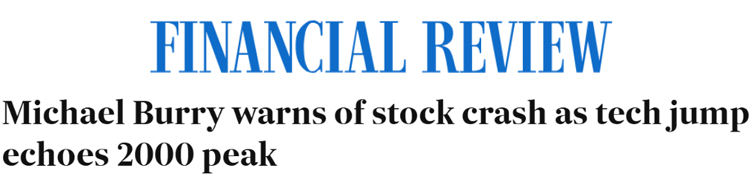
Just this week, the famous Big Short operator Michael Burry had this to say:
“We are witnessing history. In the stock market, that is not a good thing,” … “[like the] scene of the bloody car crash, minutes before it happens”.
Adding:
“We are getting into that rare air, so extreme that the consequences will be unavoidable, no matter where one hides.”
We’ve seen these types of dire warnings from Burry before…
Call it “broken clock theory” or just straightforward and sensible bearish reasoning.
But it got me thinking…is AI really
like the 2000s dotcom bubble?
Like many of you reading this, there’s a good chance you remember the good old “pre-Internet” days.
You called a landline and committed to things.
People would show up on time, or else you’d leave them behind.
Appointments and catch ups were clearly defined, as opposed to vague plans that could be cancelled with any number of weak excuses in a menu of social interactions.
Yet here we are in 2026, right on the precipice of an AI hockey stick moment that many investors think will take certain stocks to “infinity and beyond”.
Is AI buildout a page from the Google book?
My early teen years were spent without the internet.
The internet didn’t exist, and then, when I was 16, it was everywhere. I never really wondered how it came about.
I remember having to “dial up”, “log on”, and take over the home phone line for half a day to download a new song.
Things have come a long way since then…
What interests me today is the data centre buildout; the race for compute is a different chapter of the same book. And if this gives us a clue as to what comes next, I want to know about it.
You’d be well familiar with these types of stories…
$1000 dropped on Google when it started buying up abandoned fibre cables in 2005 would be worth roughly $60,000 today.
The fibre costs nothing.
And they built an empire on top of it.
So here’s the context on why the AI buildout is like the Internet…
This is the Original Story About to Repeat
The internet wasn’t sudden. It was a generational campaign of government research, two market bubbles bursting, fortunes made and lost, then a whole world connected.
The development of the Internet, going back to 1969, informs much of today’s AI growing pains.
The internet’s conception was part of a US military project. ARPANET — the original closed network — funded by DARPA.
Under the flashy government agency titles, its development motivations were mundane: resource sharing between expensive university computers. Sending digital? paperwork around. That was it.
From sending paperwork to cat memes… We’ve come a long way since.
The internet was funded by the military, supported by civilian researchers, and focused on academics.
It was an experiment until January 1, 1983, referred to as “flag day”, arriving 14 years after ARPANET switched on.
Through the 80s, the network banned commercial traffic. Academics built and tested the actual backbone during that phase. The rules relaxed through the 90s.
In a similar fashion, AI use cases have existed in government departments and logistics for a long time.
DARPA funded a program called DART — the Dynamic Analysis and Replanning Tool. Another mundane logistics scheduler.
The military deployed it in 1991 at the start of Operation Desert Storm. It simply scheduled the movement of supplies and personnel.
By optimising the movement of aircraft, ships and personnel during Desert Storm, the transport savings paid back three decades of AI investment, almost 1 billion in months, according to DARPA director Victor Reis’s 1995 statement. It was a simple system, nothing like today’s LLM models.
This showcases a continuing trend: the US government funds, trials and plants the seeds that we see develop into commercially viable infrastructure.
This federal-to-commercial model began for the internet on April 30, 1995, when the federal government decommissioned NSFNET — the National Science Foundation’s backbone network.
The government paid four commercial providers to carry and manage internet traffic.
It’s one of the largest, mostly unknown infrastructure handoffs in history. The moment the internet stopped being a government asset.
I think it is also likely the most significant in recent human history, because it laid the foundation of the current AI explosion…
The US federal government walked away –
here’s what happened…
The privatisation triggered deregulation; the 1996 Telecom Act stripped restrictions on who could own. long-range networks. The network provider space was open to anyone who could do the build-out.
Demand was climbing. The telco bubble ballooned as investment poured into the promised new digital market.
ARPANET ran on copper. Copper couldn’t keep up. Companies saw the potential in the infrastructure and the opportunity in clearing the bottleneck.
Between 1996 and 2001, companies like WorldCom, Global Crossing, Qwest and Level 3 laid millions of miles of long-haul fibre. These were the telco giants of the time; the money they invested was genuine risk capital, as the monetisation of the internet was unproven.
The starting gun fired, companies raised funding from private capital, equity through IPOs, and high-yield (junk) debt. Today, the same junk bond ledger is back. Only now, the collateral is Nvidia chips.
In 2025 alone, Microsoft, Meta, Amazon and Google all committed something on the order of ~US$320 billion in AI capex. It’s our modern long-haul fibre moment.
Today, it’s an inverse problem. The appetite for the tech is there, but the compute is at max capacity — so I think we now have a different-shaped bubble. I’ll share more on that when I dive into data centres.
Point is, back in the dotcom era, demand fell short, and the laid fibre stayed dark. The network outpaced the content, and adoption was slow.
And guess what happened?
The Telco Bubble Popped
Remember WorldCom?
It was an epic dotcom era capital inferno.
A scandal for the ages.
They went down in one of the largest accounting frauds in history. Global Crossing went bankrupt in 2002. Qwest’s CEO went to prison.
The builders wanted to own the tracks. They never considered the value in what would ride on them. The telcos, in order to keep the capital flowing and the stock price rising, cooked the books.
When the telco bubble collapsed, it cleared the field. The next generation of tech walked in and bought the wreckage cheaply.
85% of the fibre was dark until 2005, when Google entered the picture.
Amazon IPO’d in May 1997 and began buying dark fibre in the late 2000s. A $1,000 investment at that time is worth roughly $2 million today.
The fledgling tech companies saw what opportunities were beyond the infrastructure build and acquired the abandoned infrastructure cheaply through the mid 2000’s.
The assets endured. Still there. Still invisible. Still doing the work.
Google and Amazon were not the sole buyers; many of today’s tech leaders entered the market. Microsoft and Facebook, now Meta, were all collecting their share of the fibre network as it lay dark.
The survivors of the telco bubble still maintain and operate the backbone of the internet.
The survivors: Lumen, which absorbed what was previously Level 3; Zayo, now private at ~$14 Billion, and Cogent, which built its entire business model on buying bankrupt fibre.
Buyers of the wreckage became the most influential forces of our time — Google, Amazon, Microsoft, Meta — built the internet from the foundations to the cloud. Hosting cat memes and videos at lightning speed.
Government plants the seeds. Commercial capital does the build-out. The bubble pops. The builders go bust, but the assets endure. The next generation then buys cheaply.
If GPUs and data centres end up being the dark fibre of the 2020s, who picks up the wreckage?
Demand is strong. Compute is the constraint. The lesson: who walks away owning the infrastructure when the dust settles.
The key questions for investors’ portfolios THIS decade are:
- Who’s building?
- Who’s going to survive?
- Who’s going to thrive?
And if we can answer that last question, investors might just unearth the next Google-like returns of the new AI era…
In 1995, the internet economy was a rounding error. Today it’s $16 trillion. A generational bet.
Next Wednesday, I’ll delve deeper into how the internet wreckage was rebuilt.
The hidden infrastructure that today’s internet actually runs on.
And how investors can start looking for the best AI-era bets in the market.
Pleasure to be here, thanks for reading!
Regards,

Paul Dichiera,
Fat Tail Daily





Comments