



‘Don’t worry about the world coming to an end today, it’s already tomorrow in Australia.’
— Charles M. Schulz
Back in February, I wrote to you about the apocalypse.
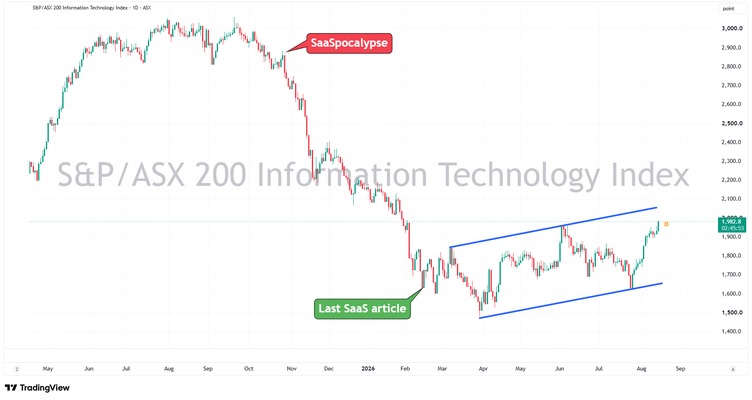
The market had decided that software was at its end. The ASX 200 Technology Index (XTX) had fallen nearly 40% from its September highs.
This so-called ‘SaaSpocalypse’ (SaaS = Software-as-a-service) pushed the sector into oversold conditions that, in some cases, dwarfed those of the pandemic and GFC.
The thinking behind the panic was asinine. If artificial intelligence can write code, nobody needs to pay for software.
I argued that it was a simplistic reading of a complex sector, and selling had gone too far.
Six months on, the numbers back that up. The XTX index is up 22% since that article, though the resurrection hasn’t been a straight line.
After hitting its lows in late March, the index has since recovered ~35% of its value. And two of the past three weeks delivered gains above 8%.
Source: TradingView
[Click to open in a new window]
So, the rapture came and went, and most of the congregation is still sitting comfortably in the pews. But the sorting is nowhere near finished.
Investors continue working through the aisles, deciding which businesses deserve salvation and which get left behind.
Meaning there are still plenty of opportunities left for you.
Judgement day for short sellers
A big part of the recovery has been a strong earnings season butting heads with traders with large short positions — betting on the stock’s downfall.
The clearest example was in New York last week.
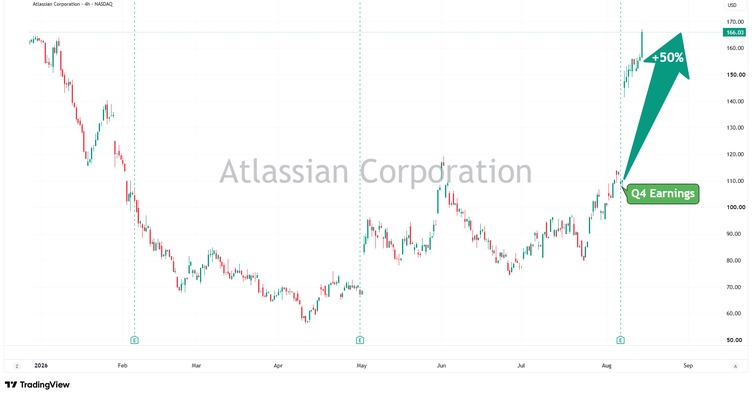
Atlassian [NASDAQ:TEAM], founded in Sydney and listed on the Nasdaq, delivered its most profitable quarter since 2021. Before earnings, around 11% of its shares were shorted.
After earnings, the stock jumped 35%, its best single day since the company went public in 2015. It’s now up 50% in five trading days.
Source: TradingView
[Click to open in a new window]
Consider what Atlassian actually sells. Collaboration and developer tools. On paper, this is precisely the sort of business that Claude Code and OpenAI’s Codex were meant to bury.
But its latest quarterly beat back those fears. Revenue was up 27.6%, with a strong double beat, as the company employed its own AI platform, Rovo AI, to drive growth.
Options data shows that much of the move came from short covering. Traders who had bet against the company were forced to buy stock back in a hurry.
The market had written the company off, so any evidence of life triggered a squeeze.
Even after that jump, Atlassian remains down ~50% from its 2025 highs.
That combination of a violent rally and a prior negative year captures the uneven character of this sector.
The same earnings week also produced some genuine casualties. HubSpot fell 19%, its worst day in a decade. Datadog fell 19% as well. And Airtable, worth close to US$12 billion at its 2021 peak, was sold for under US$1.3 billion.
Some of these firms were always out over their skis. They raised money at absurd valuations in the pre-AI era and never grew into them.
The job now is separating the disrupted from the genuine survivors.
Xero and the virtue of boring
Which brings me back home, where our two biggest software names have yet to be raised from the dead.
Xero [ASX:XRO] trades near $81.55. That leaves it down roughly 60% over the last 12 months and only recently recovering from a six-year low.
The bear case goes like this. Accounting is data entry. Data entry is the first thing a model automates. Therefore, Xero is toast.
The trouble is that this argument misreads what small businesses are actually paying for.
What Xero sells is compliance across a dozen tax jurisdictions, bank connections and payment rails negotiated with hundreds of institutions, and payroll and tax rules that shift with each new budget.
A chatbot can certainly draft an invoice for you, but it cannot lodge your quarterly BAS or accept liability when those numbers come back wrong.
Its financials hardly look terminal either. FY26 revenue grew around 31% to roughly NZ$2.75 billion. Management has guided to NZ$3.62–3.73 billion for FY27.
The genuine concerns have very little to do with AI. Yes, at its peak, investors had overpaid for growth in this name and many others.
And for Xero specifically, there are questions about its attempt to push into the US market with the Melio acquisition. Plus, governance questions naturally follow the chief executive’s sale of her holdings.
Those are fair points, but they sit a long way from ‘the product is obsolete’.
Yes, AI’s coding is impressive, but it’s nowhere near the level where small businesses or fresh competition are going to suddenly vibe-code it away.
A moat made of paperwork
Wisetech Global [ASX:WTC] is the other one worth watching. It sits near $43, down about 35% across the year as part of a larger fall from grace.
The journey from $120 to the $40s is quite the painful one for investors. But the business underlying that remains robust as ever.
Its CargoWise platform handles bookings and customs declarations for more than 17,000 customers across 193 countries.
That includes 24 of the top 25 global freight forwarders and 46 of the top 50 global third-party logistics providers. Retention rates sit above 99%.
Freight forwarding is a business built on forms. Every border has its own rules and its own penalties for getting them wrong.
Nobody is vibe-coding an international customs compliance engine over a long weekend.
Wisetech’s real risks are self-inflicted. It carries debt from the e2open purchase while that integration is still running. And it carries the baggage of a board and ex-CEO who have dragged the company’s name through the dirt with sex scandals.
But it’s one I’m personally backing with an entry during its recent lows.
Full-year results land on 26 August. That release will tell us more about the business’s future than the latest AI capabilities.
Plenty more out there
The apocalypse arrived, thinned the herd, and trimmed stretched valuations. In some sense, it’s what these episodes are supposed to accomplish.
What remains is a market relearning how to value software on earnings rather than vibes.
Wisetech and Xero both closed north of 5% on Friday.
Expect plenty more days like this, moving in both directions, particularly around individual results.
The names worth owning are the ones where ripping the software out would break a business. Or where heavy regulations form the base of a powerful moat.
Those companies deserve a place on your watchlist.
Happy hunting.
For those who want some US inspiration, check out our latest presentation into the opportunity hiding behind Elon’s latest Mega Merge plans.
Regards,

Charlie Ormond,
ATLAS and Altucher’s Investment Network Australia




Comments